Han Sangwon, Woo Sungmin, Kim Yong-Il, Lee Jae-Lyun, Wibmer Andreas G, Schoder Heiko, Ryu Jin-Sook, Vargas Hebert Alberto
Department of Nuclear Medicine, Asan Medical Center, University of Ulsan College of Medicine, Seoul 05505, Korea.
Department of Radiology, Memorial Sloan Kettering Cancer Center, New York, NY 10065, USA.
Diagnostics (Basel). 2021 Apr 7;11(4):663. doi: 10.3390/diagnostics11040663.
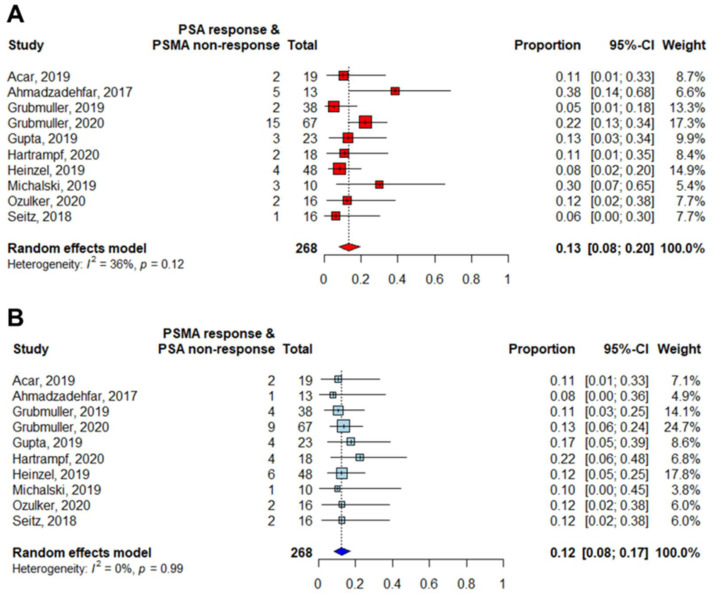
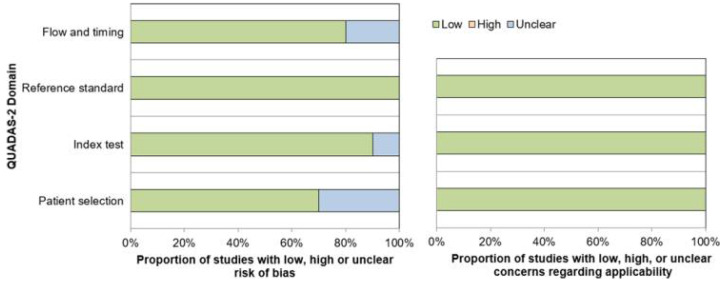
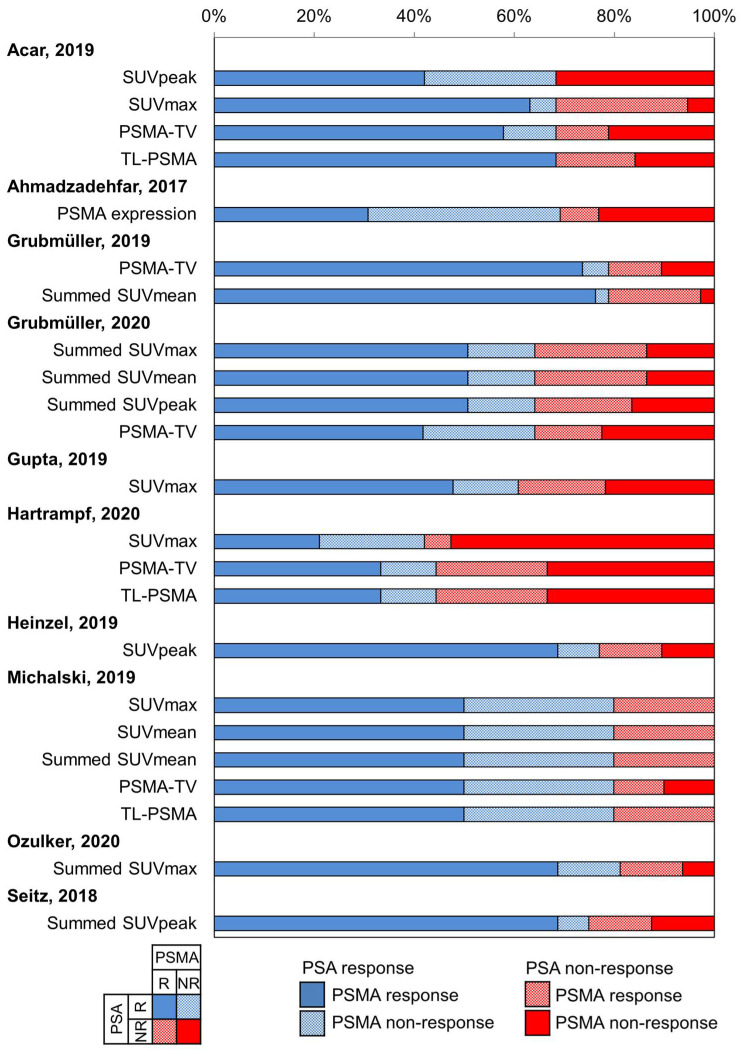
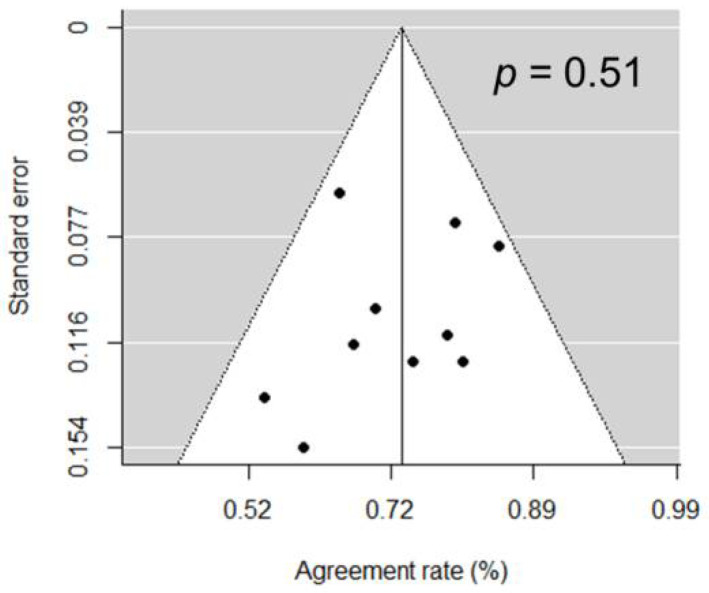
Prostate-specific membrane antigen positron emission tomography (PSMA PET) has recently gained interest as a promising tool for treatment response evaluation in metastatic castration-resistant prostate cancer (CRPC). We performed a systematic review and meta-analysis assessing the concordance between response evaluation using PSMA PET and serum prostate-specific antigen (PSA) level after systemic treatment and the association between PSMA PET and overall survival in metastatic CRPC patients. PubMed, Embase, and Cochrane library databases were searched until August 2020. Studies that reported the concordance between PSMA PET and PSA response were included. PSMA PET and PSA response evaluation were dichotomized into response vs. non-response to construct two-by-two contingency tables; an ≥30% increase in PSMA PET according to PET Response Criteria in Solid Tumors 1.0 and as an increase in serum PSA level of ≥25% as per Prostate Cancer Working Group 3 guidelines were defined as non-response. The percent agreement rates were pooled using random-effect model. Ten studies (268 patients) were included. The concordance rates ranged 0.50-0.84 with a pooled proportion of 0.73 (95% confidence interval 0.67-0.79). Patients were treated with Lu-PSMA therapy in five, chemotherapy in three, Ra in one, and more than one type in one study. Various PET parameters were used: the most widely evaluated was PSMA tumor volume (PSMA-TV). Similar proportions were found across different therapeutic agents, PET response parameters, and regarding directionality of discordance (PSA response/PSMA non-response vs. PSMA response/PSA non-response). Two studies reported that a decrease in PSMA-TV was associated with better overall survival. PSMA PET and PSA response assessments were discordant in nearly a fourth of metastatic CRPC patients. Further studies are warranted to establish the clinical meaning of this discordance and define appropriate management for such clinical situation.
前列腺特异性膜抗原正电子发射断层扫描(PSMA PET)最近作为一种有前景的工具受到关注,用于评估转移性去势抵抗性前列腺癌(CRPC)的治疗反应。我们进行了一项系统评价和荟萃分析,评估全身治疗后使用PSMA PET进行反应评估与血清前列腺特异性抗原(PSA)水平之间的一致性,以及PSMA PET与转移性CRPC患者总生存之间的关联。检索了PubMed、Embase和Cochrane图书馆数据库,直至2020年8月。纳入报告PSMA PET与PSA反应一致性的研究。将PSMA PET和PSA反应评估分为反应与无反应,构建二乘二列联表;根据实体瘤PET反应标准1.0,PSMA PET增加≥30%以及根据前列腺癌工作组3指南血清PSA水平增加≥25%被定义为无反应。使用随机效应模型汇总一致率。纳入了10项研究(268例患者)。一致率范围为0.50 - 0.84,合并比例为0.73(95%置信区间0.67 - 0.79)。5例患者接受了镥 - PSMA治疗,3例接受化疗,1例接受镭治疗,1项研究中有1例接受了不止一种类型的治疗。使用了各种PET参数:评估最广泛的是PSMA肿瘤体积(PSMA - TV)。在不同治疗药物、PET反应参数以及不一致的方向性(PSA反应/PSMA无反应与PSMA反应/PSA无反应)方面发现了类似的比例。两项研究报告PSMA - TV降低与更好的总生存相关。在近四分之一的转移性CRPC患者中,PSMA PET和PSA反应评估不一致。有必要进行进一步研究以确定这种不一致的临床意义,并为这种临床情况定义适当的管理方法。