Stangl-Kremser Judith, Rasul Sazan, Tosoian Jeffrey J, Salami Simpa S, Zaslavsky Alexander, Udager Aaron, Mazal Peter, Kain Renate, Comperat Eva, Hacker Marcus, Haug Alexander, Mitterhauser Markus, Pozo-Salido Carmen, Steinbach Christina, Hassler Melanie R, Kramer Gero, Shariat Shahrokh F, Palapattu Ganesh S
Department of Urology, Medical University of Vienna, Vienna, Austria.
Rogel Cancer Center, University of Michigan, Ann Arbor, MI, USA.
Eur Urol Open Sci. 2021 Jun 30;30:63-66. doi: 10.1016/j.euros.2021.06.007. eCollection 2021 Aug.
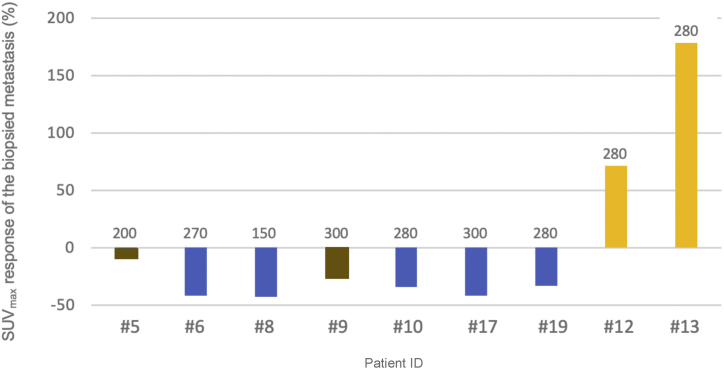
Initial reports of a clinical response in patients treated with the radioligand [Lu]-PSMA-617 for castration-resistant prostate cancer (CRPC) are promising, despite known inter- and intrapatient heterogeneity. In metastatic CRPC, we examined the association of baseline immunohistochemical (IHC) expression of prostate-specific membrane antigen (PSMA) in a single lesion and responsiveness to [Lu]-PSMA-617 therapy, measured as the PSMA maximum standardized uptake value (SUV). Between 2015 and 2020, 19 patients with multiple metastases underwent single-lesion biopsy, [Ga]-PSMA positron emission tomography (PET) imaging, and treatment with [Lu]-PSMA-617. A monoclonal anti-PSMA antibody was used to semiquantitatively assess PSMA IHC in the biopsy specimen. Imaging evaluation of the biopsied single lesion and overall response was performed according to Positron Emission Tomography Response Criteria in Solid Tumors. The PSMA IHC histoscore correlated positively with pretreatment same-site PSMA SUV ( = 0.6). Nine patients had imaging after three cycles of [Lu]-PSMA-617 and were included in the lesion-specific analysis. Of these, five patients (55.6%) had an SUV response at the biopsy site, but three experienced overall progression. The histoscore was unable to predict the lesion-specific change in SUV (95% confidence interval [CI] -44.2 to 69.2) or PSA (95% CI-125.2 to 17.2). There was no correlation between single-lesion SUV and overall progression ( = 0.1) on [Ga]-PSMA PET imaging. Additional studies need to interrogate the clinical consequence of PSMA expression heterogeneity in metastases and the association with response to [Lu]-PSMA-671.
Treatment with a radioactive binding molecule called [Lu]-PSMA-617 for men with prostate cancer resistant to castration (CRPC) is showing promise. We investigated the association between the presence of PSMA protein in metastatic lesions at biopsy and response to [Lu]-PSMA-617 among men with metastatic CRPC. We found that assessment of PSMA presence at biopsy is not a reliable predictor of response to [Lu]-PSMA-617. Additional studies are needed to better determine which CRPC metastatic sites will respond to this therapy.
尽管已知患者间和患者内存在异质性,但关于用放射性配体[镥]-PSMA-617治疗去势抵抗性前列腺癌(CRPC)患者的临床反应的初步报告很有前景。在转移性CRPC中,我们研究了单个病灶中前列腺特异性膜抗原(PSMA)的基线免疫组织化学(IHC)表达与对[镥]-PSMA-617治疗的反应性之间的关联,反应性以PSMA最大标准化摄取值(SUV)衡量。在2015年至2020年期间,19例有多处转移的患者接受了单病灶活检、[镓]-PSMA正电子发射断层扫描(PET)成像以及[镥]-PSMA-617治疗。使用单克隆抗PSMA抗体对活检标本中的PSMA IHC进行半定量评估。根据实体瘤正电子发射断层扫描反应标准对活检的单病灶和总体反应进行成像评估。PSMA IHC组织学评分与治疗前同部位PSMA SUV呈正相关(r = 0.6)。9例患者在接受三个周期的[镥]-PSMA-617治疗后进行了成像,并纳入病灶特异性分析。其中,5例患者(55.6%)在活检部位有SUV反应,但3例出现总体病情进展。组织学评分无法预测SUV(95%置信区间[CI] -44.2至69.2)或PSA(95% CI -125.2至17.2)的病灶特异性变化。在[镓]-PSMA PET成像上,单病灶SUV与总体病情进展之间无相关性(r = 0.1)。需要进一步研究探讨转移灶中PSMA表达异质性的临床后果以及与对[镥]-PSMA-671反应的关联。
用一种名为[镥]-PSMA-617的放射性结合分子治疗去势抵抗性前列腺癌(CRPC)男性患者显示出前景。我们研究了活检时转移性病灶中PSMA蛋白的存在与转移性CRPC男性患者对[镥]-PSMA-617反应之间的关联。我们发现,活检时对PSMA存在情况的评估不是对[镥]-PSMA-617反应的可靠预测指标。需要进一步研究以更好地确定哪些CRPC转移部位会对这种治疗有反应。