Yang Johnson Chia-Shen, Huang Lien-Hung, Wu Shao-Chun, Kuo Pao-Jen, Wu Yi-Chan, Wu Chia-Jung, Lin Chia-Wei, Tsai Pei-Yu, Hsieh Ching-Hua
Division of Plastic and Reconstructive Surgery, Department of Surgery, Kaohsiung Chang Gung Memorial Hospital and Graduate Institute of Clinical Medical Sciences, College of Medicine, Chang Gung University, Kaohsiung 833253, Taiwan.
Department of Plastic and Reconstructive Surgery, Xiamen Changgung Hospital, Xiamen 361000, China.
J Clin Med. 2021 Apr 6;10(7):1540. doi: 10.3390/jcm10071540.
Excess lymphedematous tissue causes excessive oxidative stress in lymphedema. Lymphaticovenous anastomosis (LVA) supermicrosurgery is currently emerging as the first-line surgical intervention for lymphedema. No data are available regarding the changes in serum proteins correlating to oxidative stress and antioxidant capacity before and after LVA.
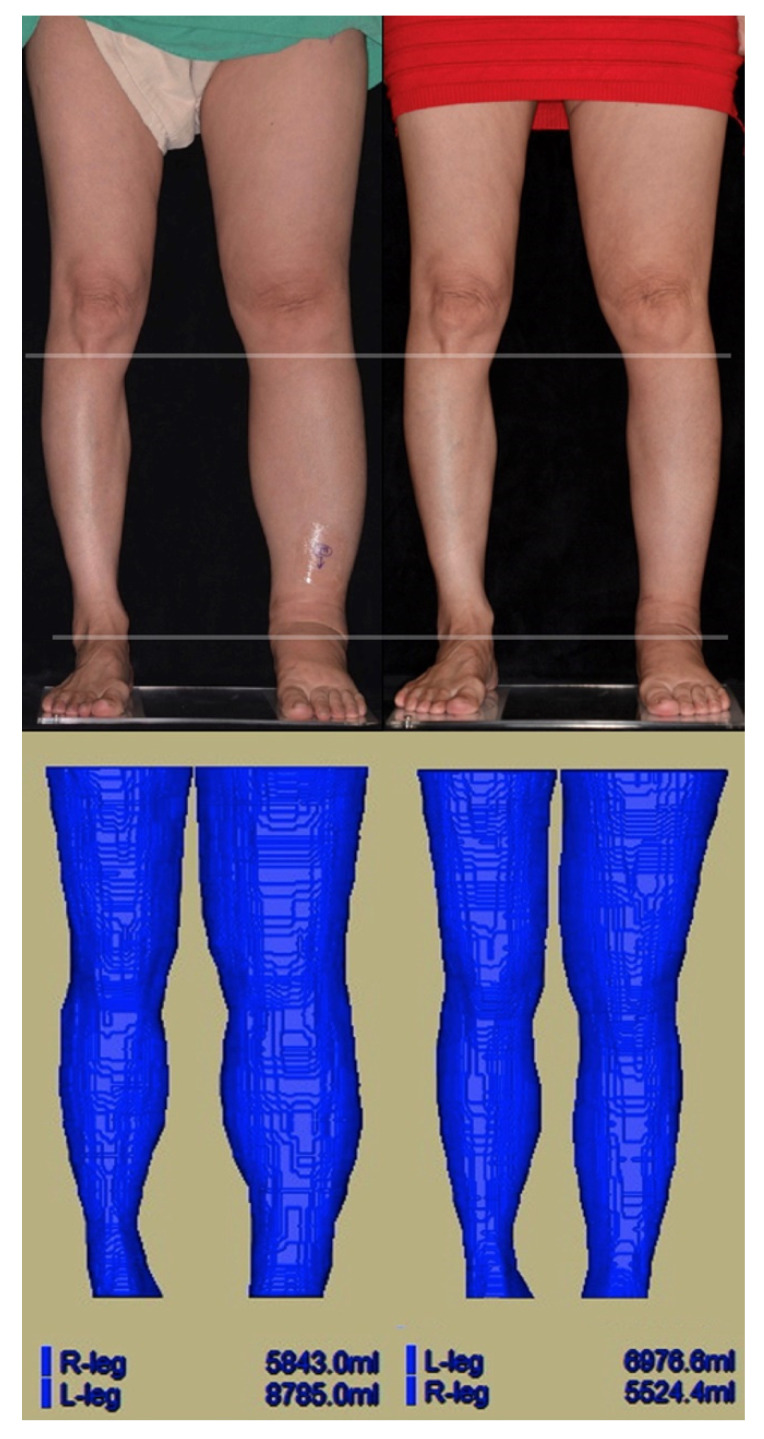
A total of 26 patients with unilateral lower limb lymphedema confirmed by lymphoscintigraphy were recruited, and venous serum samples were collected before (pre-LVA) and after LVA (post-LVA). In 16 patients, the serum proteins were identified by isobaric tags for relative and absolute quantitation-based quantitative proteomic analysis with subsequent validation of protein expression by enzyme-linked immunosorbent assay. An Oxidative Stress Panel Kit was used on an additional 10 patients. Magnetic resonance (MR) volumetry was used to measure t limb volume six months after LVA.
This study identified that catalase (CAT) was significantly downregulated after LVA (pre-LVA vs. post-LVA, 2651 ± 2101 vs. 1448 ± 593 ng/mL, respectively, = 0.033). There were significantly higher levels of post-LVA serum total antioxidant capacity (pre-LVA vs. post-LVA, 441 ± 81 vs. 488 ± 59 µmole/L, respectively, = 0.031) and glutathione peroxidase (pre-LVA vs. post-LVA, 73 ± 20 vs. 92 ± 29 U/g, respectively, = 0.018) than pre-LVA serum. In addition, after LVA, there were significantly more differences between post-LVA and pre-LVA serum levels of CAT (good outcome vs. fair outcome, -2593 ± 2363 vs. 178 ± 603 ng/mL, respectively, = 0.021) and peroxiredoxin-2 (PRDX2) (good outcome vs. fair outcome, -7782 ± 7347 vs. -397 ± 1235 pg/mL, respectively, = 0.037) in those patients with good outcomes (≥40% volume reduction in MR volumetry) than those with fair outcomes (<40% volume reduction in MR volumetry).
The study revealed that following LVA, differences in some specific oxidative stress markers and antioxidant capacity can be found in the serum of patients with lymphedema.
过多的淋巴水肿组织会在淋巴水肿中导致过度的氧化应激。淋巴静脉吻合术(LVA)超显微手术目前正成为淋巴水肿的一线外科干预手段。关于LVA前后与氧化应激和抗氧化能力相关的血清蛋白变化,尚无可用数据。
共招募了26例经淋巴闪烁显像确诊为单侧下肢淋巴水肿的患者,并在LVA前(LVA前)和LVA后(LVA后)采集静脉血清样本。在16例患者中,通过基于相对和绝对定量的等压标签定量蛋白质组分析鉴定血清蛋白,随后通过酶联免疫吸附测定法验证蛋白表达。另外10例患者使用了氧化应激检测试剂盒。在LVA后6个月,采用磁共振(MR)容积测量法测量患侧肢体体积。
本研究发现,LVA后过氧化氢酶(CAT)显著下调(LVA前与LVA后分别为2651±2101 ng/mL和1448±593 ng/mL,P = 0.033)。LVA后血清总抗氧化能力(LVA前与LVA后分别为441±81和488±59µmol/L,P = 0.031)和谷胱甘肽过氧化物酶(LVA前与LVA后分别为73±20和92±29 U/g,P = 0.018)水平显著高于LVA前血清。此外,LVA后,在预后良好(MR容积测量体积减少≥40%)的患者中,LVA后与LVA前血清CAT水平(良好预后与一般预后分别为-2593±2363和178±603 ng/mL,P = 0.021)和过氧化物还原酶-2(PRDX2)水平(良好预后与一般预后分别为-7782±7347和-397±1235 pg/mL,P = 0.037)的差异,比预后一般(MR容积测量体积减少<40%)的患者更为显著。
该研究表明,LVA后,淋巴水肿患者血清中某些特定氧化应激标志物和抗氧化能力存在差异。