Laitakari Anna, Liu Lingzhi, Frimurer Thomas M, Holst Birgitte
Novo Nordisk Foundation Center for Basic Metabolic Research, Faculty of Health and Medical Sciences, University of Copenhagen, Blegdamsvej 3B, 2200 Copenhagen, Denmark.
Department of Biomedical Sciences, Faculty of Health and Medical Sciences, University of Copenhagen, Blegdamsvej 3B, 2200 Copenhagen, Denmark.
Int J Mol Sci. 2021 Apr 8;22(8):3872. doi: 10.3390/ijms22083872.
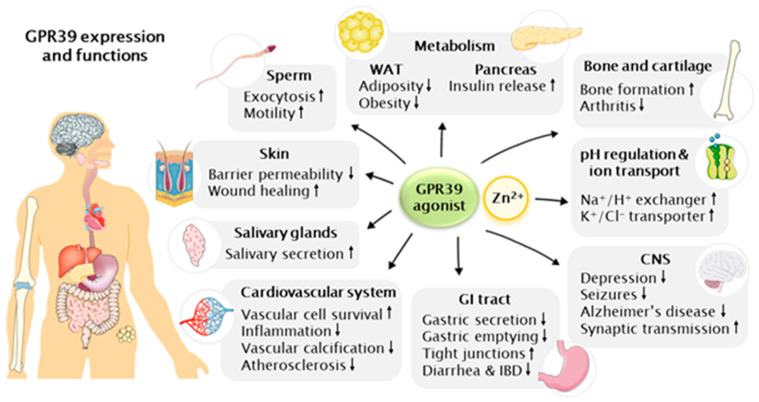
The G-protein coupled receptor GPR39 is abundantly expressed in various tissues and can be activated by changes in extracellular Zn in physiological concentrations. Previously, genetically modified rodent models have been able to shed some light on the physiological functions of GPR39, and more recently the utilization of novel synthetic agonists has led to the unraveling of several new functions in the variety of tissues GPR39 is expressed. Indeed, GPR39 seems to be involved in many important metabolic and endocrine functions, but also to play a part in inflammation, cardiovascular diseases, saliva secretion, bone formation, male fertility, addictive and depression disorders and cancer. These new discoveries offer opportunities for the development of novel therapeutic approaches against many diseases where efficient therapeutics are still lacking. This review focuses on Zn as an endogenous ligand as well as on the novel synthetic agonists of GPR39, placing special emphasis on the recently discovered physiological functions and discusses their pharmacological potential.
G蛋白偶联受体GPR39在多种组织中大量表达,可被生理浓度的细胞外锌变化激活。此前,转基因啮齿动物模型已对GPR39的生理功能有所揭示,最近新型合成激动剂的应用使得GPR39表达的多种组织中的若干新功能得以阐明。事实上,GPR39似乎参与许多重要的代谢和内分泌功能,还在炎症、心血管疾病、唾液分泌、骨形成、男性生育能力、成瘾和抑郁障碍以及癌症中发挥作用。这些新发现为开发针对许多仍缺乏有效治疗方法的疾病的新型治疗方法提供了机会。本综述重点关注锌作为内源性配体以及GPR39的新型合成激动剂,特别强调最近发现的生理功能并讨论其药理学潜力。