Savukyne Egle, Liubiniene Laura, Strelcoviene Zita, Nadisauskiene Ruta Jolanta, Vaboliene Edita, Machtejeviene Egle, Kaupas Rytis, Lauzikiene Dalia
Department of Obstetrics and Gynaecology, Hospital of Lithuanian University of Health Sciences, Kauno Klinikos, Eiveniu st. 2, 50161 Kaunas, Lithuania.
Department of Obstetrics and Gynaecology, Medical Academy, Lithuanian University of Health Sciences, A.Mickevicius st. 7, 44307 Kaunas, Lithuania.
Medicina (Kaunas). 2021 Apr 2;57(4):345. doi: 10.3390/medicina57040345.
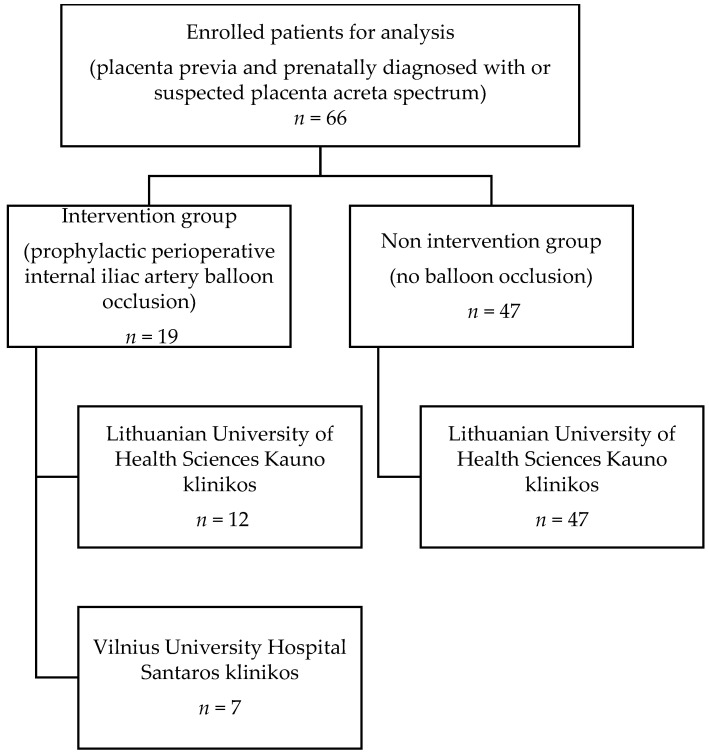
: Placenta previa and placenta accreta spectrum are considered major causes of massive postpartum hemorrhage. Objective: To determine whether the placement of an occlusion balloon catheter in the internal iliac artery could reduce bleeding and other related complications during cesarean delivery in patients with placenta previa and placenta accreta spectrum. : A retrospective analysis was conducted at two tertiary obstetric units of Lithuania. From January 2016 to November 2019 patients with placenta previa and antenatally suspected invasive placenta were included in the intervention group and underwent cesarean delivery with endovascular procedure. From January 2014 to December 2015 patients with placenta previa and suspected placenta accreta spectrum were included in the non-intervention group. The primary outcomes were reduction in intraoperative blood loss and transfusion volumes in the intervention group. Secondary outcomes were the incidence of hysterectomy and maternal complications. : Nineteen patients underwent cesarean delivery with preoperative endovascular procedure, and 47 women underwent elective cesarean delivery. The median intraoperative blood loss (1000 (400-4500) mL vs. 1000 (400-5000) mL; = 0.616) and the need for red blood cell transfusion during operation (26% vs. 23%; = 0.517) did not differ significantly between the patients groups. Seven patients in the intervention group and two patients in the non-intervention group underwent perioperative hysterectomy ( = 0.002). None of the patients had complications related to the endovascular procedure. : The use of intermittent balloon occlusion catheter in patients with placenta pathology is a safe method but does not significantly reduce intraoperative blood loss during cesarean delivery.
前置胎盘和胎盘植入谱系被认为是产后大出血的主要原因。目的:确定在髂内动脉放置阻塞球囊导管是否能减少前置胎盘和胎盘植入谱系患者剖宫产术中的出血及其他相关并发症。方法:在立陶宛的两个三级产科单位进行回顾性分析。2016年1月至2019年11月,前置胎盘且产前怀疑有侵袭性胎盘的患者被纳入干预组,并接受了剖宫产及血管内介入手术。2014年1月至2015年12月,前置胎盘且怀疑有胎盘植入谱系的患者被纳入非干预组。主要结局是干预组术中失血量和输血量的减少。次要结局是子宫切除术的发生率和产妇并发症。结果:19例患者接受了术前血管内介入手术的剖宫产,47例妇女接受了择期剖宫产。两组患者的术中失血量中位数(1000(400 - 4500)mL对1000(400 - 5000)mL;P = 0.616)和手术期间红细胞输血需求(26%对23%;P = 0.517)差异无统计学意义。干预组7例患者和非干预组2例患者接受了围手术期子宫切除术(P = 0.002)。所有患者均未出现与血管内介入手术相关的并发症。结论:在胎盘病变患者中使用间歇性球囊阻塞导管是一种安全的方法,但不能显著减少剖宫产术中的失血量。