Zhou Qian, Katano Masahisa, Zhang Jia-He, Liu Xiao, Wang Ke-Yong, Iinuma Mitsuo, Kubo Kin-Ya, Azuma Kagaku
Department of Anatomy, School of Medicine, University of Occupational and Environmental Health, Fukuoka 807-8555, Japan.
Department of Pediatric Dentistry, Asahi University School of Dentistry, Gifu 501-0296, Japan.
Brain Sci. 2021 Apr 9;11(4):479. doi: 10.3390/brainsci11040479.
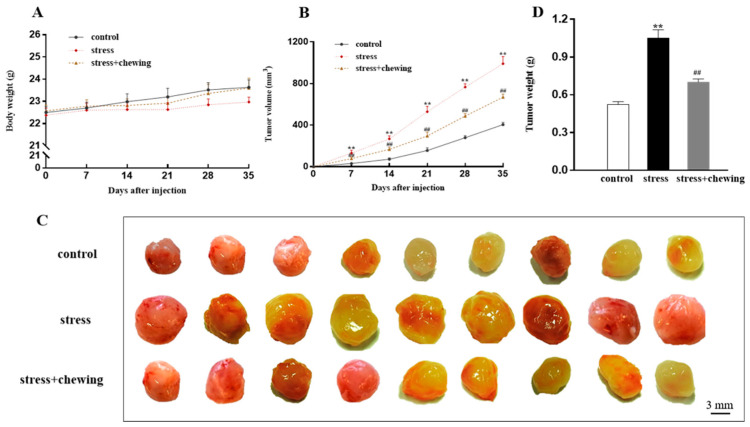
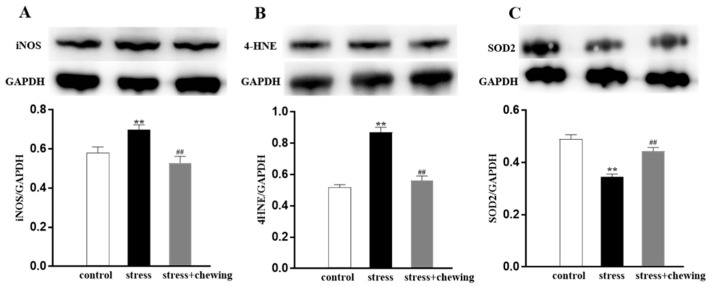
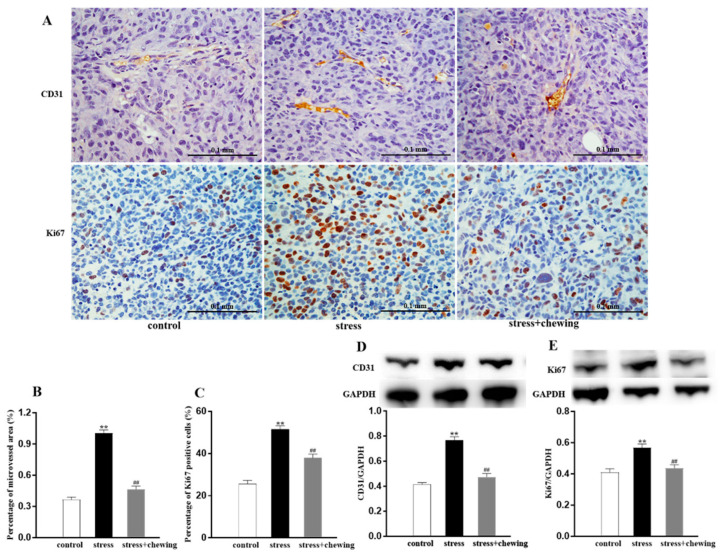
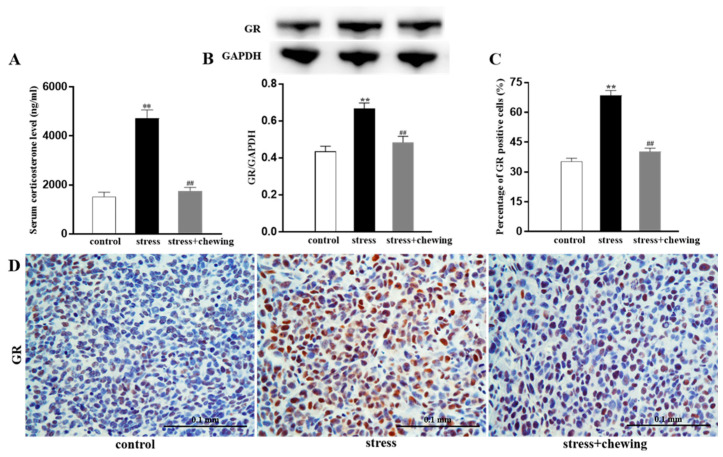
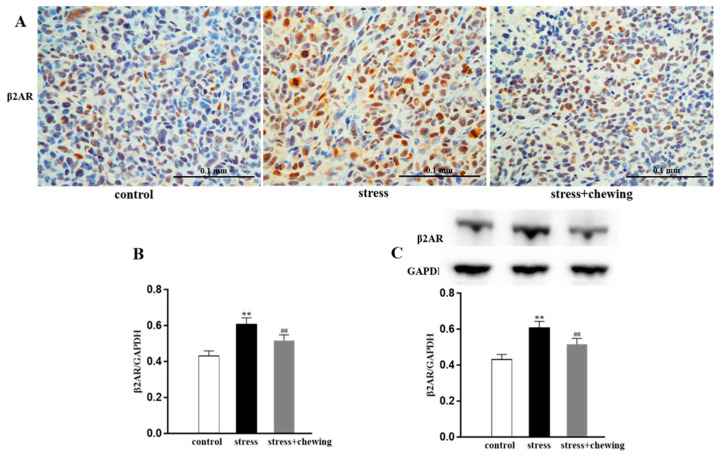
We examined whether chewing behavior affects the tumor progression-enhancing impact of psychological stress. Human breast cancer cell line (MDA-MB-231) cells were inoculated into the mammary fat pads of athymic nude mice. The mice were assigned randomly to control, stress, and stress+chewing groups. Psychological stress was created by keeping mice in a transparent restraint cylinder for 45 min, three times a day, for 35 days after cell inoculation. Animals in the stress+chewing group were provided with a wooden stick for chewing on during the psychological stress period. Chewing behavior remarkably inhibited the tumor growth accelerated by the psychological stress. Immunohistochemical and Western blot findings revealed that chewing behavior during psychological stress markedly suppressed tumor angiogenesis and cell proliferation. In addition, chewing behavior decreased serum glucocorticoid levels and expressions of glucocorticoid and β2-adrenergic receptors in tumors. Chewing behavior decreased expressions of inducible nitric oxide synthase and 4-hydroxynonenal, and increased expression of superoxide dismutase 2 in tumors. Our findings suggest that chewing behavior could ameliorate the enhancing effects of psychological stress on the progression of breast cancer, at least partially, through modulating stress hormones and their receptors, and the subsequent signaling pathways involving reactive oxygen and nitrogen species.
我们研究了咀嚼行为是否会影响心理压力对肿瘤进展的促进作用。将人乳腺癌细胞系(MDA-MB-231)细胞接种到无胸腺裸鼠的乳腺脂肪垫中。将小鼠随机分为对照组、应激组和应激+咀嚼组。接种细胞后,每天3次将小鼠置于透明约束筒中45分钟,持续35天,以此制造心理压力。应激+咀嚼组的动物在心理应激期间会提供一根木棍用于咀嚼。咀嚼行为显著抑制了由心理压力加速的肿瘤生长。免疫组织化学和蛋白质印迹结果显示,心理应激期间的咀嚼行为显著抑制了肿瘤血管生成和细胞增殖。此外,咀嚼行为降低了血清糖皮质激素水平以及肿瘤中糖皮质激素和β2-肾上腺素能受体的表达。咀嚼行为降低了肿瘤中诱导型一氧化氮合酶和4-羟基壬烯醛的表达,并增加了超氧化物歧化酶2的表达。我们的研究结果表明,咀嚼行为至少部分地通过调节应激激素及其受体,以及随后涉及活性氧和氮物种的信号通路,来改善心理压力对乳腺癌进展的增强作用。