Piccioni Andrea, Franza Laura, Brigida Mattia, Zanza Christian, Torelli Enrico, Petrucci Martina, Nicolò Rebecca, Covino Marcello, Candelli Marcello, Saviano Angela, Ojetti Veronica, Franceschi Francesco
Emergency Medicine, Fondazione Policlinico Universitario A. Gemelli IRCCS, 1-00168 Rome, Italy.
Università Cattolica del Sacro Cuore, 1-00168 Rome, Italy.
J Pers Med. 2021 Apr 14;11(4):298. doi: 10.3390/jpm11040298.
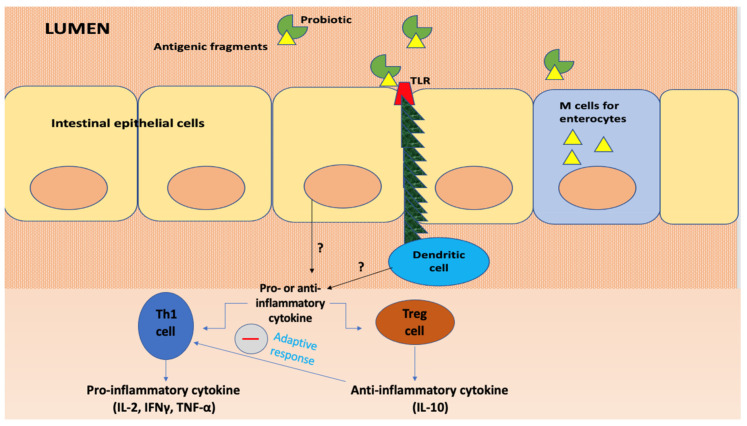
How can the knowledge of probiotics and their mechanisms of action be translated into clinical practice when treating patients with diverticular disease and acute diverticulitis? Changes in microbiota composition have been observed in patients who were developing acute diverticulitis, with a reduction of taxa with anti-inflammatory activity, such as Clostridium cluster IV, Lactobacilli and Bacteroides. Recent observations supported that a dysbiosis characterised by decreased presence of anti-inflammatory bacterial species might be linked to mucosal inflammation, and a vicious cycle results from a mucosal inflammation driving dysbiosis at the same time. An alteration in gut microbiota can lead to an altered activation of nerve fibres, and subsequent neuronal and muscular dysfunction, thus favoring abdominal symptoms' development. The possible role of dysbiosis and mucosal inflammation in leading to dysmotility is linked, in turn, to bacterial translocation from the lumen of the diverticulum to perivisceral area. There, a possible activation of Toll-like receptors has been described, with a subsequent inflammatory reaction at the level of the perivisceral tissues. Being aware that bacterial colonisation of diverticula is involved in the pathogenesis of acute diverticulitis, the rationale for the potential role of probiotics in the treatment of this disease becomes clearer. For this review, articles were identified using the electronic PubMed database through a comprehensive search conducted by combining key terms such as "gut microbiota", "probiotics and gut disease", "probiotics and acute diverticulitis", "probiotics and diverticular disease", "probiotics mechanism of action". However, the amount of data present on this matter is not sufficient to draw robust conclusions on the efficacy of probiotics for symptoms' management in diverticular disease.
在治疗憩室病和急性憩室炎患者时,如何将益生菌及其作用机制的知识转化为临床实践?在正在发生急性憩室炎的患者中观察到微生物群组成的变化,具有抗炎活性的分类群减少,如梭菌属IV群、乳酸杆菌属和拟杆菌属。最近的观察结果支持,以抗炎细菌种类减少为特征的生态失调可能与粘膜炎症有关,并且粘膜炎症同时驱动生态失调会导致恶性循环。肠道微生物群的改变可导致神经纤维激活改变,进而导致神经元和肌肉功能障碍,从而促进腹部症状的发展。生态失调和粘膜炎症在导致运动障碍方面的可能作用,反过来又与细菌从憩室腔转移到内脏周围区域有关。在那里,已经描述了Toll样受体的可能激活,随后在内脏周围组织水平发生炎症反应。认识到憩室的细菌定植参与急性憩室炎的发病机制后,益生菌在治疗这种疾病中潜在作用的基本原理就变得更加清晰了。在本次综述中,通过结合“肠道微生物群”、“益生菌与肠道疾病”、“益生菌与急性憩室炎”、“益生菌与憩室病”、“益生菌作用机制”等关键词进行全面搜索,利用电子PubMed数据库识别文章。然而,关于此事的数据量不足以就益生菌对憩室病症状管理的疗效得出有力结论。