Menon Ipshita, Bagwe Priyal, Gomes Keegan Braz, Bajaj Lotika, Gala Rikhav, Uddin Mohammad N, D'Souza Martin J, Zughaier Susu M
Vaccine Nanotechnology Laboratory, Center for Drug Delivery Research, College of Pharmacy, Mercer University, Atlanta, GA 30341, USA.
Biotechnology Division, Center for Mid-Atlantic (CMA), Fraunhofer USA, Newark, DE 19711, USA.
Micromachines (Basel). 2021 Apr 14;12(4):435. doi: 10.3390/mi12040435.
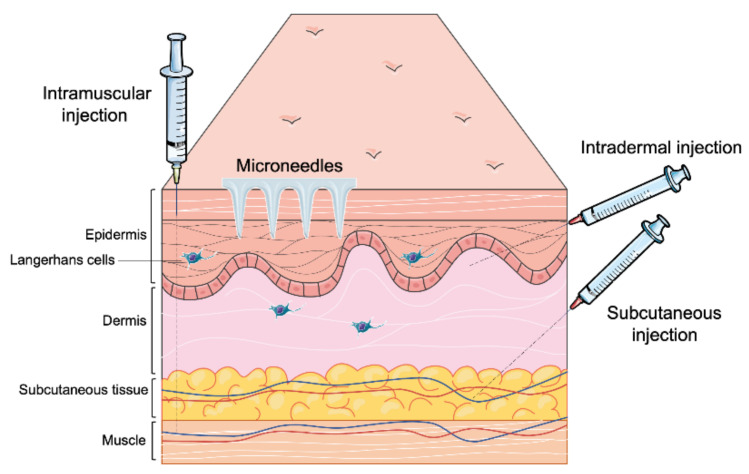
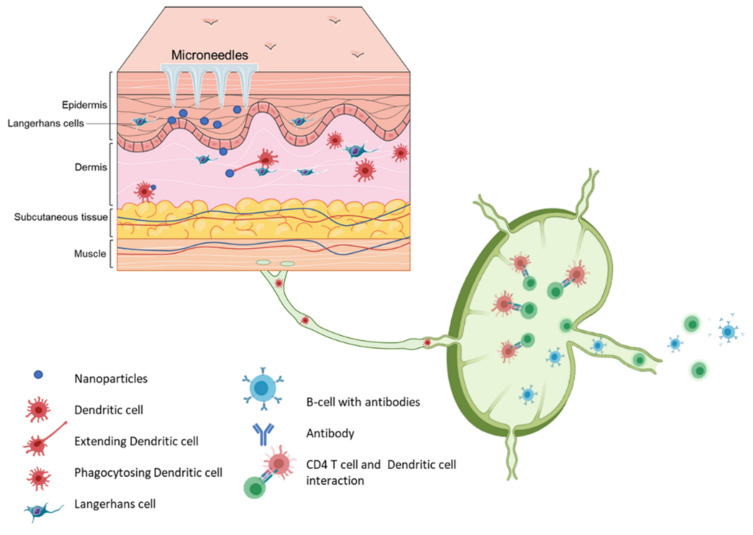
Transdermal vaccination route using biodegradable microneedles is a rapidly progressing field of research and applications. The fear of painful needles is one of the primary reasons most people avoid getting vaccinated. Therefore, developing an alternative pain-free method of vaccination using microneedles has been a significant research area. Microneedles comprise arrays of micron-sized needles that offer a pain-free method of delivering actives across the skin. Apart from being pain-free, microneedles provide various advantages over conventional vaccination routes such as intramuscular and subcutaneous. Microneedle vaccines induce a robust immune response as the needles ranging from 50 to 900 μm in length can efficiently deliver the vaccine to the epidermis and the dermis region, which contains many Langerhans and dendritic cells. The microneedle array looks like band-aid patches and offers the advantages of avoiding cold-chain storage and self-administration flexibility. The slow release of vaccine antigens is an important advantage of using microneedles. The vaccine antigens in the microneedles can be in solution or suspension form, encapsulated in nano or microparticles, and nucleic acid-based. The use of microneedles to deliver particle-based vaccines is gaining importance because of the combined advantages of particulate vaccine and pain-free immunization. The future of microneedle-based vaccines looks promising however, addressing some limitations such as dosing inadequacy, stability and sterility will lead to successful use of microneedles for vaccine delivery. This review illustrates the recent research in the field of microneedle-based vaccination.
使用可生物降解微针的经皮接种途径是一个快速发展的研究和应用领域。对疼痛针头的恐惧是大多数人避免接种疫苗的主要原因之一。因此,开发一种使用微针的无痛替代接种方法一直是一个重要的研究领域。微针由微米级针头阵列组成,提供了一种无痛的活性物质经皮递送方法。除了无痛之外,微针相对于传统的接种途径(如肌肉注射和皮下注射)还具有各种优势。微针疫苗能引发强烈的免疫反应,因为长度在50至900微米之间的微针可以有效地将疫苗递送至表皮和真皮区域,该区域含有许多朗格汉斯细胞和树突状细胞。微针阵列看起来像创可贴贴片,具有避免冷链储存和自我给药灵活性的优点。疫苗抗原的缓慢释放是使用微针的一个重要优势。微针中的疫苗抗原可以是溶液或悬浮液形式,封装在纳米或微粒中,以及基于核酸的形式。由于颗粒疫苗和无痛免疫的综合优势,使用微针递送基于颗粒的疫苗正变得越来越重要。基于微针的疫苗的未来看起来很有前景,然而,解决一些局限性,如剂量不足、稳定性和无菌性,将导致微针成功用于疫苗递送。这篇综述阐述了基于微针接种领域的最新研究。