Gurung Suman Chandra, Dixit Kritika, Rai Bhola, Dhital Raghu, Paudel Puskar Raj, Acharya Shraddha, Budhathoki Gangaram, Malla Deepak, Levy Jens W, Lönnroth Knut, Ramsay Andrew, Basnyat Buddha, Thapa Anil, Mishra Gokul, Subedi Bishal, Shah Mohammad Kashim, Shrestha Anil, Caws Maxine
Birat Nepal Medical Trust, Kathmandu 44600, Nepal.
LIV-TB Collaboration, Departments of International Public Health and Clinical Sciences, Liverpool School of Tropical Medicine, Liverpool L35QA, UK.
Trop Med Infect Dis. 2021 Apr 14;6(2):50. doi: 10.3390/tropicalmed6020050.
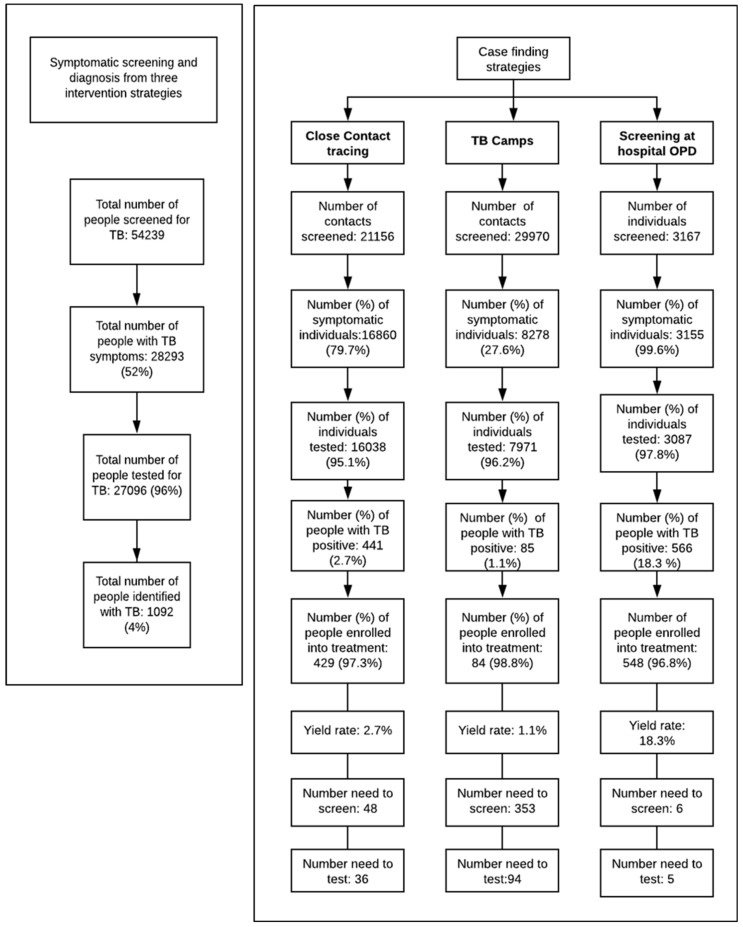
This study compared the yield of tuberculosis (TB) active case finding (ACF) interventions applied under TB REACH funding. Between June 2017 to November 2018, Birat Nepal Medical Trust identified presumptive cases using simple verbal screening from three interventions: door-to-door screening of social contacts of known index cases, TB camps in remote areas, and screening for hospital out-patient department (OPD) attendees. Symptomatic individuals were then tested using smear microscopy or GeneXpert MTB/RIF as first diagnostic test. Yield rates were compared for each intervention and diagnostic method. We evaluated additional cases notified from ACF interventions by comparing case notifications of the intervention and control districts using standard TB REACH methodology. The project identified 1092 TB cases. The highest yield was obtained from OPD screening at hospitals (n = 566/1092; 52%). The proportion of positive tests using GeneXpert (5.5%, n = 859/15,637) was significantly higher than from microscopy testing 2% (n = 120/6309). (OR = 1.4; 95%CI = 1.12-1.72; p = 0.0026). The project achieved 29% additionality in case notifications in the intervention districts demonstrating that GeneXpert achieved substantially higher case-finding yields. Therefore, to increase national case notification for TB, Nepal should integrate OPD screening using GeneXpert testing in every district hospital and scale up of community-based ACF of TB patient contacts nationally.
本研究比较了在“结核病防治拓展计划(TB REACH)”资助下实施的结核病(TB)主动病例发现(ACF)干预措施的成效。2017年6月至2018年11月期间,比拉特尼泊尔医疗信托基金通过三种干预措施,即对已知索引病例的社会接触者进行挨家挨户筛查、在偏远地区设立结核病筛查营、以及对医院门诊(OPD)就诊者进行筛查,采用简单的口头筛查来确定疑似病例。然后,对有症状的个体使用涂片显微镜检查或GeneXpert MTB/RIF作为首次诊断检测。比较了每种干预措施和诊断方法的检出率。我们使用标准的“结核病防治拓展计划”方法,通过比较干预区和对照区的病例通报情况,评估了ACF干预措施额外通报的病例。该项目共发现1092例结核病病例。医院门诊筛查的检出率最高(n = 566/1092;52%)。使用GeneXpert检测的阳性比例(5.5%,n = 859/15,637)显著高于显微镜检测(2%,n = 120/6309)。(比值比 = 1.4;95%置信区间 = 1.12 - 1.72;p = 0.0026)。该项目在干预区的病例通报中实现了29%的额外增加,表明GeneXpert的病例发现率显著更高。因此,为提高尼泊尔全国的结核病病例通报率,应在每个地区医院整合使用GeneXpert检测的门诊筛查,并在全国范围内扩大对结核病患者接触者的社区ACF。