Musculoskeletal Pain and Motor Control Research Group, Faculty of Health Sciences, Universidad Europea de Madrid, 28670 Madrid, Spain.
Department of Physiotherapy, Faculty of Biomedical and Health Sciences, Universidad Europea de Madrid, 28670 Madrid, Spain.
Int J Environ Res Public Health. 2021 Apr 15;18(8):4206. doi: 10.3390/ijerph18084206.
It remains unclear as to whether verbal suggestions and expectancies can influence the perception of post-needling soreness. The aim of this study was to analyze the effects of verbal suggestions on post-needling soreness after dry needling of the trapezius muscle.
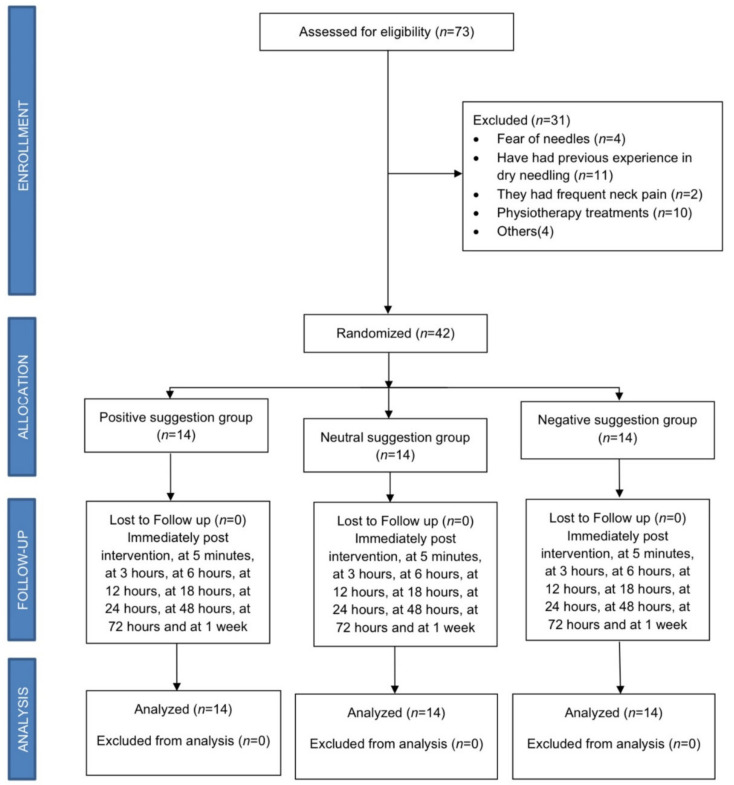
This study is a randomized controlled trial including healthy subjects randomly assigned to one of three groups receiving different verbal suggestions about the effects of dry needling and the occurrence of post needling soreness (positive, negative, or neutral). Then, dry needling on a latent trigger point of the upper trapezius muscle was performed and the following outcomes were measured immediately after, 24, 48, and 72 h, and one week after the intervention: post-needling soreness intensity, pressure pain threshold (PPT), temporal summation (TS) and conditioned pain modulation (CPM).
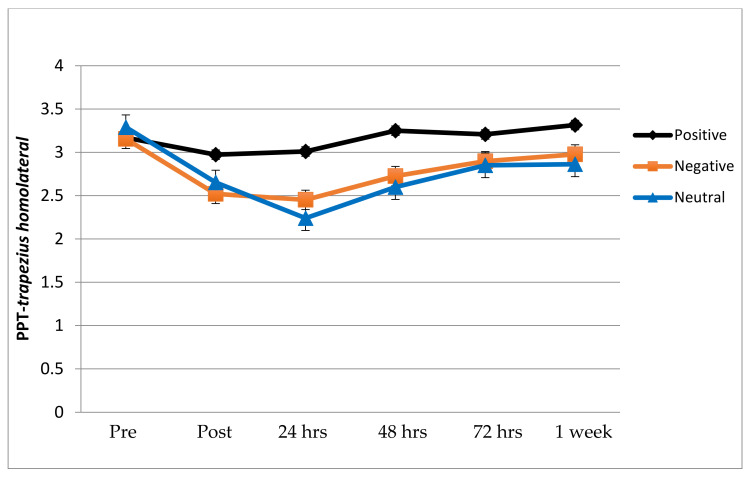
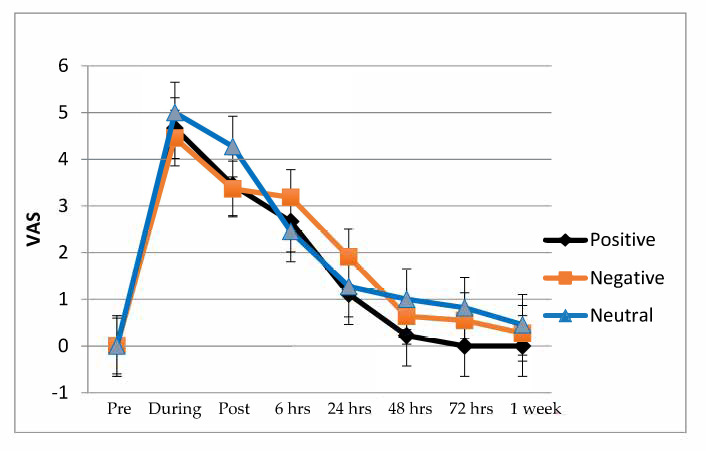
Seventy-three consecutive participants were screened and 42 participants (12 men and 30 women, aged: 24 ± 8 years old) were eligible and finished the study protocol. The results showed that verbal suggestion did not influence the perception of post-needling soreness, since there were no differences between groups ( < 0.05) on the intensity of post-needling soreness or tenderness over a one-week follow-up. Moreover, verbal suggestion did not associate with changes in sensorimotor variables of TS and CPM.
The induction of different types of expectations through verbal suggestion does not influence the perception of acute pain perceived during the performance of a deep dry needling technique and post-needling pain or soreness after deep dry needling on a latent upper trapezius myofascial trigger point (MTrP).
言语暗示和期望是否会影响针刺后疼痛的感知尚不清楚。本研究旨在分析言语暗示对斜方肌干针后疼痛的影响。
这是一项随机对照试验,纳入的健康受试者被随机分为三组,分别接受关于干针效应和针刺后疼痛发生的不同言语暗示(阳性、阴性或中性)。然后,在斜方肌上的潜在触发点进行干针治疗,并在干预后立即、24 小时、48 小时和 72 小时以及一周后测量以下结果:针刺后疼痛强度、压痛阈值(PPT)、时间总和(TS)和条件疼痛调制(CPM)。
连续筛查了 73 名受试者,其中 42 名参与者(12 名男性,30 名女性,年龄:24±8 岁)符合条件并完成了研究方案。结果表明,言语暗示并未影响针刺后疼痛的感知,因为在针刺后疼痛强度或一周内压痛方面,各组之间没有差异(<0.05)。此外,言语暗示与 TS 和 CPM 的感觉运动变量的变化无关。
通过言语暗示诱导不同类型的期望并不会影响深干针技术实施过程中感知到的急性疼痛的感知,也不会影响深部斜方肌肌筋膜触发点(MTrP)干针后疼痛或疼痛的感知。