Piga Antonio, Conte Paola, Fois Simonetta, Catzeddu Pasquale, Del Caro Alessandra, Sanguinetti Anna Maria, Fadda Costantino
Dipartimento di Agraria, Università degli Studi di Sassari, Viale Italia 39/A, 07100 Sassari, Italy.
Porto Conte Ricerche Srl, Località Tramariglio, 07041 Alghero, Italy.
Foods. 2021 Apr 22;10(5):920. doi: 10.3390/foods10050920.
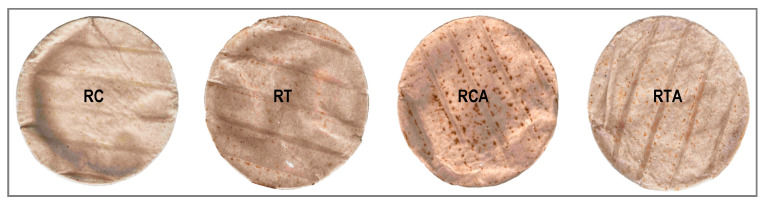
Celiac disease is increasing all over the world. In this context, most recent research in this area is addressing and attempting to improve the nutritional value and sensory characteristics of gluten-free (GF) food products and to enhance their technological properties. Here, amaranth flour was studied as a potential healthy ingredient for the development of an innovative GF flat bread. Starting from two different basic formulations (rice flour:corn starch and rice flour:tapioca starch, 50:50), the impact of partially replacing rice flour (6%) and starch (6%) with amaranth on the nutritional characteristics, polyphenol composition, textural, and sensory properties of the resulting GF flat breads was explored. The substitution with amaranth led to detrimental effects on the doughs' viscometric properties, especially in the case of tapioca starch, but significantly improved the doughs' textural properties. All the amaranth-enriched flat breads showed a better color and a significant increase in all polyphenols fractions but lower antioxidant activity. During bread storage for three days, a detrimental effect on both starch retrogradation, toughness, and extensibility properties were observed, especially when tapioca starch was used. Check-all-that-apply (CATA) sensory test results showed that the incorporation of amaranth increased yeast odor and yeast flavor perception and decreased the softness in mouth-only in tapioca-based samples. A better compromise among technological, nutritional, and sensory properties was achieved when amaranth flour was added to the basic rice and corn formulation.
乳糜泻在全球范围内呈上升趋势。在此背景下,该领域的最新研究致力于提高无麸质(GF)食品的营养价值和感官特性,并增强其工艺性能。在此,对苋菜粉作为开发创新型无麸质扁平面包的潜在健康成分进行了研究。从两种不同的基本配方(米粉:玉米淀粉和米粉:木薯淀粉,50:50)开始,探讨了用苋菜部分替代米粉(6%)和淀粉(6%)对所得无麸质扁平面包的营养特性、多酚组成、质地和感官特性的影响。用苋菜替代对面团的粘度特性产生了不利影响,尤其是在木薯淀粉的情况下,但显著改善了面团的质地特性。所有富含苋菜的扁平面包都呈现出更好的色泽,所有多酚组分均显著增加,但抗氧化活性较低。在面包储存三天期间,观察到对淀粉回生、韧性和延展性特性均有不利影响,尤其是使用木薯淀粉时。多选式(CATA)感官测试结果表明,添加苋菜会增加酵母气味和酵母风味感知,且仅在以木薯为基础的样品中会降低口腔中的柔软度。当将苋菜粉添加到基本的大米和玉米配方中时,在工艺、营养和感官特性之间实现了更好的平衡。