Kameda Medical Center, Department of Obstetrics and Gynecology, Kamogawa 296-8602, Japan.
Int J Mol Sci. 2021 Apr 23;22(9):4409. doi: 10.3390/ijms22094409.
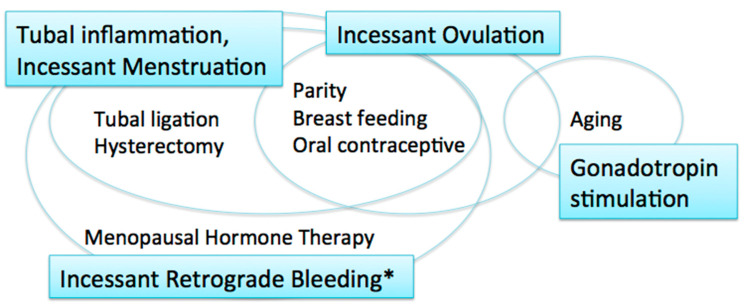
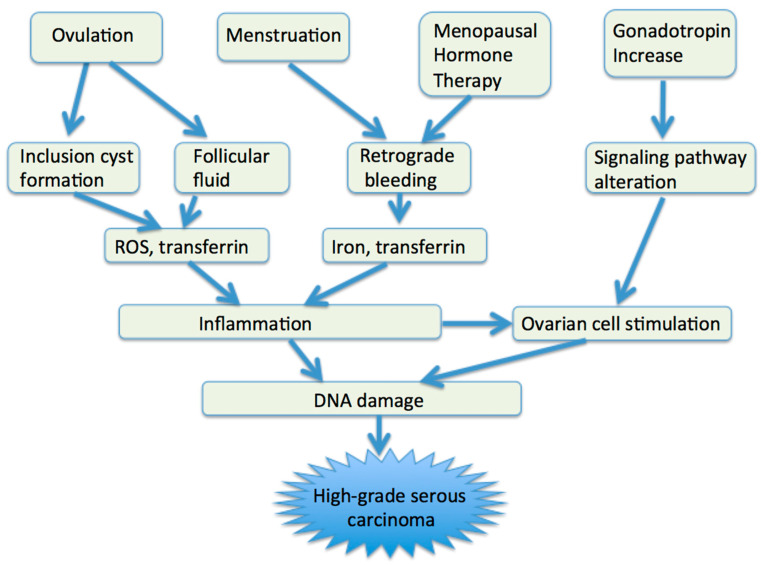
Ovarian high-grade serous carcinomas (HGSCs) are a heterogeneous group of diseases. They include fallopian-tube-epithelium (FTE)-derived and ovarian-surface-epithelium (OSE)-derived tumors. The risk/protective factors suggest that the etiology of HGSCs is multifactorial. Inflammation caused by ovulation and retrograde bleeding may play a major role. HGSCs are among the most genetically altered cancers, and mutations are ubiquitous. Key driving events other than mutations include homologous recombination (HR) deficiency, such as BRCA 1/2 dysfunction, and activation of the CCNE1 pathway. HR deficiency and the amplification appear to be mutually exclusive. Intratumor heterogeneity resulting from genomic instability can be observed at the early stage of tumorigenesis. In this review, I discuss current carcinogenic hypotheses, sites of origin, etiologic factors, and molecular alterations of HGSCs.
卵巢高级别浆液性癌(HGSCs)是一组异质性疾病。它们包括输卵管上皮(FTE)衍生和卵巢表面上皮(OSE)衍生的肿瘤。风险/保护因素表明 HGSCs 的病因是多因素的。排卵和逆行性出血引起的炎症可能起主要作用。HGSCs 是基因突变最常见的癌症之一, 突变普遍存在。除 突变外,关键驱动事件还包括同源重组(HR)缺陷,如 BRCA 1/2 功能障碍,以及 CCNE1 通路的激活。HR 缺陷和 扩增似乎是相互排斥的。肿瘤发生早期即可观察到基因组不稳定性导致的肿瘤内异质性。在这篇综述中,我讨论了 HGSCs 的当前致癌假说、起源部位、病因因素和分子改变。