Bujdoso Geza, Illes Benjamin, Varjas Virag, Cseke Klara
Centre for Horticultural Sciences, Hungarian University of Agriculture and Life Sciences, Park u. 2, 1223 Budapest, Hungary.
Forest Research Institute, University of Sopron, Várkerület 30/A, 9600 Sárvár, Hungary.
Plants (Basel). 2021 Apr 23;10(5):854. doi: 10.3390/plants10050854.
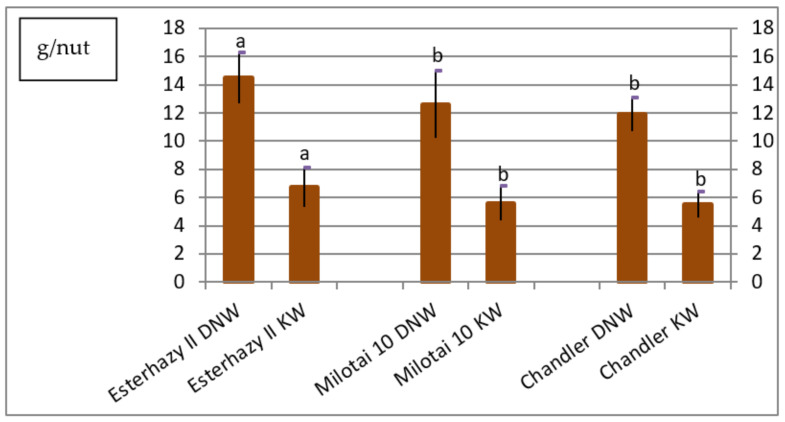
The old walnut ( L.) genotype called "Esterhazy II" was well-known in the Austro-Hungarian Monarchy before World War II, and it can still be found in the Austrian, German and Swiss backyard gardens today. Unfortunately, nowadays, vegetatively propagated progenies of the original "Esterhazy II" are not available anymore around the world because walnut grafting started later than this genotype had become well-known. Although various accessions with "Esterhazy II"-"blood" are available, it is difficult to determine which one can be considered true or the most similar to the original one. In this paper, phenological and nut morphological characteristics of an "Esterhazy II" specimen planted in a Hungarian gene bank were compared to the varieties "Milotai 10" and "Chandler". Examined characteristics were: budbreak, blossom time, type of dichogamy, ripening time, nut and kernel features. An additional SSR fingerprinting was used to identify identical genotypes and to demonstrate the relatedness of the analyzed "Esterhazy II" genotype to the other Hungarian walnut cultivars. It can be concluded that under the name "Esterhazy II", several different genotypes can be observed. All the checked characteristics except budbreak fitted well with the previous descriptions. Our results confirmed that the examined "Esterhazy II" genotype shows high similarity to the "original" "Esterhazy II" described in the literature.
名为“埃斯特哈齐二号”的老核桃(L.)基因型在第二次世界大战前的奥匈帝国就已闻名,如今在奥地利、德国和瑞士的后院花园中仍能找到。不幸的是,如今世界各地已不再有原始“埃斯特哈齐二号”的无性繁殖后代,因为核桃嫁接开始的时间晚于该基因型闻名的时间。尽管有各种带有“埃斯特哈齐二号”“血统”的种质,但很难确定哪一种可被视为真正的或与原始品种最相似的。本文将种植在匈牙利基因库中的一个“埃斯特哈齐二号”样本的物候和坚果形态特征与“米洛泰10号”和“钱德勒”品种进行了比较。所研究的特征包括:萌芽、开花时间、雌雄异熟类型、成熟时间、坚果和果仁特征。还使用了额外的SSR指纹图谱来鉴定相同的基因型,并证明所分析的“埃斯特哈齐二号”基因型与其他匈牙利核桃品种的亲缘关系。可以得出结论,在“埃斯特哈齐二号”这个名称下,可以观察到几种不同的基因型。除萌芽外,所有检查的特征都与之前的描述非常吻合。我们的结果证实,所研究的“埃斯特哈齐二号”基因型与文献中描述的“原始”“埃斯特哈齐二号”具有高度相似性。