Grigora Maria-Eirini, Terzopoulou Zoi, Tsongas Konstantinos, Klonos Panagiotis, Kalafatakis Nikolaos, Bikiaris Dimitrios N, Kyritsis Apostolos, Tzetzis Dimitrios
Digital Manufacturing and Materials Characterization Laboratory, School of Science and Technology, International Hellenic University, 14 km Thessaloniki, 57001 N. Moudania, Greece.
Laboratory of Polymer Chemistry and Technology, Department of Chemistry, Aristotle University of Thessaloniki, 54124 Thessaloniki, Greece.
Polymers (Basel). 2021 Apr 23;13(9):1381. doi: 10.3390/polym13091381.
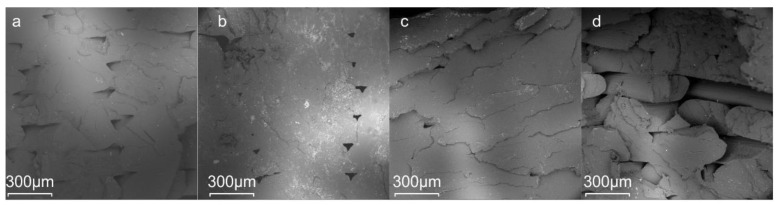
Fused deposition modeling (FDM) is currently the most popular 3D printing method, where thermoplastic polymers are predominantly used. Among them, the biobased poly(lactic acid) (PLA) governs the FDM filament market, with demand higher than supply, since not all grades of PLA are suitable for FDM filament production. In this work, the effect of a food grade chain extender (Joncryl ADR 4400) on the physicochemical properties and printability of PLA marketed for injection molding was examined. All samples were characterized in terms of their mechanical and thermal properties. The microstructure of the filaments and 3D-printed fractured surfaces following tensile testing were examined with optical and scanning electron microscopy, respectively. Molecular weight and complex viscosity increased, while the melt flow index decreased after the incorporation of Joncryl, which resulted in filaments of improved quality and 3D-printed constructs with enhanced mechanical properties. Dielectric spectroscopy revealed that the bulk properties of PLA with respect to molecular mobility, both local and segmental, were, interestingly, not affected by the modifier. Indirectly, this may suggest that the major effects of the extender are on chain length, without inducing chain branching, at least not to a significant extent.
熔融沉积建模(FDM)是目前最流行的3D打印方法,主要使用热塑性聚合物。其中,生物基聚乳酸(PLA)主导着FDM长丝市场,需求大于供应,因为并非所有等级的PLA都适用于FDM长丝生产。在这项工作中,研究了食品级扩链剂(Joncryl ADR 4400)对用于注塑成型的PLA的物理化学性质和可打印性的影响。所有样品均通过其机械和热性能进行表征。分别用光学显微镜和扫描电子显微镜检查了拉伸试验后长丝的微观结构和3D打印断裂表面。加入Joncryl后,分子量和复数粘度增加,而熔体流动指数降低,这导致长丝质量提高,3D打印结构的机械性能增强。介电谱表明,有趣的是,PLA关于分子迁移率的整体性质,包括局部和链段的,不受改性剂的影响。间接地,这可能表明扩链剂的主要作用是增加链长,而不会诱导链支化,至少不会在很大程度上诱导链支化。