Kim Sehwa, Lee Yoonseok, Bang Soo Min, Bak Haein, Yim Sun Young, Lee Young Sun, Yoo Yang Jae, Jung Young Kul, Kim Ji Hoon, Seo Yeon Seok, Yim Hyung Joon, Um Soon Ho, Byun Kwan Soo, Yeon Jong Eun
Department of Internal Medicine, Korea University College of Medicine, Seoul 08308, Korea.
Department of Internal Medicine, Bundang Jesaeng General Hospital, Seongnam-si 13590, Korea.
J Clin Med. 2021 Apr 23;10(9):1840. doi: 10.3390/jcm10091840.
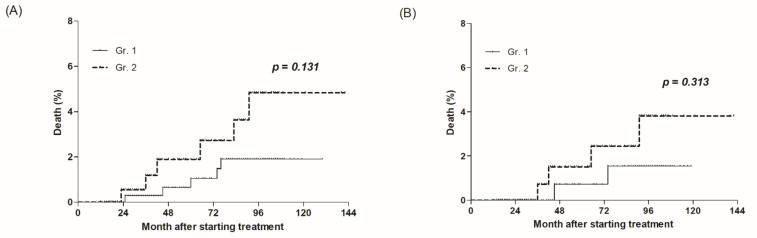
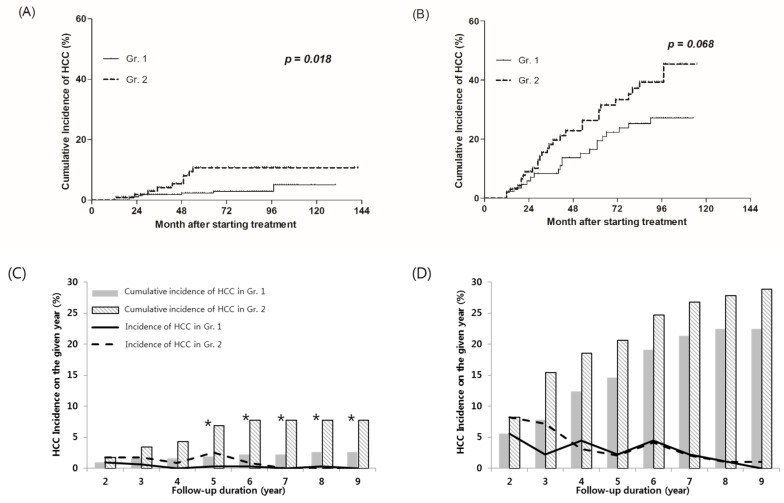
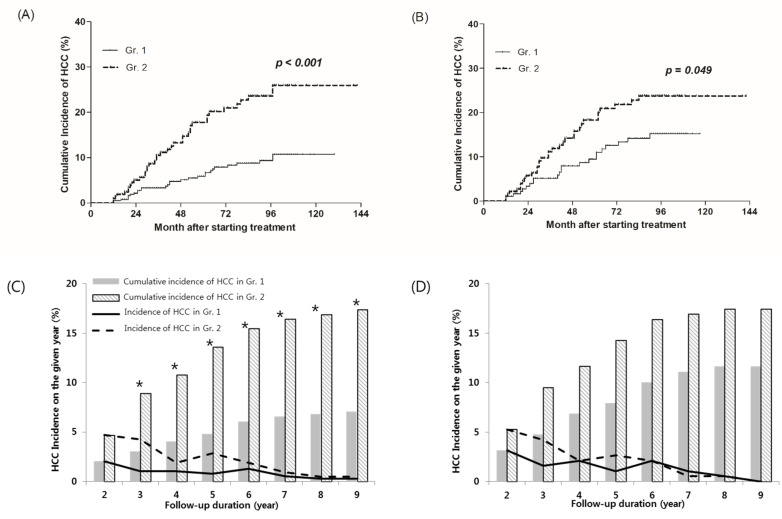
Potent antiviral agents effectively reduce liver-related events in patients with chronic hepatitis B. This study aimed to determine whether alanine aminotransferase normalization using potent antiviral agents was related to hepatocellular carcinoma development. From 2007 to 2017, we included 610 patients with chronic hepatitis B who received entecavir or tenofovir disoproxil fumarate. The patients were divided into the alanine aminotransferase normalization group (Gr.1) and non-normalization group (Gr.2) within a year of potent antiviral treatment. Liver-related events included hepatic encephalopathy, variceal bleeding, and ascites. The mortality rate and hepatocellular carcinoma incidence were investigated for each group. The patients who showed ALT normalization at 1 year of treatment were 397 (65.1%) of 610. During a median follow-up period of 86 months, 65 (10.7%) patients developed hepatocellular carcinoma. The cumulative incidence of hepatocellular carcinoma was significantly lower in Gr.1 than in Gr.2 ( < 0.001). Risk factors for alanine aminotransferase non-normalization were body mass index, cholesterol, and liver cirrhosis at baseline. Male sex, age, platelet level, alcohol use, presence of cirrhosis at baseline, and non-normalization after 1 year of treatment were independent risk factors for hepatocellular carcinoma. Alanine aminotransferase normalization within 1 year of initiating antiviral agents reduces the risk of hepatocellular carcinoma development.
强效抗病毒药物可有效减少慢性乙型肝炎患者的肝脏相关事件。本研究旨在确定使用强效抗病毒药物实现丙氨酸转氨酶正常化是否与肝细胞癌的发生有关。2007年至2017年,我们纳入了610例接受恩替卡韦或替诺福韦酯治疗的慢性乙型肝炎患者。在强效抗病毒治疗的一年内,将患者分为丙氨酸转氨酶正常化组(第1组)和未正常化组(第2组)。肝脏相关事件包括肝性脑病、静脉曲张出血和腹水。对每组的死亡率和肝细胞癌发病率进行了调查。在610例患者中,治疗1年时丙氨酸转氨酶正常化的患者有397例(65.1%)。在中位随访期86个月期间,65例(10.7%)患者发生了肝细胞癌。第1组肝细胞癌的累积发病率显著低于第2组(<0.001)。丙氨酸转氨酶未正常化的危险因素为基线时的体重指数、胆固醇和肝硬化。男性、年龄、血小板水平、饮酒情况、基线时肝硬化的存在以及治疗1年后未正常化是肝细胞癌的独立危险因素。开始抗病毒药物治疗1年内丙氨酸转氨酶正常化可降低肝细胞癌发生的风险。