Rowe Alexander D, Stoway Stephanie D, Åhlman Henrik, Arora Vaneet, Caggana Michele, Fornari Anna, Hagar Arthur, Hall Patricia L, Marquardt Gregg C, Miller Bobby J, Nixon Christopher, Norgan Andrew P, Orsini Joseph J, Pettersen Rolf D, Piazza Amy L, Schubauer Neil R, Smith Amy C, Tang Hao, Tavakoli Norma P, Wei Sainan, Zetterström Rolf H, Currier Robert J, Mørkrid Lars, Rinaldo Piero
Norwegian National Unit for Newborn Screening, Division of Paediatric and Adolescent Medicine, Oslo University Hospital, 0424 Oslo, Norway.
Biochemical Genetics Laboratory, Department of Laboratory Medicine and Pathology, Mayo Clinic, Rochester, MN 55905, USA.
Int J Neonatal Screen. 2021 Apr 23;7(2):23. doi: 10.3390/ijns7020023.
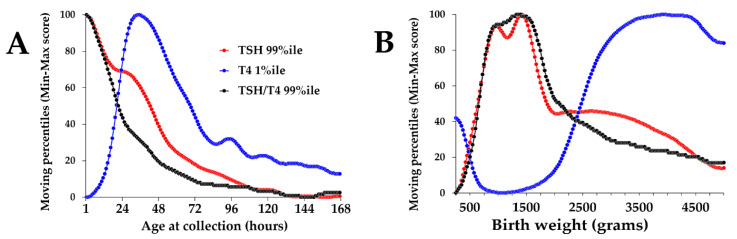
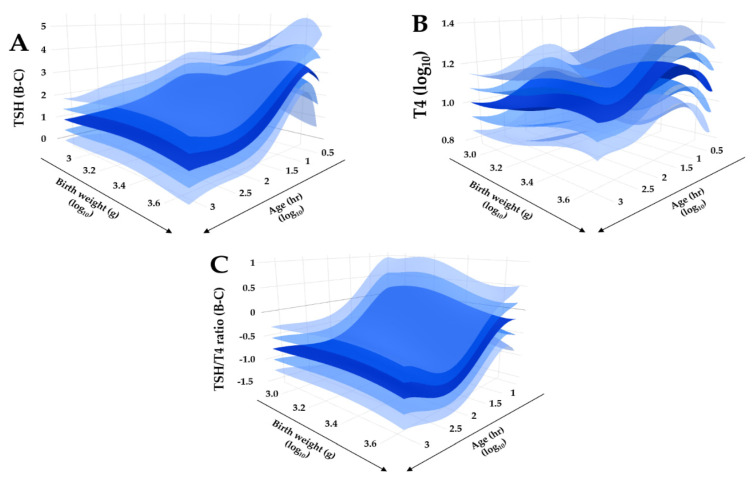
Newborn screening for congenital hypothyroidism remains challenging decades after broad implementation worldwide. Testing protocols are not uniform in terms of targets (TSH and/or T4) and protocols (parallel vs. sequential testing; one or two specimen collection times), and specificity (with or without collection of a second specimen) is overall poor. The purpose of this retrospective study is to investigate the potential impact of multivariate pattern recognition software (CLIR) to improve the post-analytical interpretation of screening results. Seven programs contributed reference data (N = 1,970,536) and two sets of true (TP, N = 1369 combined) and false (FP, N = 15,201) positive cases for validation and verification purposes, respectively. Data were adjusted for age at collection, birth weight, and location using polynomial regression models of the fifth degree to create three-dimensional regression surfaces. Customized Single Condition Tools and Dual Scatter Plots were created using CLIR to optimize the differential diagnosis between TP and FP cases in the validation set. Verification testing correctly identified 446/454 (98%) of the TP cases, and could have prevented 1931/5447 (35%) of the FP cases, with variable impact among locations (range 4% to 50%). CLIR tools either as made here or preferably standardized to the recommended uniform screening panel could improve performance of newborn screening for congenital hypothyroidism.
在全球广泛实施数十年后,先天性甲状腺功能减退症的新生儿筛查仍然具有挑战性。检测方案在目标(促甲状腺激素和/或甲状腺素)和方案(平行检测与序贯检测;一个或两个标本采集时间)方面并不统一,并且特异性(采集或不采集第二个标本)总体较差。这项回顾性研究的目的是调查多变量模式识别软件(CLIR)对改善筛查结果分析后解释的潜在影响。七个项目提供了参考数据(N = 1,970,536),以及两组分别用于验证和核查目的的真阳性(TP,共N = 1369)和假阳性(FP,N = 15,201)病例。使用五次多项式回归模型对采集时的年龄、出生体重和地点进行数据调整,以创建三维回归曲面。使用CLIR创建定制的单条件工具和双散点图,以优化验证集中TP和FP病例之间的鉴别诊断。核查测试正确识别了446/454(98%)的TP病例,并且可以预防1931/5447(35%)的FP病例,不同地点的影响各不相同(范围为4%至50%)。在此制作的CLIR工具,或者更好地标准化为推荐的统一筛查组,可能会提高先天性甲状腺功能减退症新生儿筛查的性能。