Tamarit Alicia, Schoeps Konstanze, Peris-Hernández Montserrat, Montoya-Castilla Inmaculada
Department of Personality, Assessment and Psychological Treatment, Faculty of Psychology, University of Valencia, 46022 Valencia, Spain.
Department of Personality, Evaluation and Psychological Treatments of the University of the Basque Country, 48940 Leioa, Spain.
Int J Environ Res Public Health. 2021 Apr 16;18(8):4226. doi: 10.3390/ijerph18084226.
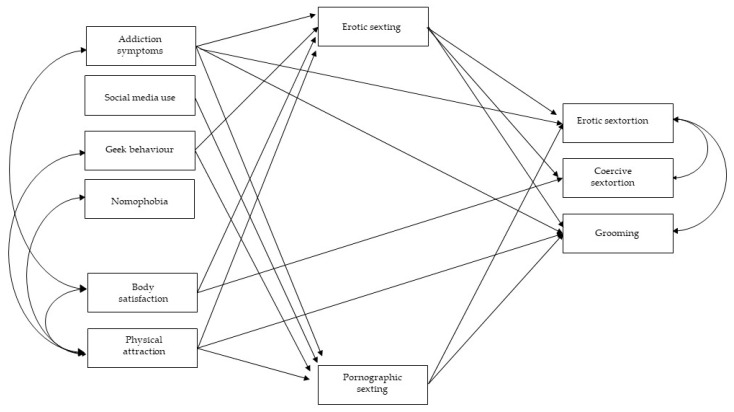
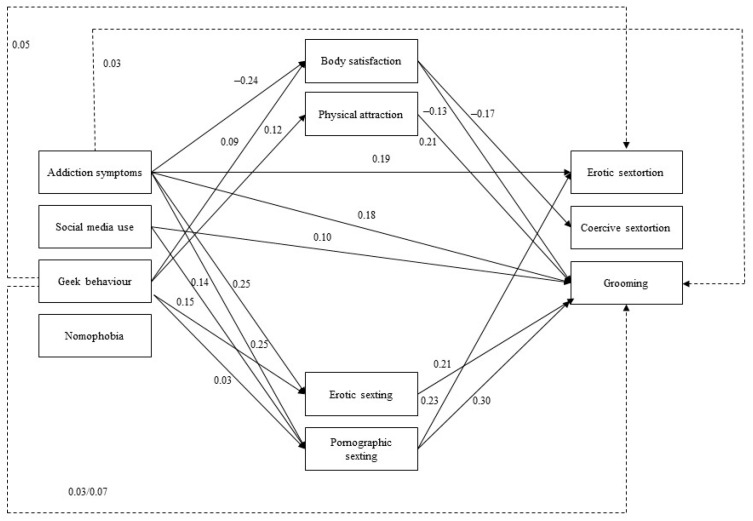
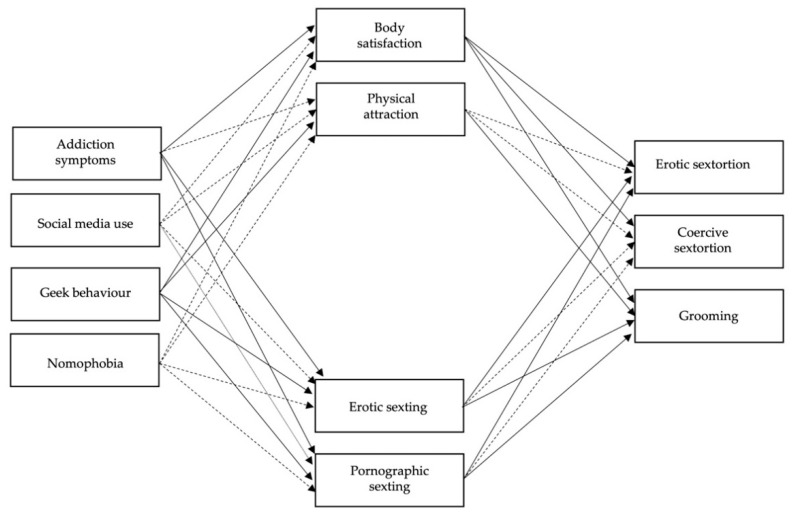
Adolescents' problematic use of the internet and the risk of sexual online victimization are an increasing concern among families, researchers, professionals and society. This study aimed to analyze the interplay between adolescents' addiction to social networks and internet, body self-esteem and sexual-erotic risk behavior online: sexting, sextortion and grooming. While sexting refers to the voluntary engagement in texting sexual-erotic messages, sextortion and grooming are means of sexual-erotic victimization through the use of the internet. Participants were 1763 adolescents (51% girls), aged 12 to 16 years ( = 14.56; = 1.16), from public ( = 1068; 60.60%) and private ( = 695; 39.40%) high schools in the Basque Country (Spain). We carried out structural equation modeling (SEM) using Mplus to assess the mediating effects of body self-esteem in the relationship between addiction to social media and internet and sexual-erotic risk behavior. The results showed that internet addiction predicts online sexual victimization; specifically, the best predictors of sexting, sextortion and grooming victimization were symptoms of internet addiction and geek behavior. Body self-esteem and sexting mediated the relationship between internet addiction and sexual online victimization in adolescents. These results highlight the importance of attending to adolescents' mental health regarding their online behavior, considering the risk and protective factors involved, due to its close association with online sexual victimization.
青少年对互联网的问题性使用以及网络性侵害风险日益受到家庭、研究人员、专业人士和社会的关注。本研究旨在分析青少年对社交网络和互联网的成瘾、身体自尊与网络性风险行为(发送色情短信、敲诈勒索和诱导)之间的相互作用。发送色情短信是指自愿发送性相关的色情信息,而敲诈勒索和诱导是通过互联网进行性侵害的手段。研究参与者为1763名12至16岁的青少年(51%为女孩)(平均年龄 = 14.56岁;标准差 = 1.16),来自西班牙巴斯克地区的公立高中(n = 1068;60.60%)和私立高中(n = 695;39.40%)。我们使用Mplus进行结构方程模型(SEM)分析,以评估身体自尊在社交媒体和互联网成瘾与性风险行为之间关系中的中介作用。结果表明,网络成瘾可预测网络性侵害;具体而言,发送色情短信、敲诈勒索和诱导侵害的最佳预测因素是网络成瘾症状和怪异行为。身体自尊和发送色情短信在青少年网络成瘾与网络性侵害之间起中介作用。这些结果凸显了关注青少年网络行为心理健康的重要性,鉴于其与网络性侵害密切相关,需考虑其中涉及的风险和保护因素。