
柠檬酸循环代谢物预测短暂性冠状动脉闭塞并接受琥珀酸脱氢酶抑制剂或远程缺血预处理治疗的梗塞面积。
Citric Acid Cycle Metabolites Predict Infarct Size in Submitted to Transient Coronary Artery Occlusion and Treated with Succinate Dehydrogenase Inhibitors or Remote Ischemic Perconditioning.
机构信息
Cardiovascular Diseases Research Group, Department of Cardiology, Vall d'Hebron Institut de Recerca (VHIR), Vall d'Hebron Hospital Universitari, Vall d'Hebron Barcelona Hospital Campus, Passeig Vall d'Hebron 119-129, 08035 Barcelona, Spain.
Departament de Medicina, Universitat Autònoma de Barcelona, 08193 Bellaterra, Spain.
出版信息
Int J Mol Sci. 2021 Apr 16;22(8):4151. doi: 10.3390/ijms22084151.
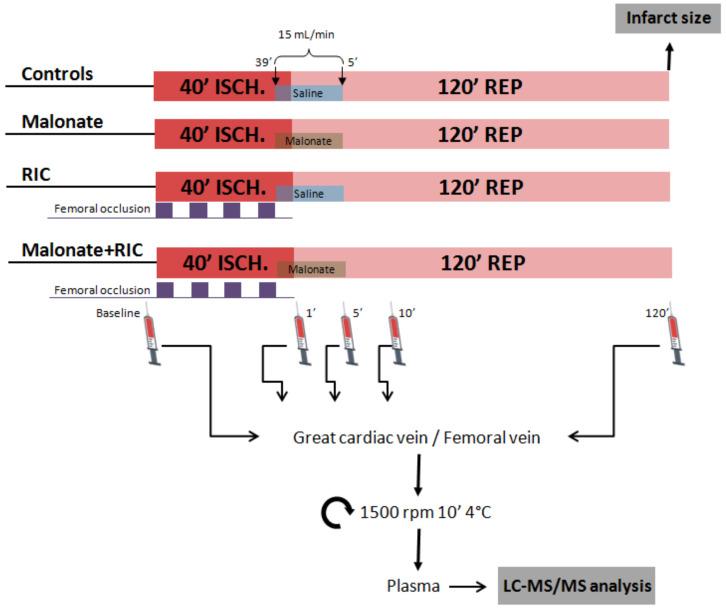
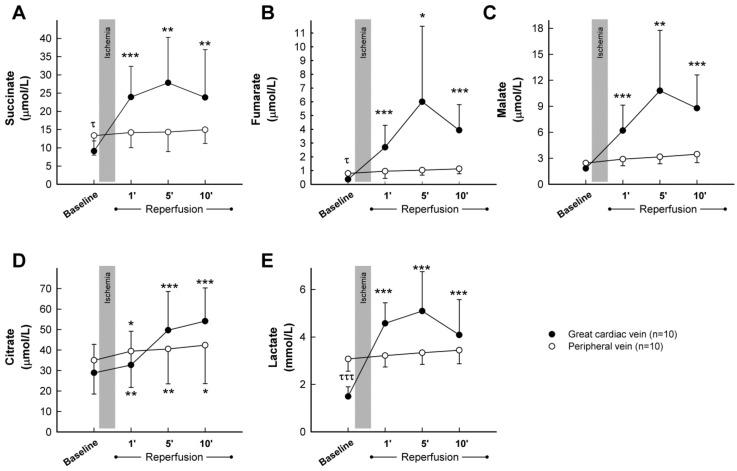
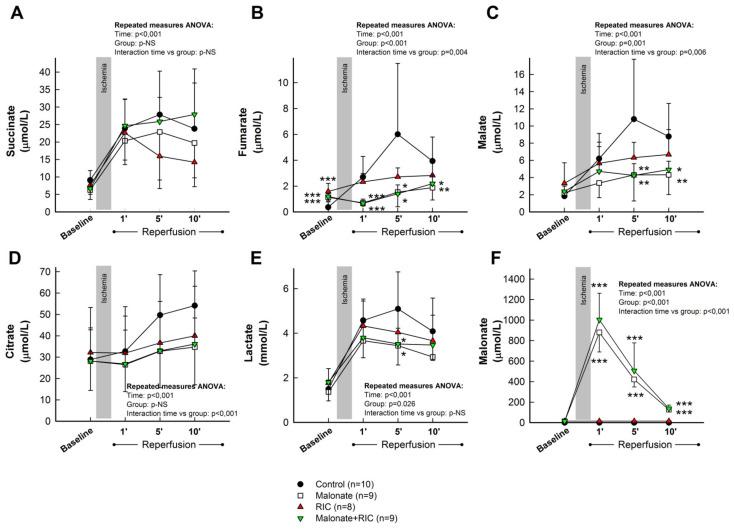
Succinate dehydrogenase (SDH) inhibition with malonate during reperfusion reduced myocardial infarction in animals, whereas its endogenous substrate, succinate, is detected in plasma from STEMI patients. We investigated whether protection by SDH inhibition is additive to that of remote ischemic perconditioning (RIC) in submitted to transient coronary artery occlusion, and whether protective maneuvers influence plasma levels of citric acid cycle metabolites. Forty were submitted to 40 min coronary occlusion and reperfusion, and allocated to four groups (controls, sodium malonate 10 mmol/L, RIC, and malonate + RIC). Plasma was obtained from femoral and great cardiac veins and analyzed by LC-MS/MS. Malonate, RIC, and malonate + RIC reduced infarct size (24.67 ± 5.98, 25.29 ± 3.92 and 29.83 ± 4.62% vs. 46.47 ± 4.49% in controls, < 0.05), but no additive effects were detected. Enhanced concentrations of succinate, fumarate, malate and citrate were observed in controls during initial reperfusion in the great cardiac vein, and most were reduced by cardioprotective maneuvers. Concentrations of succinate, fumarate, and malate significantly correlated with infarct size. In conclusion, despite the combination of SDH inhibition during reperfusion and RIC did not result in additive protection, plasma concentrations of selected citric acid cycle metabolites are attenuated by protective maneuvers, correlate with irreversible injury, and might become a prognosis tool in STEMI patients.
琥珀酸脱氢酶(SDH)抑制剂丙二酸在再灌注期间减少了动物的心肌梗死,而其内源性底物琥珀酸在 STEMI 患者的血浆中被检测到。我们研究了在经历短暂冠状动脉闭塞的患者中,SDH 抑制与远程缺血预处理(RIC)的保护作用是否具有相加作用,以及保护措施是否会影响柠檬酸循环代谢物的血浆水平。40 名患者接受了 40 分钟的冠状动脉闭塞和再灌注,并分为四组(对照组、10mmol/L 丙二酸、RIC 和丙二酸+RIC)。从股静脉和大心静脉采集血浆,并通过 LC-MS/MS 进行分析。丙二酸、RIC 和丙二酸+RIC 降低了梗死面积(24.67±5.98%、25.29±3.92%和 29.83±4.62% vs. 对照组的 46.47±4.49%, < 0.05),但没有观察到相加作用。在大心静脉中,对照组在再灌注初始期间观察到琥珀酸、富马酸、苹果酸和柠檬酸的浓度增强,大多数保护措施都降低了这些浓度。琥珀酸、富马酸和苹果酸的浓度与梗死面积显著相关。总之,尽管在再灌注期间联合使用 SDH 抑制剂和 RIC 并没有导致相加的保护作用,但选定柠檬酸循环代谢物的血浆浓度通过保护措施而减弱,与不可逆损伤相关,并且可能成为 STEMI 患者的预后工具。



 Zotero 插件