Barca Juan A, Bravo Coral, Pintado-Recarte Maria P, Asúnsolo Ángel, Cueto-Hernández Ignacio, Ruiz-Labarta Javier, Buján Julia, Ortega Miguel A, De León-Luis Juan A
Department of Public and Maternal and Child Health, School of Medicine, Complutense University of Madrid, 28040 Madrid, Spain.
Department of Obstetrics and Gynecology, University Hospital Gregorio Marañón, 28009 Madrid, Spain.
J Clin Med. 2021 Apr 13;10(8):1652. doi: 10.3390/jcm10081652.
To compare pelvic floor disorders between vaginal delivery (VD) and cesarean delivery (CD).
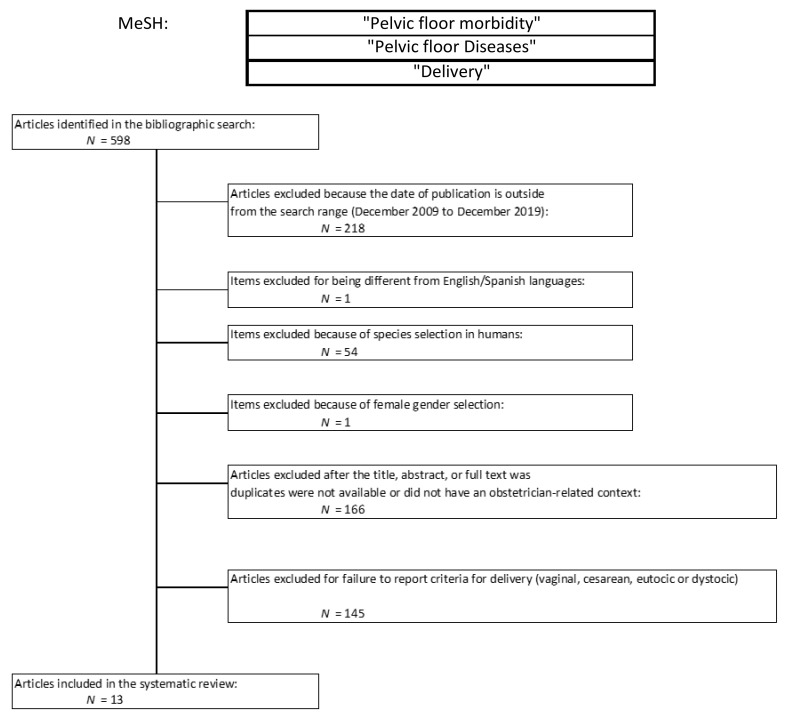
For this study, a PUBMED database search was used, utilizing a combination of relevant medical subjects' headings (MeSH) terms, with the following keywords: "Pelvic floor disorders" or "Pelvic floor morbidity" and "Delivery". Search limits were articles in English or Spanish, about women, published from December 2009 to December 2019. The STATA 16 package was used for meta-analysis and data heterogeneity assessment.
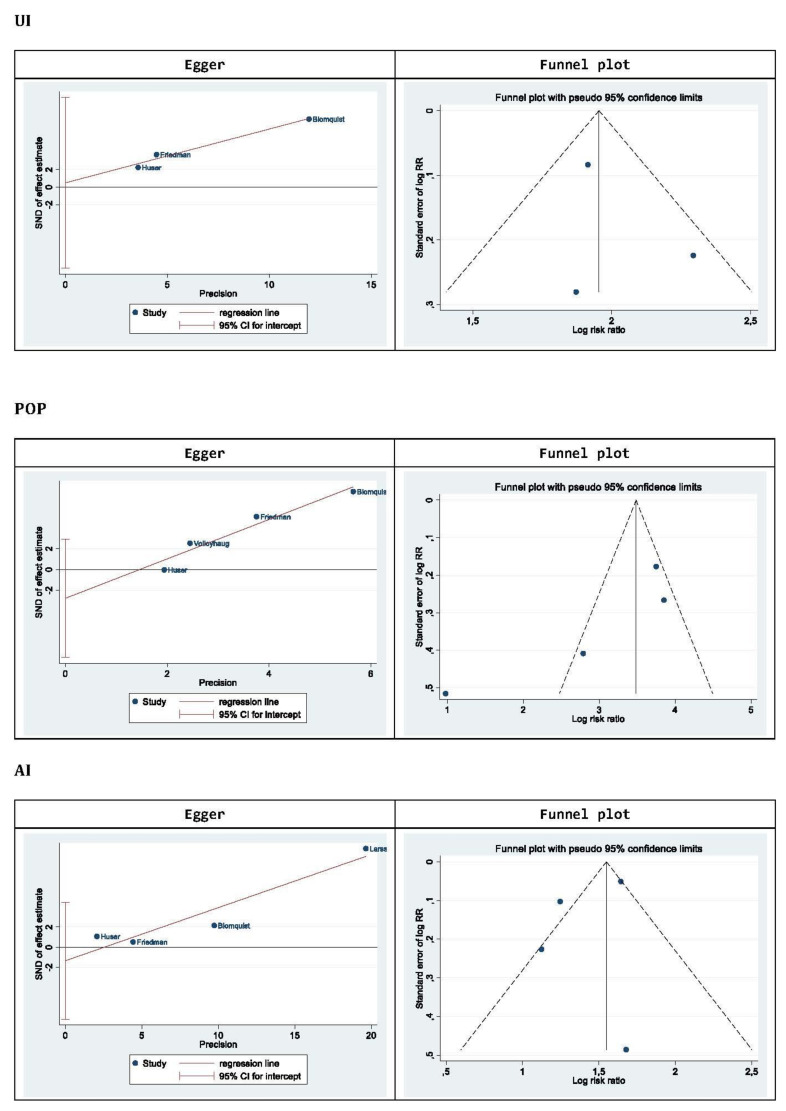
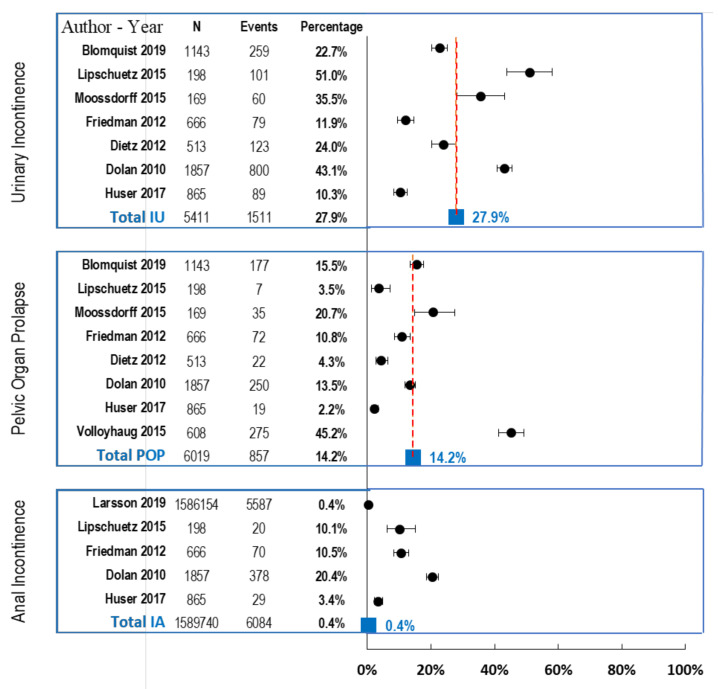
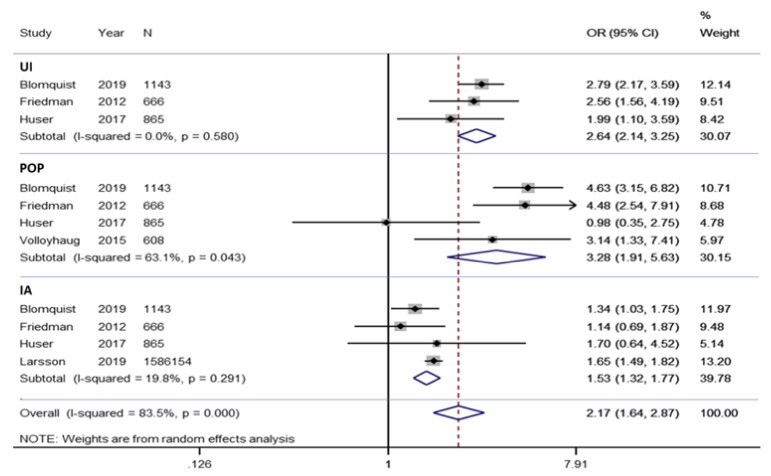
Thirteen studies meeting eligibility criteria were identified comprising 1,597,303 participants. Abstract: Pelvic floor morbidity prevalence was Urinary Incontinence (UI) 27.9% (5411 patients in 7 studies with reported cases), Pelvic Organ Prolapse (POP) 14.2% (6019 patients in 8 studies with reported cases), and Anal Incontinence (AI) 0.4% (1,589,740 patients in 5 studies with reported cases). Our meta-analyses revealed significantly higher rates of all three morbidities and overall morbidity in the VD versus CD group: UI OR = 2.17, 95% CI 1.64-2.87, for heterogeneity ≤ 0.0001, = 84%; POP OR = 3.28, 95% CI 1.91-5.63, for heterogenicity ≤ 0.043, = 63%; AI OR = 1.53, 95% CI 1.32-1.77; for heterogeneity ≤ 0.291, = 20%; and overall morbidity (OR = 2.17, 95% CI 1.64-2.87; for heterogeneity ≤ 0.0001, = 84%).
Vaginal delivery is directly related to the appearance of pelvic floor disorders, mainly UI, POP, and AI. The risk of POP should be taken into higher consideration after vaginal delivery and postpartum follow-up should be performed, to identify and/or treat it at the earliest stages.
比较阴道分娩(VD)和剖宫产(CD)后的盆底功能障碍情况。
在本研究中,我们利用相关医学主题词(MeSH)进行组合,在PUBMED数据库中进行检索,关键词如下:“盆底功能障碍”或“盆底疾病”以及“分娩”。检索限制为2009年12月至2019年12月发表的、关于女性的英文或西班牙文文章。使用STATA 16软件包进行荟萃分析和数据异质性评估。
共确定了13项符合纳入标准的研究,涉及1,597,303名参与者。摘要:盆底疾病的患病率分别为尿失禁(UI)27.9%(7项报告病例的研究中有5411例患者)、盆腔器官脱垂(POP)14.2%(8项报告病例的研究中有6019例患者)、肛门失禁(AI)0.4%(5项报告病例的研究中有1,589,740例患者)。我们的荟萃分析显示,与剖宫产组相比,阴道分娩组的这三种疾病以及总体疾病发生率均显著更高:尿失禁的比值比(OR)=2.17,95%置信区间(CI)为1.64 - 2.87,异质性≤0.0001,I² = 84%;盆腔器官脱垂的OR = 3.28,95% CI为1.91 - 5.63,异质性≤0.043,I² = 63%;肛门失禁的OR = 1.53,95% CI为1.32 - 1.77,异质性≤0.291,I² = 20%;总体疾病发生率(OR = 2.17,95% CI为1.64 - 2.87;异质性≤0.0001,I² = 84%)。
阴道分娩与盆底功能障碍的出现直接相关,主要是尿失禁、盆腔器官脱垂和肛门失禁。阴道分娩后应更高度重视盆腔器官脱垂的风险,并应进行产后随访,以便在最早阶段识别和/或治疗该疾病。