Department of Anaesthesiology and Critical Care Medicine, Medical University of Innsbruck, 6020 Innsbruck, Austria.
Department of Visceral, Transplant and Thoracic Surgery, Medical University of Innsbruck, 6020 Innsbruck, Austria.
Int J Mol Sci. 2021 Apr 13;22(8):4019. doi: 10.3390/ijms22084019.
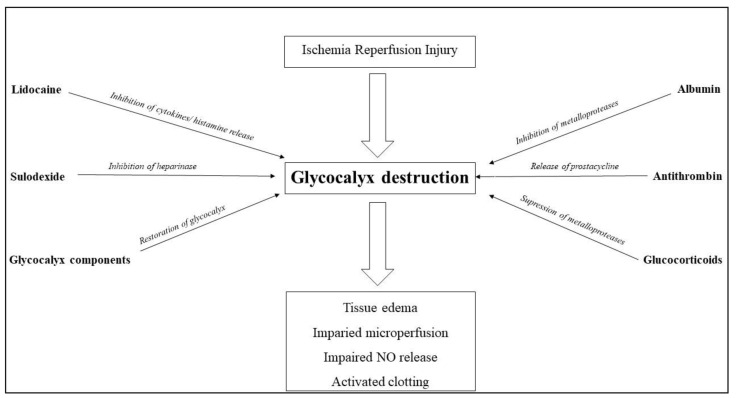
The endothelial glycocalyx is a thin layer consisting of proteoglycans, glycoproteins and glycosaminoglycans that lines the luminal side of vascular endothelial cells. It acts as a barrier and contributes to the maintenance of vascular homeostasis and microperfusion. During solid organ transplantation, the endothelial glycocalyx of the graft is damaged as part of Ischemia Reperfusion Injury (IRI), which is associated with impaired organ function. Although several substances are known to mitigate glycocalyx damage, it has not been possible to use these substances during graft storage on ice. Normothermic machine perfusion (NMP) emerges as an alternative technology for organ preservation and allows for organ evaluation, but also offers the possibility to treat and thus improve organ quality during storage. This review highlights the current knowledge on glycocalyx injury during organ transplantation, presents ways to protect the endothelial glycocalyx and discusses potential glycocalyx protection strategies during normothermic machine perfusion.
内皮糖萼是一层由糖蛋白、蛋白聚糖和糖胺聚糖组成的薄涂层,位于血管内皮细胞的腔侧。它作为一种屏障,有助于维持血管内环境稳定和微循环。在实体器官移植过程中,移植物的内皮糖萼会因缺血再灌注损伤 (IRI) 而受损,这与器官功能障碍有关。尽管有几种物质被认为可以减轻糖萼损伤,但在冰上储存移植物时,无法使用这些物质。常温机器灌注 (NMP) 作为一种器官保存的替代技术,不仅可以进行器官评估,还可以提供在储存过程中进行治疗和改善器官质量的可能性。这篇综述强调了器官移植过程中糖萼损伤的最新知识,介绍了保护内皮糖萼的方法,并讨论了常温机器灌注过程中潜在的糖萼保护策略。