INSERM U1198 Mécanismes Moléculaires dans les Démences Neurodégénératives, Montpellier University, 34095 Montpellier, France.
INSERM, MMDN, EPHE, Montpellier University, 34095 Montpellier, France.
Int J Mol Sci. 2021 Apr 28;22(9):4626. doi: 10.3390/ijms22094626.
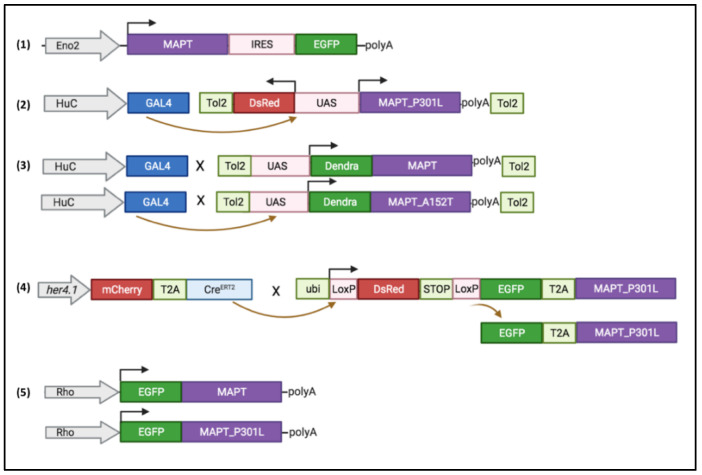
Tauopathies represent a vast family of neurodegenerative diseases, the most well-known of which is Alzheimer's disease. The symptoms observed in patients include cognitive deficits and locomotor problems and can lead ultimately to dementia. The common point found in all these pathologies is the accumulation in neural and/or glial cells of abnormal forms of Tau protein, leading to its aggregation and neurofibrillary tangles. Zebrafish transgenic models have been generated with different overexpression strategies of human Tau protein. These transgenic lines have made it possible to highlight Tau interacting factors or factors which may limit the neurotoxicity induced by mutations and hyperphosphorylation of the Tau protein in neurons. Several studies have tested neuroprotective pharmacological approaches. On few-days-old larvae, modulation of various signaling or degradation pathways reversed the deleterious effects of Tau mutations, mainly hTauP301L and hTauA152T. Live imaging and live tracking techniques as well as behavioral follow-up enable the analysis of the wide range of Tau-related phenotypes from synaptic loss to cognitive functional consequences.
tau 病代表了一大类神经退行性疾病,其中最著名的是阿尔茨海默病。患者表现出的症状包括认知障碍和运动问题,并最终导致痴呆。所有这些病变的共同点是 Tau 蛋白的异常形式在神经和/或神经胶质细胞中的积累,导致其聚集和神经纤维缠结。已经使用不同的人 Tau 蛋白过表达策略生成了斑马鱼转基因模型。这些转基因系使我们能够突出 Tau 相互作用因子或可能限制神经元中 Tau 蛋白突变和过度磷酸化诱导的神经毒性的因子。已经有几项研究测试了神经保护药理学方法。在几天大的幼虫中,各种信号或降解途径的调节逆转了 Tau 突变的有害影响,主要是 hTauP301L 和 hTauA152T。活体成像和活体跟踪技术以及行为随访使我们能够分析从突触丧失到认知功能后果的广泛 Tau 相关表型。