Ko Yong-Il, Kim Min-Jae, Lee Dong-Yun, Nam Jungtae, Jang A-Rang, Lee Jeong-O, Kim Keun-Soo
Department of Physics and Graphene Research Institute, Sejong University, Seoul 05006, Korea.
Department of Electrical Engineering, Semyung University, Jecheon 27136, Korea.
Polymers (Basel). 2021 Apr 28;13(9):1423. doi: 10.3390/polym13091423.
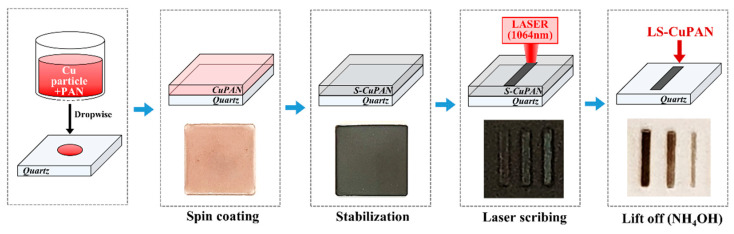
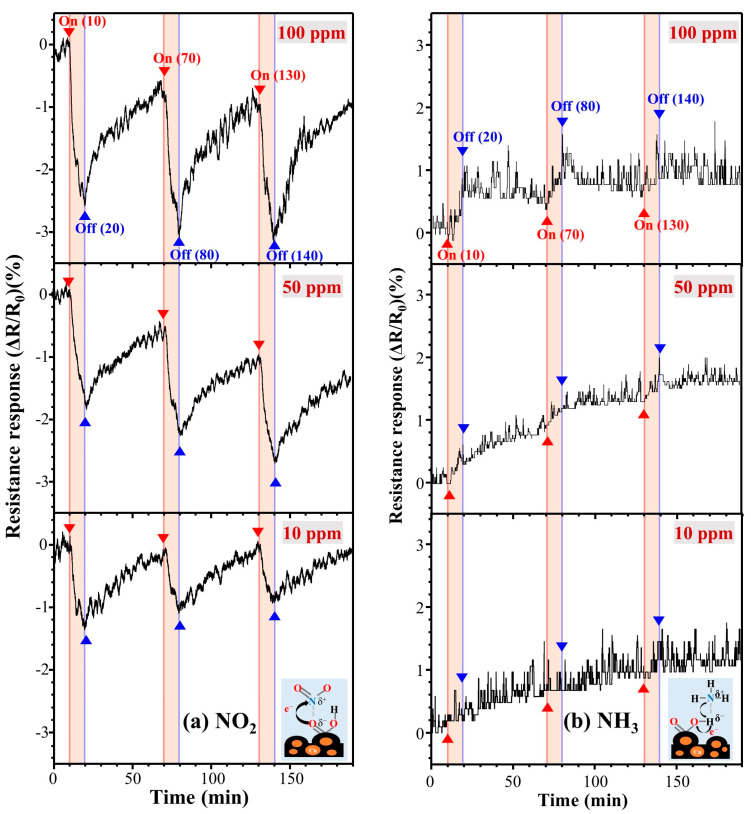
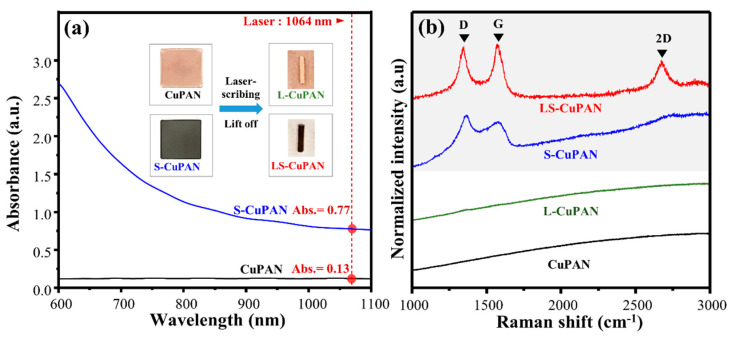
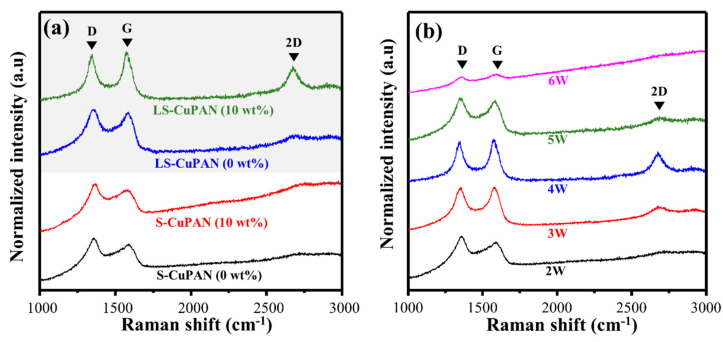
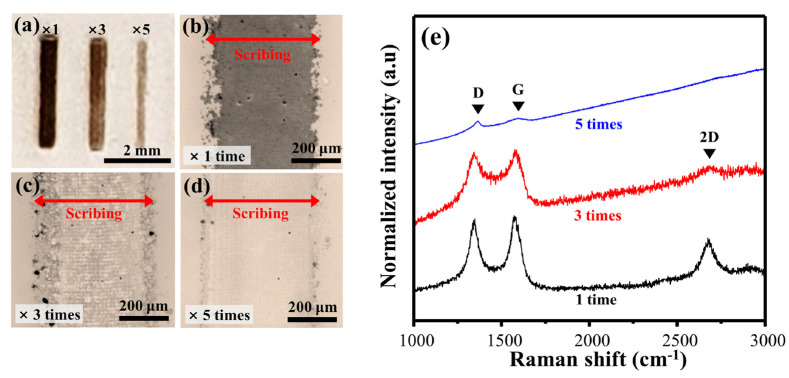
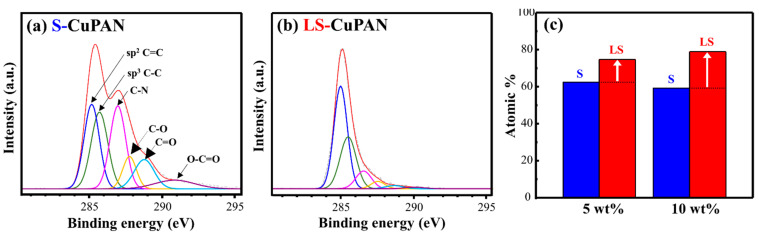
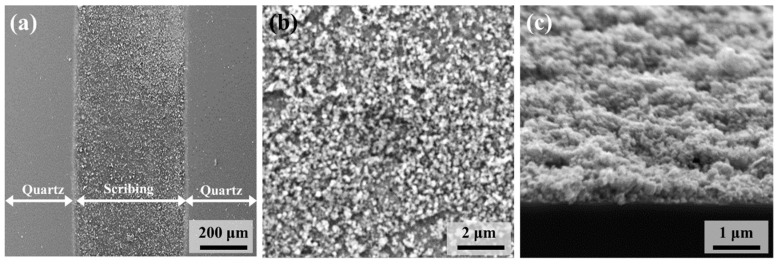
Carbon nanomaterials have attracted significant research attention as core materials in various industrial sectors owing to their excellent physicochemical properties. However, because the preparation of carbon materials is generally accompanied by high-temperature heat treatment, it has disadvantages in terms of cost and process. In this study, highly sensitive carbon nanomaterials were synthesized using a local laser scribing method from a copper-embedded polyacrylonitrile (CuPAN) composite film with a short processing time and low cost. The spin-coated CuPAN was converted into a carbonization precursor through stabilization and then patterned into a carbon nanomaterial of the desired shape using a pulsed laser. In particular, the stabilization process was essential in laser-induced carbonization, and the addition of copper promoted this effect as a catalyst. The synthesized material had a porous 3D structure that was easy to detect gas, and the resistance responses were detected as -2.41 and +0.97% by exposure to NO and NH, respectively. In addition, the fabricated gas sensor consists of carbon materials and quartz with excellent thermal stability; therefore, it is expected to operate as a gas sensor even in extreme environments.
由于其优异的物理化学性质,碳纳米材料作为各种工业领域的核心材料已引起了广泛的研究关注。然而,由于碳材料的制备通常伴随着高温热处理,在成本和工艺方面存在缺点。在本研究中,采用局部激光刻划法,以铜嵌入聚丙烯腈(CuPAN)复合膜为原料,在短时间内低成本合成了高灵敏度碳纳米材料。旋涂的CuPAN通过稳定化转化为碳化前驱体,然后用脉冲激光将其图案化为所需形状的碳纳米材料。特别是,稳定化过程在激光诱导碳化中至关重要,铜的添加作为催化剂促进了这一效果。合成的材料具有易于检测气体的多孔三维结构,通过分别暴露于NO和NH中,电阻响应分别检测为-2.41%和+0.97%。此外,制造的气体传感器由具有优异热稳定性的碳材料和石英组成;因此,即使在极端环境下,它也有望作为气体传感器工作。