Guo Li, Hao Ya-Wei, Li Pei-Long, Song Jiang-Feng, Yang Rui-Zhu, Fu Xiu-Yan, Xie Sheng-Yi, Zhao Jing, Zhang Yong-Lai
Institute of Materials, China Academy of Engineering Physics, Mianyang, Sichuan, 621900, People's Republic of China.
State Key Laboratory on Integrated Optoelectronics, College of Electronic Science and Engineering, Jilin University 2699 Qianjin Street, Changchun, 130012, People's Republic of China.
Sci Rep. 2018 Mar 20;8(1):4918. doi: 10.1038/s41598-018-23091-1.
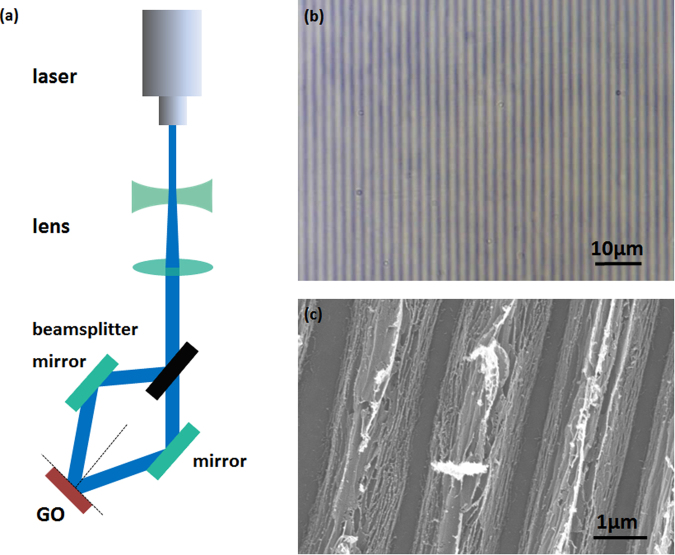
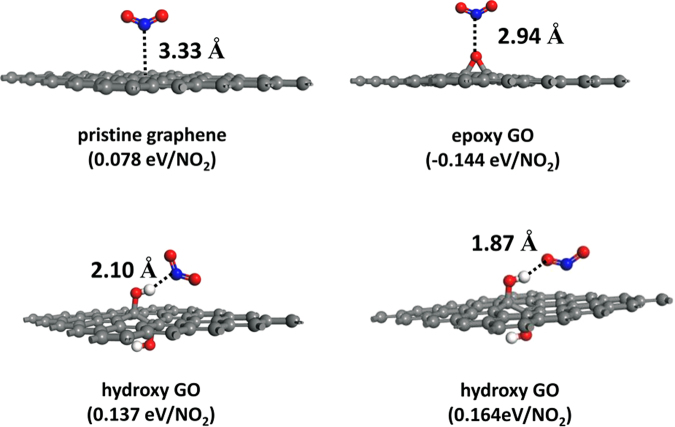
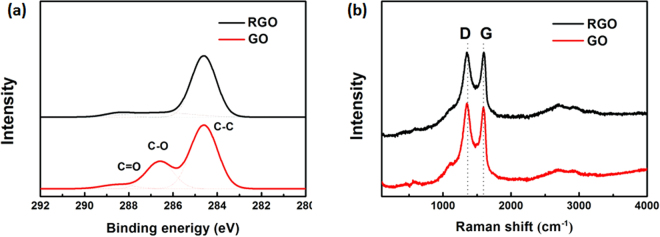
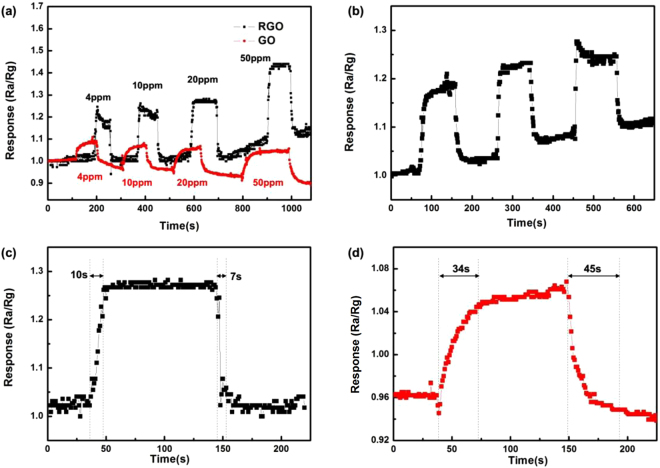
We report on the fabrication of a NO gas sensor from room-temperature reduction of graphene oxide(GO) via two-beam-laser interference (TBLI). The method of TBLI gives the distribution of periodic dissociation energies for oxygen functional groups, which are capable to reduce the graphene oxide to hierarchical graphene nanostructures, which holds great promise for gaseous molecular adsorption. The fabricated reduced graphene oxide(RGO) sensor enhanced sensing response in NO and accelerated response/recovery rates. It is seen that, for 20 ppm NO, the response (R/R) of the sensor based on RGO hierarchical nanostructures is 1.27, which is higher than that of GO (1.06) and thermal reduced RGO (1.04). The response time and recovery time of the sensor based on laser reduced RGO are 10 s and 7 s, which are much shorter than those of GO (34 s and 45 s), indicating that the sensing performances for NO sensor at room temperature have been enhanced by introduction of nanostructures. This mask-free and large-area approach to the production of hierarchical graphene micro-nanostructures, could lead to the implementation of future graphene-based sensors.
我们报道了一种通过双光束激光干涉(TBLI)在室温下还原氧化石墨烯(GO)制备NO气体传感器的方法。TBLI方法给出了氧官能团的周期性解离能分布,这些官能团能够将氧化石墨烯还原为分级石墨烯纳米结构,这对于气态分子吸附具有很大的潜力。所制备的还原氧化石墨烯(RGO)传感器增强了对NO的传感响应并加快了响应/恢复速率。可以看出,对于20 ppm的NO,基于RGO分级纳米结构的传感器的响应(R/R)为1.27,高于GO(1.06)和热还原RGO(1.04)的响应。基于激光还原RGO的传感器的响应时间和恢复时间分别为10 s和7 s,远短于GO的响应时间(34 s)和恢复时间(45 s),这表明通过引入纳米结构提高了室温下NO传感器的传感性能。这种用于生产分级石墨烯微纳米结构的无掩膜大面积方法,可能会推动未来基于石墨烯的传感器的实现。