School of Kinesiology, University of Minnesota, Minneapolis, MN 55455, USA.
Division of Epidemiology & Community Health, University of Minnesota, Minneapolis, MN 55455, USA.
Int J Environ Res Public Health. 2021 Apr 27;18(9):4613. doi: 10.3390/ijerph18094613.
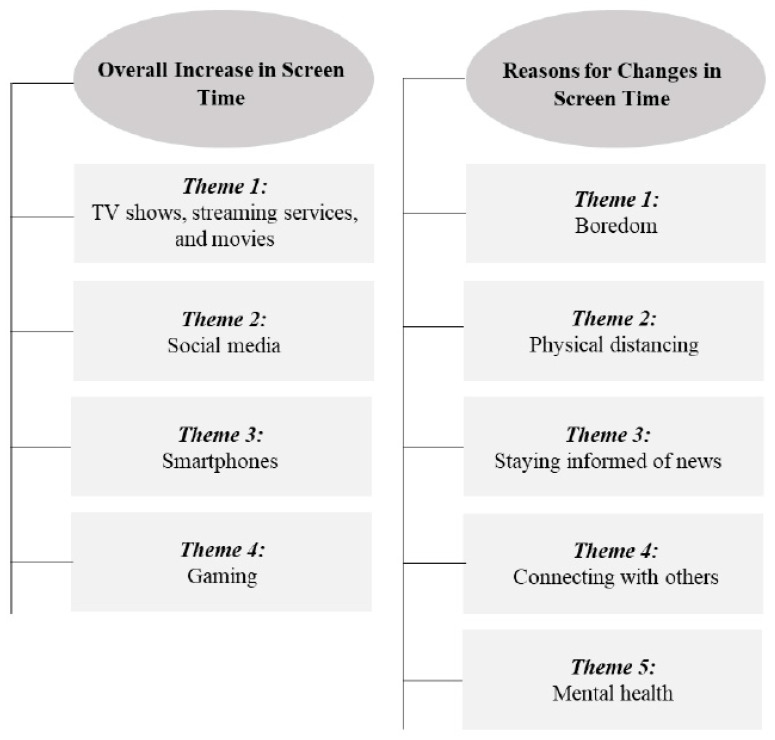
Understanding how screen time behaviors changed during the COVID-19 pandemic is important to inform the design of health promotion interventions. The purpose of this study was to quantify and describe changes in recreational screen time from 2018 to 2020 among a diverse sample of emerging adults. Participants (n = 716) reported their average weekly recreational screen time in 2018 and again during the pandemic in 2020. Additionally, participants qualitatively reported how events related to COVID-19 had influenced their screen time. Weekly recreational screen time increased from 25.9 ± 11.9 h in 2018 to 28.5 ± 11.6 h during COVID-19 ( < 0.001). The form of screen time most commonly reported to increase was TV shows and streaming services (n = 233). Commonly reported reasons for changes in screen time were boredom (n = 112) and a desire to connect with others (n = 52). Some participants reported trying to reduce screen time because of its negative impact on their mental health (n = 32). Findings suggest that screen time and mental health may be intertwined during the pandemic as it may lead to poorer mental health for some, while promoting connectedness for others. Health professionals and public health messaging could promote specific forms for screen time to encourage social connection during the COVID-19 pandemic and beyond.
了解在 COVID-19 大流行期间屏幕时间行为如何变化对于设计健康促进干预措施非常重要。本研究的目的是量化和描述在 COVID-19 大流行期间,不同样本人群中年轻人休闲屏幕时间的变化。参与者(n=716)报告了他们在 2018 年和 2020 年大流行期间的平均每周休闲屏幕时间。此外,参与者还定性报告了与 COVID-19 相关的事件如何影响他们的屏幕时间。每周休闲屏幕时间从 2018 年的 25.9 ± 11.9 小时增加到 COVID-19 期间的 28.5 ± 11.6 小时(<0.001)。报告增加最多的屏幕时间形式是电视节目和流媒体服务(n=233)。报告屏幕时间变化的常见原因是无聊(n=112)和与他人联系的愿望(n=52)。一些参与者报告说,因为屏幕时间对他们的心理健康有负面影响,他们试图减少屏幕时间(n=32)。研究结果表明,在大流行期间,屏幕时间和心理健康可能相互交织,因为它可能导致一些人的心理健康状况恶化,而对其他人来说则促进了联系。卫生专业人员和公共卫生信息宣传可以推广特定形式的屏幕时间,以鼓励在 COVID-19 大流行期间及以后的社交联系。