Student Scientific Society, Laboratory of Genetic Diagnostics, Medical University of Lublin, 20-093 Lublin, Poland.
Department of Pediatric Hematology, Oncology and Transplantology, Medical University of Lublin, 20-093 Lublin, Poland.
Int J Mol Sci. 2021 Apr 26;22(9):4502. doi: 10.3390/ijms22094502.
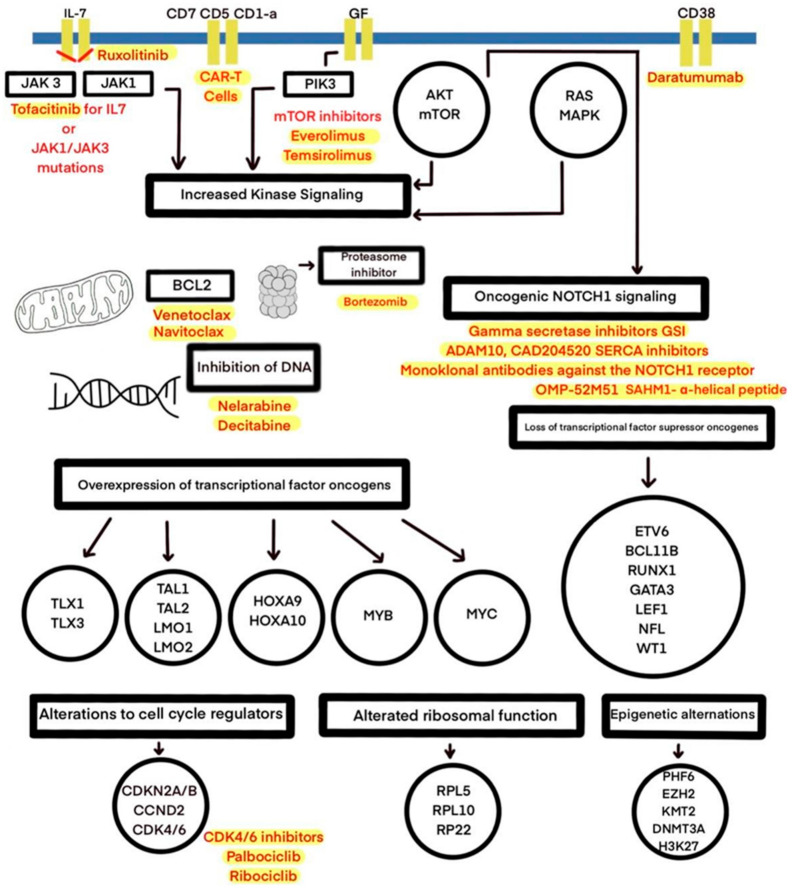
Childhood acute lymphoblastic leukemia is a genetically heterogeneous cancer that accounts for 10-15% of T-cell acute lymphoblastic leukemia (T-ALL) cases. The T-ALL event-free survival rate (EFS) is 85%. The evaluation of structural and numerical chromosomal changes is important for a comprehensive biological characterization of T-ALL, but there are currently no genetic prognostic markers. Despite chemotherapy regimens, steroids, and allogeneic transplantation, relapse is the main problem in children with T-ALL. Due to the development of high-throughput molecular methods, the ability to define subgroups of T-ALL has significantly improved in the last few years. The profiling of the gene expression of T-ALL has led to the identification of T-ALL subgroups, and it is important in determining prognostic factors and choosing an appropriate treatment. Novel therapies targeting molecular aberrations offer promise in achieving better first remission with the hope of preventing relapse. The employment of precisely targeted therapeutic approaches is expected to improve the cure of the disease and quality of life of patients. These include therapies that inhibit Notch1 activation (bortezomib), JAK inhibitors in ETP-ALL (ruxolitinib), BCL inhibitors (venetoclax), and anti-CD38 therapy (daratumumab). Chimeric antigen receptor T-cell therapy (CAR-T) is under investigation, but it requires further development and trials. Nelarabine-based regimens remain the standard for treating the relapse of T-ALL.
儿童急性淋巴细胞白血病是一种遗传异质性癌症,占 T 细胞急性淋巴细胞白血病(T-ALL)病例的 10-15%。T-ALL 的无事件生存(EFS)率为 85%。结构和数量染色体变化的评估对于 T-ALL 的全面生物学特征具有重要意义,但目前没有遗传预后标志物。尽管有化疗方案、类固醇和同种异体移植,但复发是 T-ALL 患儿的主要问题。由于高通量分子方法的发展,近年来 T-ALL 的亚组定义能力显著提高。T-ALL 的基因表达谱分析导致了 T-ALL 亚组的鉴定,这对于确定预后因素和选择适当的治疗方法非常重要。针对分子异常的新疗法有望在实现更好的首次缓解方面取得进展,从而有希望预防复发。精确靶向治疗方法的应用有望提高疾病的治愈率和患者的生活质量。这些治疗方法包括抑制 Notch1 激活的疗法(硼替佐米)、ETP-ALL 中的 JAK 抑制剂(鲁索利替尼)、BCL 抑制剂(维奈托克)和抗 CD38 治疗(达雷妥尤单抗)。嵌合抗原受体 T 细胞疗法(CAR-T)正在研究中,但需要进一步开发和试验。基于奈拉滨的方案仍然是治疗 T-ALL 复发的标准。