Saw Swee Hock School of Public Health, National University of Singapore, 12 Science Drive 2, Singapore 117549, Singapore.
Health Economics and Outcomes Research Centre of Excellence (Greater Asia), Becton, Dickinson and Company, 2 International Business Park Road, Singapore 609930, Singapore.
Int J Environ Res Public Health. 2021 Apr 26;18(9):4586. doi: 10.3390/ijerph18094586.
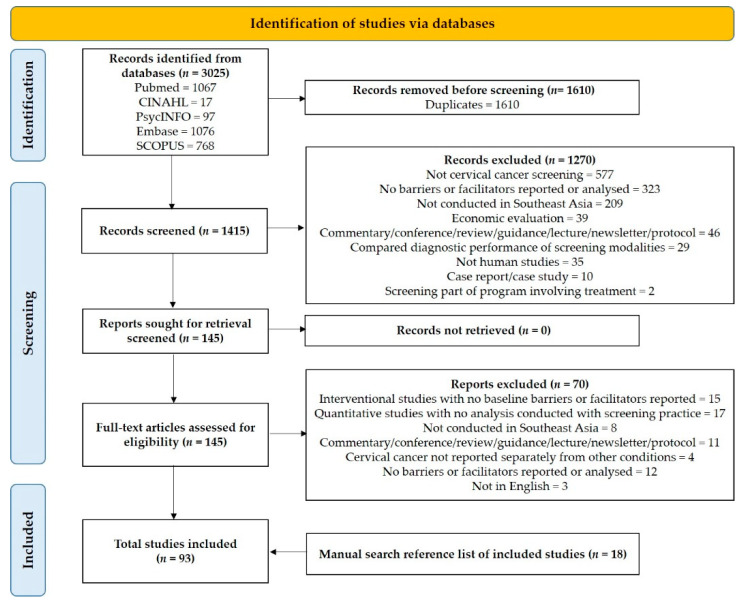
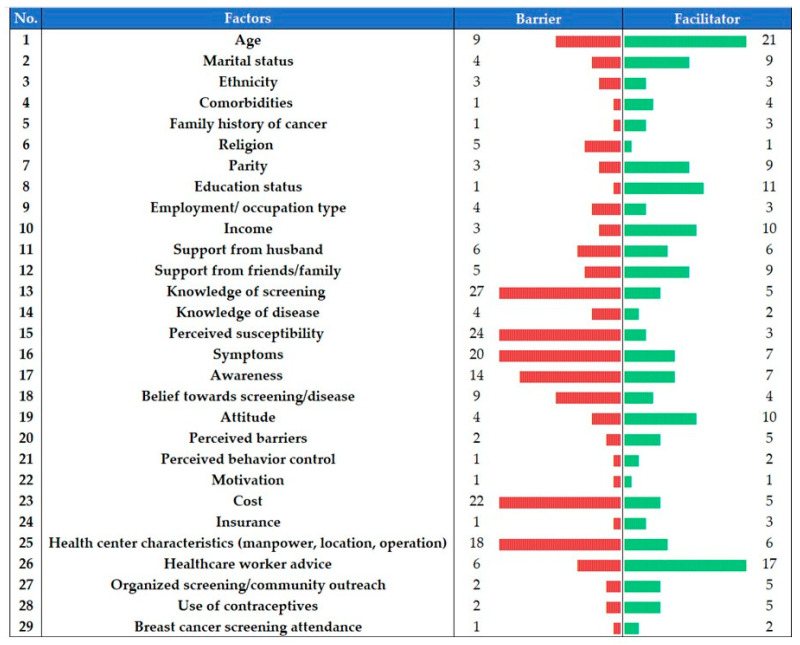
In Southeast Asia, cervical cancer is the second most common cancer in women. Low coverage for cervical cancer screening (CCS) becomes a roadblock to disease detection and treatment. Existing reviews on CCS have limited insights into the barriers and facilitators for SEA. Hence, this study aims to identify key barriers and facilitators among women living in SEA. A systematic literature review was conducted on Pubmed, Embase, PsycINFO, CINAHL, and SCOPUS. Primary qualitative and quantitative studies published in English that reported barriers and facilitators to CCS were included. The Mix Methods Appraisal Tool was used for the quality assessment of the included studies. Among the 93 included studies, pap smears (73.1%) were the most common screening modality. A majority of the studies were from Malaysia (35.5%). No studies were from Timor-Leste and the Philippines. The most common barriers were embarrassment (number of articles, = 33), time constraints ( = 27), and poor knowledge of screening ( = 27). The most common facilitators were related to age ( = 21), receiving advice from healthcare workers ( = 17), and education status ( = 11). Findings from this review may inform health policy makers in developing effective cervical cancer screening programs in SEA countries.
在东南亚,宫颈癌是女性中第二大常见癌症。宫颈癌筛查(CCS)的覆盖率低成为了疾病检测和治疗的障碍。现有的 CCS 综述对东南亚的障碍和促进因素的了解有限。因此,本研究旨在确定生活在东南亚的女性中 CCS 的主要障碍和促进因素。我们在 Pubmed、Embase、PsycINFO、CINAHL 和 SCOPUS 上进行了系统的文献综述。纳入了以英文发表的报告 CCS 障碍和促进因素的定性和定量的原始研究。采用混合方法评估工具对纳入研究进行质量评估。在 93 项纳入研究中,巴氏涂片检查(73.1%)是最常见的筛查方法。大多数研究来自马来西亚(35.5%)。没有来自东帝汶和菲律宾的研究。最常见的障碍是尴尬(文章数量, = 33)、时间限制( = 27)和对筛查的了解不足( = 27)。最常见的促进因素与年龄有关( = 21)、接受医护人员的建议( = 17)和教育程度( = 11)。本综述的结果可能为东南亚国家制定有效的宫颈癌筛查计划提供信息。