Jualaong Suthep, Kanghae Hirun, Thongprajukaew Karun, Saekhow Suktianchai, Amartiratana Natthida, Sotong Piyanan
Marine and Coastal Resources Research Center, The Eastern Upper Gulf of Thailand, Rayong 21170, Thailand.
Phuket Marine Biological Center, Phuket 83000, Thailand.
Animals (Basel). 2021 Apr 26;11(5):1252. doi: 10.3390/ani11051252.
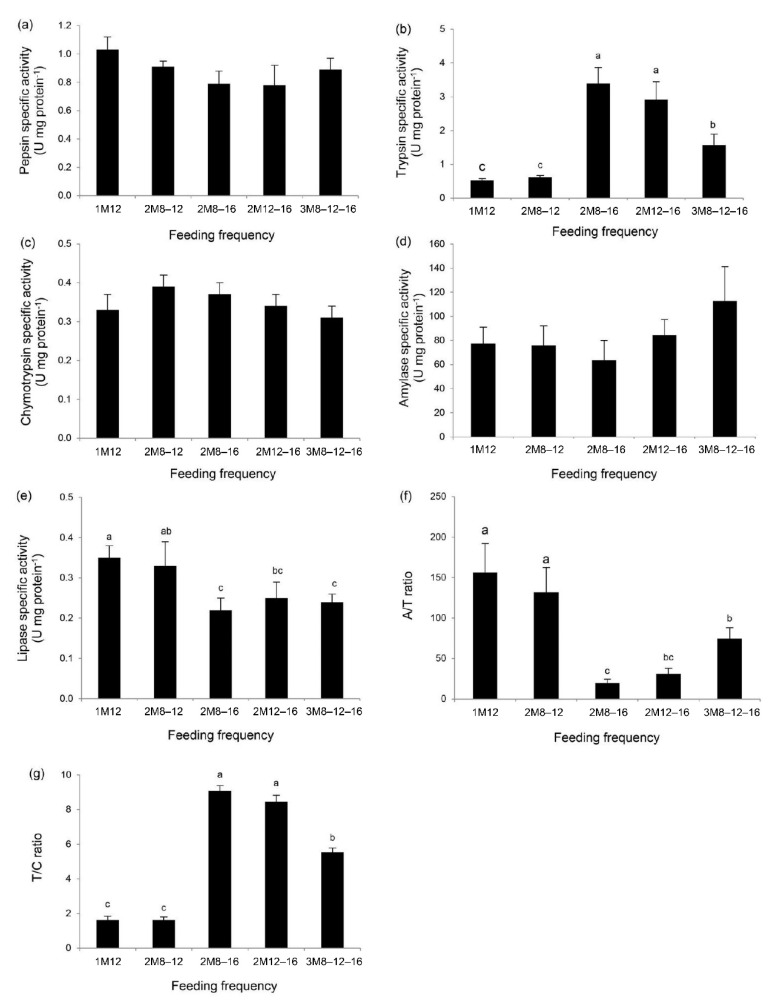
Hawksbill sea turtle () has been reared in head-starting captivity programs, while the feeding regimens have never been optimized. In the current study, the feeding frequency of hawksbill sea turtle was investigated in indoor experimental conditions. Two-month-old turtles (38.98 ± 0.02 g) were distributed to triplicates of five treatments containing three turtles each and they were fed at different frequencies: one meal daily at 12.00 h (1M12), two meals daily at 08.00 and 12.00 h (2M8-12), two meals daily at 08.00 and 16.00 h (2M8-16), two meals daily at 12.00 and 16.00 h (2M12-16), or three meals daily at 08.00, 12.00 and 16.00 h (3M8-12-16). At the end of an 8-week trial, growth performance (specific growth rate 2.39 ± 0.02% body weight day) and feed consumption (feeding rate 2.00 ± 0.43 g day) were highest for turtles fed 2M8-16, followed by 2M12-16 or 3M8-12-16 relative to the other treatments ( ˂ 0.05). These treatments had significantly higher trypsin specific activity and trypsin/chymotrypsin ratio, and for lipase specific activity and amylase/trypsin ratio, relative to the remaining treatments. These match well with the fecal thermal properties that indicate amounts of available and unavailable nutrients present in the feces. Hematological parameters and carapace elemental composition showed no negative effects to turtles in 2M8-16 treatment. Therefore, two meals daily with long time interval were optimal for feeding hawksbill sea turtle. Findings from the current study could be directly used as a feeding guideline supporting the head-starting programs of this species.
玳瑁海龟()已在圈养育幼项目中饲养,但喂养方案从未得到优化。在当前研究中,在室内实验条件下对玳瑁海龟的喂食频率进行了调查。将两个月大的海龟(38.98±0.02克)分配到五个处理组的重复组中,每个处理组有三只海龟,它们以不同频率喂食:每天12.00时一餐(1M12)、每天08.00和12.00时两餐(2M8 - 12)、每天08.00和16.00时两餐(2M8 - 16)、每天12.00和16.00时两餐(2M12 - 16)或每天08.00、12.00和16.00时三餐(3M8 - 12 - 16)。在为期8周的试验结束时,相对于其他处理组,2M8 - 16组海龟的生长性能(特定生长率为体重的2.39±0.02%/天)和饲料消耗(摄食率为2.00±0.43克/天)最高(<0.05)。相对于其余处理组,这些处理组的胰蛋白酶比活性和胰蛋白酶/糜蛋白酶比值显著更高,脂肪酶比活性和淀粉酶/胰蛋白酶比值也更高。这些与粪便热特性相匹配,粪便热特性表明粪便中可利用和不可利用营养物质的含量。血液学参数和背甲元素组成对2M8 - 16处理组的海龟没有负面影响。因此,每天两餐且间隔时间长是喂养玳瑁海龟的最佳方式。当前研究的结果可直接用作支持该物种圈养育幼项目的喂养指南。