Dahlen Sara, Connolly Dean, Arif Isra, Junejo Muhammad Hyder, Bewley Susan, Meads Catherine
Department of Global Health & Social Medicine, King's College London, London, UK.
Barts Health NHS Trust, London, UK.
BMJ Open. 2021 Apr 29;11(4):e048943. doi: 10.1136/bmjopen-2021-048943.
To identify and critically appraise published clinical practice guidelines (CPGs) regarding healthcare of gender minority/trans people.
Systematic review and quality appraisal using AGREE II (Appraisal of Guidelines for Research and Evaluation tool), including stakeholder domain prioritisation.
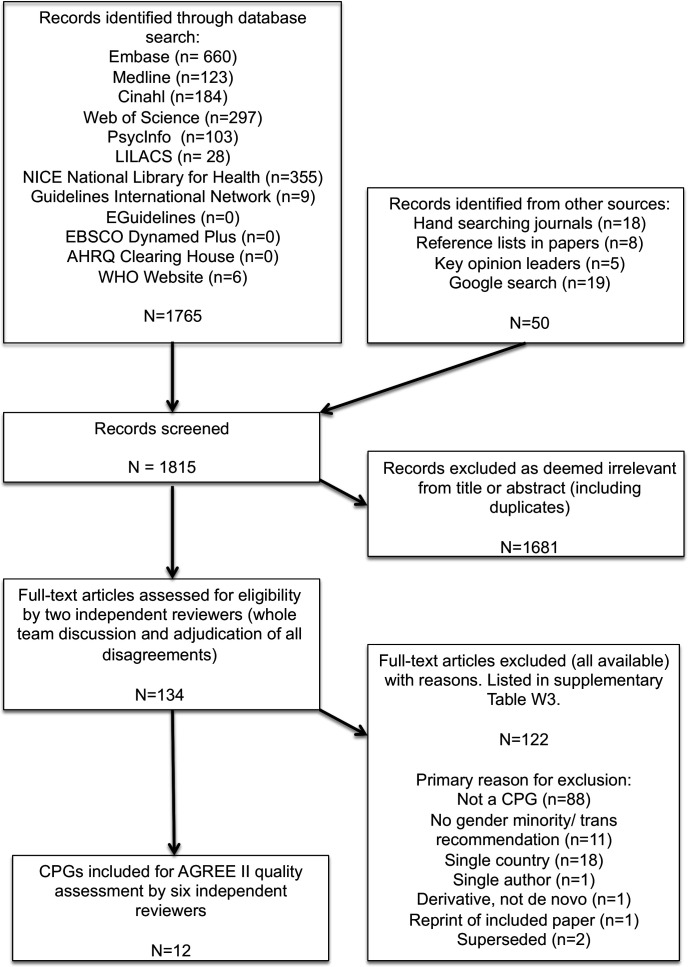
Six databases and six CPG websites were searched, and international key opinion leaders approached.
CPGs relating to adults and/or children who are gender minority/trans with no exclusions due to comorbidities, except differences in sex development.
Any health-related intervention connected to the care of gender minority/trans people.
Number and quality of international CPGs addressing the health of gender minority/trans people, information on estimated changes in mortality or quality of life (QoL), consistency of recommended interventions across CPGs, and appraisal of key messages for patients.
Twelve international CPGs address gender minority/trans people's healthcare as complete (n=5), partial (n=4) or marginal (n=3) focus of guidance. The quality scores have a wide range and heterogeneity whichever AGREE II domain is prioritised. Five higher-quality CPGs focus on HIV and other blood-borne infections (overall assessment scores 69%-94%). Six lower-quality CPGs concern transition-specific interventions (overall assessment scores 11%-56%). None deal with primary care, mental health or longer-term medical issues. Sparse information on estimated changes in mortality and QoL is conflicting. Consistency between CPGs could not be examined due to unclear recommendations within the World Professional Association for Transgender Health Standards of Care Version 7 and a lack of overlap between other CPGs. None provide key messages for patients.
A paucity of high-quality guidance for gender minority/trans people exists, largely limited to HIV and transition, but not wider aspects of healthcare, mortality or QoL. Reference to AGREE II, use of systematic reviews, independent external review, stakeholder participation and patient facing material might improve future CPG quality.
CRD42019154361.
识别并严格评估已发表的关于性少数群体/跨性别者医疗保健的临床实践指南(CPG)。
使用AGREE II(研究与评估指南评估工具)进行系统评价和质量评估,包括利益相关者领域优先级排序。
检索了六个数据库和六个CPG网站,并联系了国际关键意见领袖。
与性少数群体/跨性别成年人和/或儿童相关的CPG,除性发育差异外,不排除合并症患者。
任何与性少数群体/跨性别者护理相关的健康干预措施。
涉及性少数群体/跨性别者健康的国际CPG的数量和质量、死亡率或生活质量(QoL)估计变化的信息、CPG之间推荐干预措施的一致性,以及对患者关键信息的评估。
十二份国际CPG将性少数群体/跨性别者的医疗保健作为完整(n = 5)、部分(n = 4)或边缘(n = 3)的指导重点。无论优先考虑AGREE II的哪个领域,质量得分范围都很广且存在异质性。五份质量较高的CPG关注艾滋病毒和其他血源感染(总体评估得分69%-94%)。六份质量较低的CPG涉及特定的过渡干预措施(总体评估得分11%-56%)。没有一份涉及初级保健、心理健康或长期医疗问题。关于死亡率和QoL估计变化的信息稀少且相互矛盾。由于世界跨性别健康专业协会《护理标准》第7版中的建议不明确,且其他CPG之间缺乏重叠,因此无法检查CPG之间的一致性。没有一份为患者提供关键信息。
针对性少数群体/跨性别者的高质量指南匮乏,主要限于艾滋病毒和过渡方面,而非更广泛的医疗保健、死亡率或QoL方面。参考AGREE II、使用系统评价、独立外部审查、利益相关者参与和面向患者的材料可能会提高未来CPG的质量。
PROSPERO注册号:CRD42019154361。