Center of Innovation for Complex Chronic Healthcare, Edward Hines, Jr. VA Hospital, Hines, IL 60141, USA.
Jesse Brown VA Medical Center, Chicago, IL 60612, USA.
J Public Health (Oxf). 2022 Mar 7;44(1):207-213. doi: 10.1093/pubmed/fdab062.
The United States Department of Veterans Affairs established a program in which actors incognito portray veterans experiencing homelessness with pre-determined needs to identify barriers to access and services at community-based organizations.
From 2017 to 2019, actors who varied in gender, skin color and age portrayed one of three scripts at all VA Community-Based Resource and Referral Centers (CRRCs) serving veterans experiencing homelessness in 30 cities and completed an evaluative survey. They carried authentic VA identification and were registered in a VA patient database for each identity. CRRCs were provided with reports annually and asked to implement corrective plans. Data from the survey were analysed for change over time.
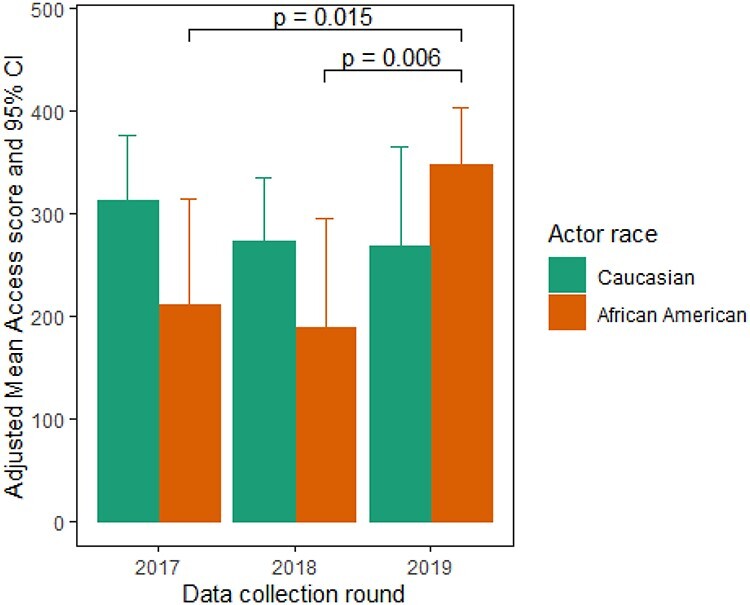
Access to food, counselling, PTSD treatment, and hypertension/prediabetes care services increased significantly from 68-77% in year 2 to 83-97% in year 3 (each P < 0.05 adjusted for script present). A significant disparity in access for African American actors resolved following more uniform adherence to pre-existing policies.
The 'unannounced standardized veteran' (USV) can identify previously unrecognized barriers to needed services and care. Audit and feedback programs based on direct covert observation with systematic data collection and rapid feedback may be an effective strategy for improving services to highly vulnerable populations.
美国退伍军人事务部设立了一个计划,让演员匿名扮演有预先确定需求的无家可归退伍军人,以确定在社区组织中获得服务和服务的障碍。
2017 年至 2019 年,演员们在 30 个城市的所有退伍军人事务部社区资源和转介中心(CRRC)中扮演三个脚本中的一个,他们的性别、肤色和年龄各不相同,并完成了评估调查。他们携带真实的 VA 身份证明,并在每个身份下在 VA 患者数据库中注册。每年向 CRRCs 提供报告,并要求他们实施纠正计划。对调查数据进行了分析,以了解随时间的变化。
从 2017 年到 2019 年,获得食物、咨询、创伤后应激障碍治疗和高血压/糖尿病前期护理服务的机会显著增加,从 68-77%增加到 83-97%(每个 P<0.05 调整后的脚本存在)。在遵循预先存在的政策更加一致之后,解决了非裔美国演员在获得服务方面的显著差距。
“未宣布的标准化退伍军人”(USV)可以确定以前未被认识到的对所需服务和护理的障碍。基于直接隐蔽观察、系统数据收集和快速反馈的审计和反馈计划可能是改善高度脆弱人群服务的有效策略。