Department of Oncology, The Second Affiliated Hospital of Nanchang University, Nanchang University, No.1 Minde Street, Nanchang, 330000, Jiangxi Province, People's Republic of China.
Jiangxi Key Laboratory of Clinical Translational Cancer Research, Nanchang, Jiangxi Province, 330000, People's Republic of China.
BMC Cancer. 2021 Apr 30;21(1):482. doi: 10.1186/s12885-021-08228-2.
This retrospective study aimed to evaluate the efficacy of epidermal growth factor receptor (EGFR) tyrosine kinase inhibitors (TKIs) with stereotactic body radiation therapy (SBRT) and to elucidate potential mechanisms of acquired resistance.
Patients with advanced NSCLC harboring positive EGFR mutations after initial TKI therapy for at least 8 weeks were eligible for SBRT between August 2016 and August 2019. Eligible patients were treated with thoracic SBRT, and TKI was continued after SBRT until it was considered ineffective. The control group was treated with TKIs monotherapy. Propensity score matching (PSM, ratio of 1:2) was used to account for differences in baseline characteristics. Overall survival (OS), progression-free survival (PFS), treatment safety and resistance mechanisms were evaluated.
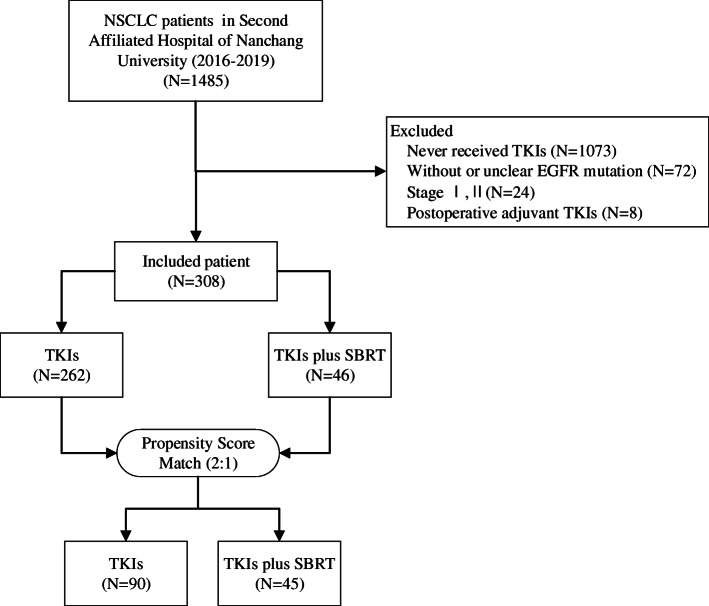
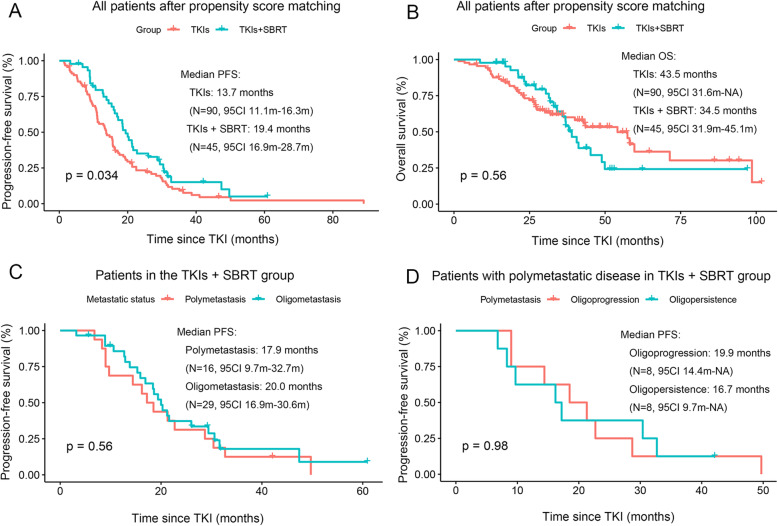
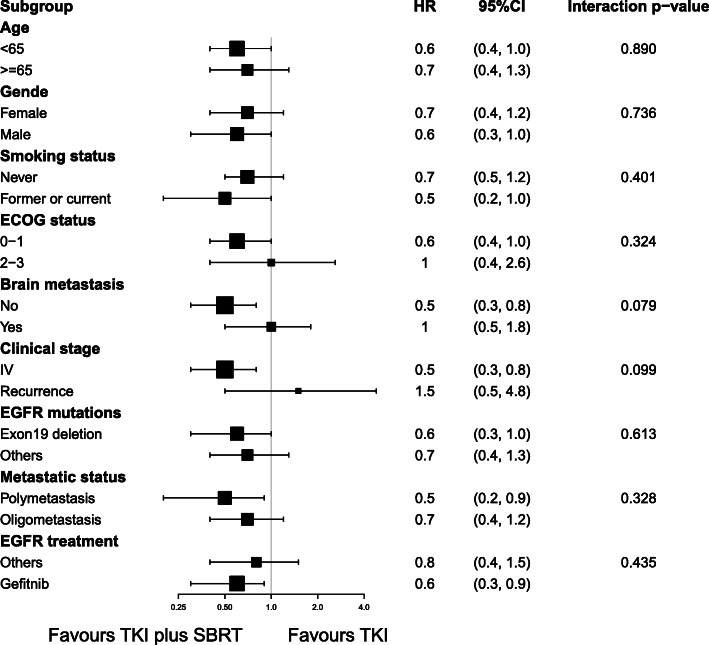
Three hundred eight patients were included in the study population. Among them, 262 patients received TKIs alone, and 46 patients received TKIs with SBRT. Baseline characteristics were not significantly different between the two cohorts after PSM. The median PFS was 19.4 months in the TKIs +SBRT group compared to 13.7 months in the TKIs group (p = 0.034). An influence on OS has not yet been shown (p = 0.557). Of the 135 patients evaluated after PSM, 28 and 71 patients in the TKIs and TKIs +SBRT cohorts, respectively, had plasma cell-free DNA (cfDNA) next-generation sequencing (NGS) performed at baseline and disease progression. In the TKIs +SBRT cohort, the NGS results showed that T790M mutations were detected in 64.3% (18/28) of patients. Patients in the TKIs cohort exhibited fewer T790M-positive mutations (40.8%, p = 0.035) compared to patients in the TKIs +SBRT cohort.
Real world data prove that TKIs plus thoracic SBRT significantly extend PFS with tolerable toxicity. The mutation ratio of T790M was increased in the TKIs +SBRT group compared to the TKIs only group. Further randomized studies are warranted.
本回顾性研究旨在评估表皮生长因子受体(EGFR)酪氨酸激酶抑制剂(TKI)联合立体定向体部放疗(SBRT)的疗效,并阐明获得性耐药的潜在机制。
对初始 TKI 治疗至少 8 周后出现 EGFR 阳性突变的晚期 NSCLC 患者,有资格在 2016 年 8 月至 2019 年 8 月期间接受 SBRT。符合条件的患者接受胸部 SBRT,SBRT 后继续使用 TKI,直到认为无效。对照组仅接受 TKI 治疗。采用倾向评分匹配(PSM,1:2 比例)来解释基线特征的差异。评估总生存期(OS)、无进展生存期(PFS)、治疗安全性和耐药机制。
共有 308 例患者纳入研究人群。其中,262 例患者单独接受 TKI 治疗,46 例患者接受 TKI 联合 SBRT。PSM 后两组患者的基线特征无显著差异。TKI+SBRT 组的中位 PFS 为 19.4 个月,而 TKI 组为 13.7 个月(p=0.034)。尚未显示对 OS 的影响(p=0.557)。在 PSM 后评估的 135 例患者中,TKI 组和 TKI+SBRT 组分别有 28 例和 71 例患者在基线和疾病进展时进行了血浆无细胞 DNA(cfDNA)下一代测序(NGS)。在 TKI+SBRT 组中,NGS 结果显示 64.3%(18/28)的患者检测到 T790M 突变。与 TKI+SBRT 组相比,TKI 组的 T790M 阳性突变较少(40.8%,p=0.035)。
真实世界数据证明,TKI 联合胸部 SBRT 可显著延长 PFS,且毒性可耐受。与 TKI 单药组相比,TKI+SBRT 组 T790M 的突变率增加。需要进一步进行随机研究。