Research Center for Translational Medicine, Shanghai East Hospital, School of Medicine, Tongji University, Shanghai, 200092, China.
Key Laboratory of Spine and Spinal Cord Injury Repair and Regeneration of Ministry of Education, Stem Cell Translational Research Center of Tongji Hospital, School of Life Science and Technology, Tongji University, 389 Xincun Road, Shanghai, 200065, China.
Stem Cell Res Ther. 2021 May 1;12(1):257. doi: 10.1186/s13287-021-02287-9.
Cutaneous wound healing and regeneration have become a recognized health challenge in the world, which causes severe damage to the mental and physical health of patients. Human adipose-derived mesenchymal stem cells (hADSC) play an essential role in wound healing via their paracrine function. Exosomes secreted by hADSC may contribute to this progress. In this study, we investigated the potential clinical application roles of hADSC and hADSC-derived exosomes (hADSC-Exo) in cutaneous wound healing.
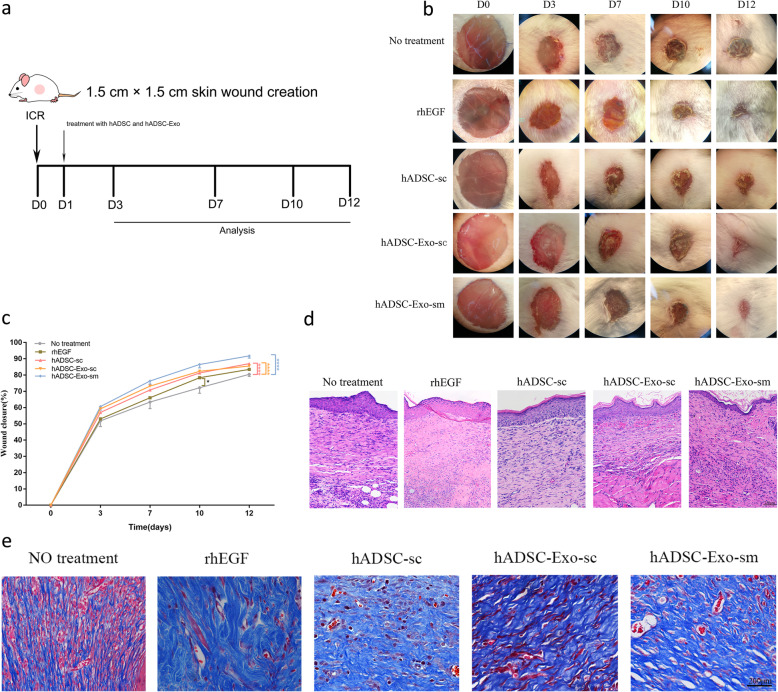
hADSC-Exo was isolated from human hADSC by ultracentrifugation. Mice were subjected to a full-thickness skin biopsy experiment and treated with either control vehicle or hADSC or hADSC-Exo by smearing administration (sm) or subcutaneous administration (sc) or intravenous administration (iv). The efficacy of hADSC and hADSC-Exo on wound healing was evaluated by measuring wound closure rates, histological analysis.
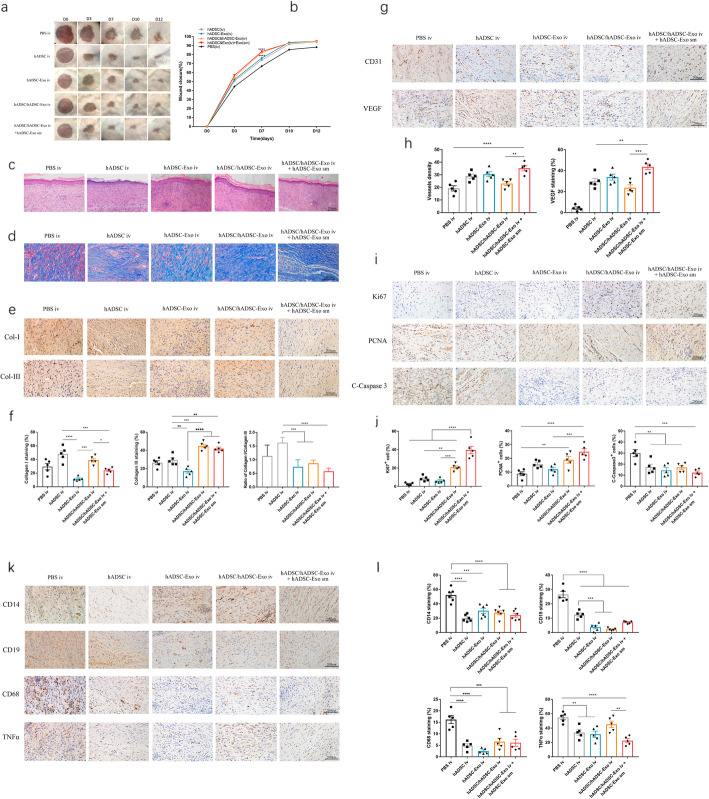
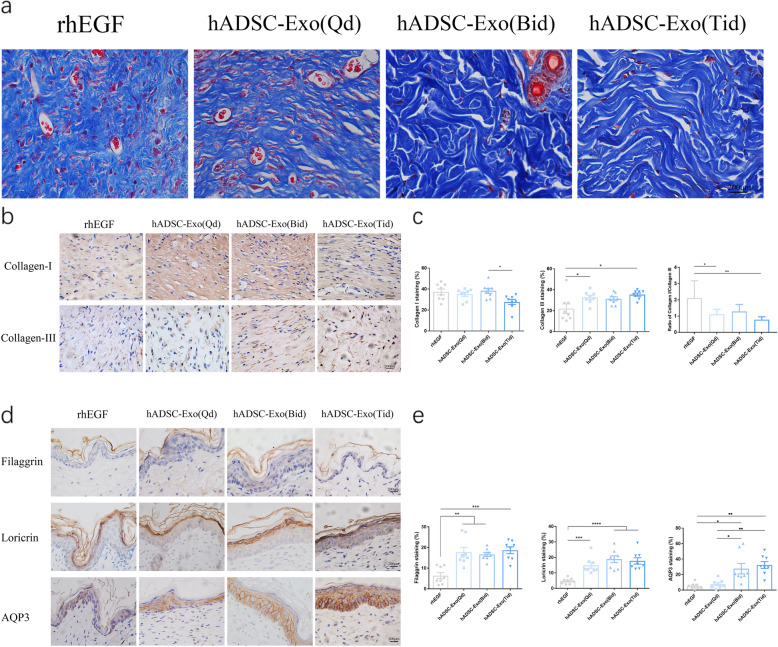
Combined application of local hADSC-Exo smearing and hADSC/hADSC-Exo intravenous administration offered the additional benefit of promoting wound healing, accelerating re-epithelialization, reducing scar widths, and enhancing angiogenesis and collagen synthesis. Either topical application of hADSC-Exo or systemic administration with hADSC/hADSC-Exo appeared more effective in stimulating cell proliferation, inhibiting cell apoptosis and inflammation, and promoting skin elasticity and barrier integrity, with increased genes expression of PCNA, VEGF, collagen III, Filaggrin, Loricrin, and AQP3, with decreased genes expression of TNF-alpha.
Our findings suggest that the combined administration of hADSC/hADSC-Exo can facilitate cutaneous wound healing and reduce scar formation. These data provide the first evidence for the feasibility of smearing of hADSC-Exo as a cell-free therapy in treating cutaneous wounds, and the potential clinical value of combined administration of hADSC/hADSC-Exo.
皮肤伤口愈合和再生已成为世界范围内公认的健康挑战,这对患者的身心健康造成严重损害。人脂肪间充质干细胞(hADSC)通过旁分泌作用在伤口愈合中发挥重要作用。hADSC 分泌的外泌体可能有助于这一进展。在这项研究中,我们研究了 hADSC 和 hADSC 衍生的外泌体(hADSC-Exo)在皮肤伤口愈合中的潜在临床应用作用。
通过超速离心从人 hADSC 中分离 hADSC-Exo。通过涂抹给药(sm)或皮下给药(sc)或静脉内给药(iv),将 hADSC 或 hADSC-Exo 或对照载体施用于小鼠全层皮肤活检实验。通过测量伤口闭合率和组织学分析来评估 hADSC 和 hADSC-Exo 对伤口愈合的疗效。
局部 hADSC-Exo 涂抹联合 hADSC/hADSC-Exo 静脉内给药的联合应用具有促进伤口愈合、加速再上皮化、减少疤痕宽度以及增强血管生成和胶原合成的额外益处。局部应用 hADSC-Exo 或全身给予 hADSC/hADSC-Exo 似乎更有效地刺激细胞增殖、抑制细胞凋亡和炎症,并促进皮肤弹性和屏障完整性,增加 PCNA、VEGF、胶原 III、Filaggrin、Loricrin 和 AQP3 的基因表达,降低 TNF-α的基因表达。
我们的研究结果表明,hADSC/hADSC-Exo 的联合给药可以促进皮肤伤口愈合并减少疤痕形成。这些数据为 hADSC-Exo 作为一种无细胞治疗在治疗皮肤伤口中的可行性提供了第一个证据,并为 hADSC/hADSC-Exo 的联合给药提供了潜在的临床价值。