Pike Hanne, Eilevstjønn Joar, Bjorland Peder, Linde Jørgen, Ersdal Hege, Rettedal Siren
Department of Paediatrics, Stavanger University Hospital, Post Box 8100, 4068, Stavanger, Norway.
Department of Research, Laerdal Medical, Stavanger, Norway.
BMC Res Notes. 2021 May 1;14(1):166. doi: 10.1186/s13104-021-05576-x.
To compare the accuracy of heart rate detection properties of a novel, wireless, dry-electrode electrocardiogram (ECG) device, NeoBeat®, to that of a conventional 3-lead gel-electrode ECG monitor (PropaqM®) in newborns.
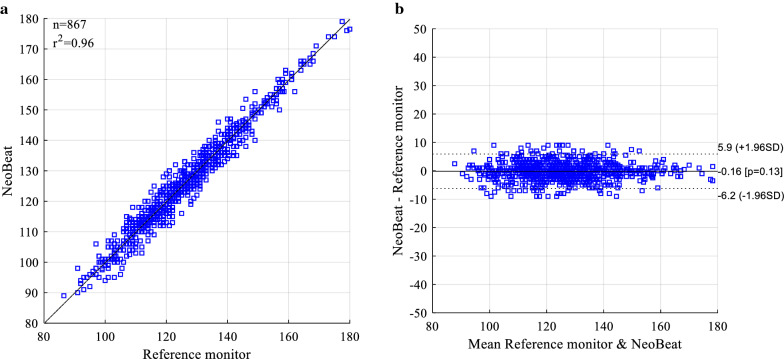
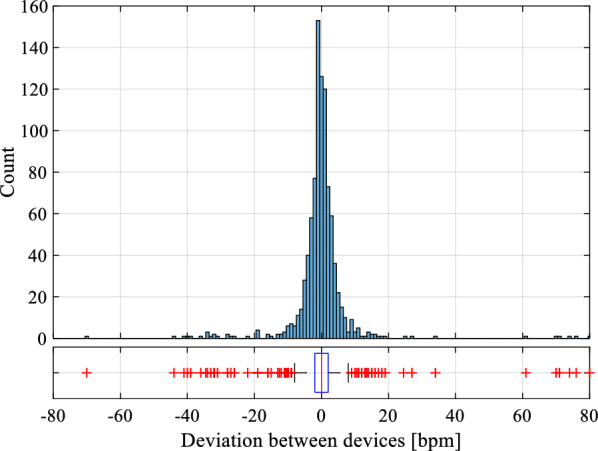
The study population had a mean gestational age of 39 weeks and 2 days (1.5 weeks) and birth weight 3528 g (668 g). There were 950 heart rate notations from each device, but heart rate was absent from the reference monitor in 14 of these data points, leaving 936 data pairs to compare. The mean (SD) difference when comparing NeoBeat to the reference monitor was -0.25 (9.91) beats per minute (bpm) (p = 0.44). There was a deviation of more than 10 bpm in 7.4% of the data pairs, which primarily (78%) was attributed to ECG signal disturbance, and secondly (22%) due to algorithm differences between the devices. Excluding these outliers, the correlation was equally consistent (r = 0.96) in the full range of heart rate captured measurements with a mean difference of - 0.16 (3.09) bpm. The mean difference was less than 1 bpm regardless of whether outliers were included or not.
比较一种新型无线干电极心电图(ECG)设备NeoBeat®与传统三导联凝胶电极ECG监护仪PropaqM®在新生儿心率检测特性方面的准确性。
研究人群的平均胎龄为39周零2天(1.5周),出生体重为3528克(668克)。每个设备记录了950次心率,但在这些数据点中有14个数据点的参考监护仪未记录到心率,因此留下936对数据进行比较。将NeoBeat与参考监护仪进行比较时,平均(标准差)差异为每分钟-0.25(9.91)次心跳(bpm)(p = 0.44)。在7.4%的数据对中,偏差超过10 bpm,其中主要(78%)归因于ECG信号干扰,其次(22%)是由于设备之间的算法差异。排除这些异常值后,在整个心率测量范围内,相关性同样一致(r = 0.96),平均差异为-0.16(3.09)bpm。无论是否包括异常值,平均差异均小于1 bpm。