Department of Laboratory Medicine and Pathology, University of California, Irvine, D440 Medical Sciences, Irvine, California, USA.
Department of Laboratory Medicine and Pathology, University of California, Irvine, D440 Medical Sciences, Irvine, California, USA.
J Biol Chem. 2021 Jan-Jun;296:100732. doi: 10.1016/j.jbc.2021.100732. Epub 2021 Apr 30.
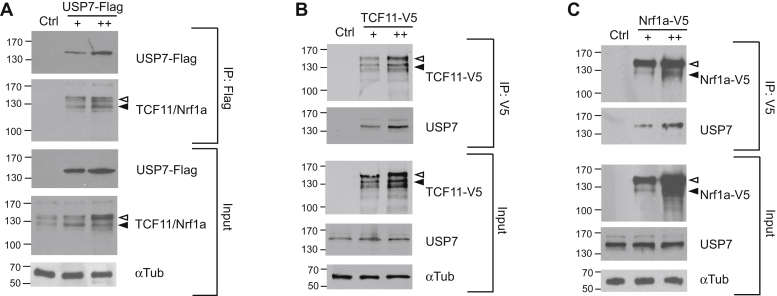
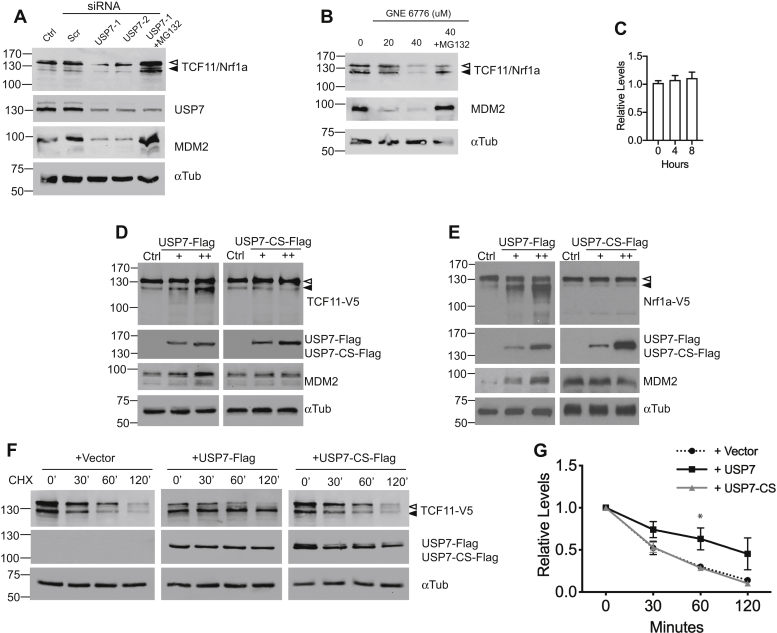
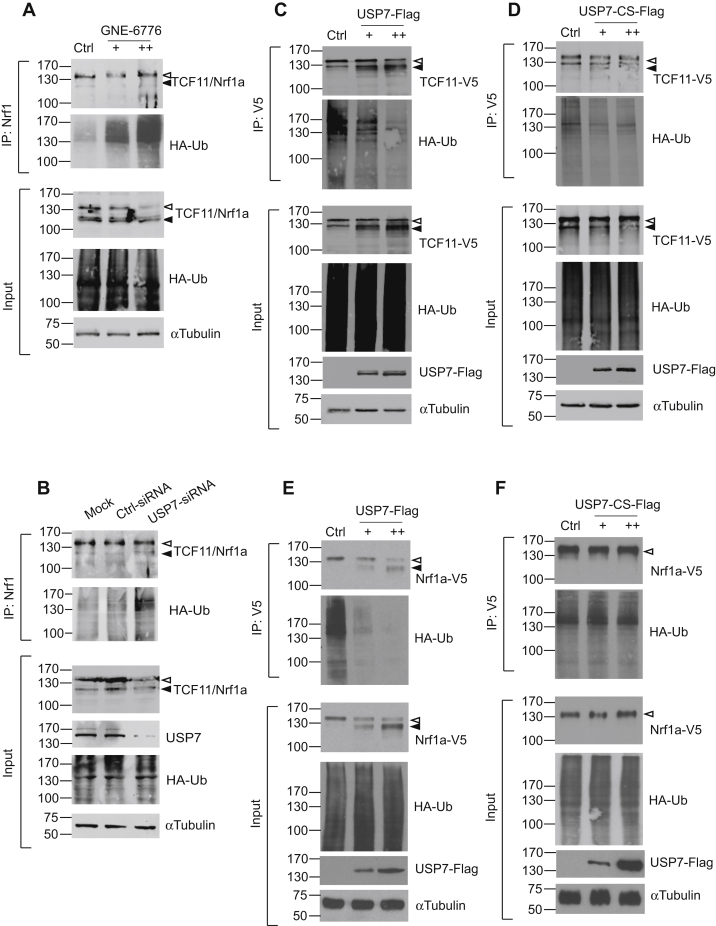
The nuclear factor E2-related factor 1 (Nrf1) transcription factor performs a critical role in regulating cellular homeostasis as part of the cellular stress response and drives the expression of antioxidants and detoxification enzymes among many other functions. Ubiquitination plays an important role in controlling the abundance and thus nuclear accumulation of Nrf1 proteins, but the regulatory enzymes that act on Nrf1 are not fully defined. Here, we identified ubiquitin specific protease 7 (USP7), a deubiquitinating enzyme, as a novel regulator of Nrf1 activity. We found that USP7 interacts with Nrf1a and TCF11-the two long protein isoforms of Nrf1. Expression of wildtype USP7, but not its catalytically defective mutant, resulted in decreased ubiquitination of TCF11 and Nrf1a, leading to their increased stability and increased transactivation of reporter gene expression by TCF11 and Nrf1a. In contrast, knockdown or pharmacologic inhibition of USP7 dramatically increased ubiquitination of TCF11 and Nrf1a and reduction of their steady state levels. Loss of USP7 function attenuated the induction of Nrf1 protein expression in response to treatment with arsenic and other toxic metals, and inhibition of USP7 activity significantly sensitized cells to arsenic treatment. Collectively, these findings suggest that USP7 may act to modulate abundance of Nrf1 protein to induce gene expression in response to toxic metal exposure.
核因子 E2 相关因子 1(Nrf1)转录因子作为细胞应激反应的一部分,在调节细胞内稳态方面发挥着关键作用,并驱动抗氧化剂和解毒酶等多种功能的表达。泛素化在控制 Nrf1 蛋白的丰度和因此核积累方面起着重要作用,但作用于 Nrf1 的调节酶尚未完全定义。在这里,我们确定了泛素特异性蛋白酶 7(USP7),一种去泛素化酶,是 Nrf1 活性的新型调节剂。我们发现 USP7 与 Nrf1a 和 TCF11(Nrf1 的两种长蛋白同工型)相互作用。野生型 USP7 的表达,但不是其催化缺陷突变体,导致 TCF11 和 Nrf1a 的泛素化减少,导致其稳定性增加,并增加 TCF11 和 Nrf1a 的报告基因表达的转录激活。相比之下,USP7 的敲低或药理学抑制显着增加了 TCF11 和 Nrf1a 的泛素化,并减少了它们的稳定状态水平。USP7 功能的丧失减弱了砷和其他有毒金属处理后 Nrf1 蛋白表达的诱导,并且 USP7 活性的抑制显着使细胞对砷处理敏感。总之,这些发现表明 USP7 可能通过调节 Nrf1 蛋白的丰度来发挥作用,以响应有毒金属暴露诱导基因表达。