School of Nursing, Shandong University of Traditional Chinese Medicine, Jinan, China.
Department of Information Engineering, Shandong Labor Vocational and Technical College, Jinan, China.
Nurse Educ Today. 2021 Jul;102:104938. doi: 10.1016/j.nedt.2021.104938. Epub 2021 Apr 26.
Almost all universities have been forced to close and change to online teaching during the COVID-19 pandemic, which has been a big challenge for students. There is little knowledge about the academic burnout among nursing students in these difficult circumstances, especially in traditional Chinese medicine universities, and the relationship between the burnout and their psychological capital and academic engagement.
The aim is to describe academic burnout and clarify the relationships between academic burnout, academic engagement, and psychological capital among nursing students in traditional Chinese medicine universities.
This is a cross-sectional, descriptive study.
The study sampled a four-year undergraduate traditional Chinese medicine university in Jian, Shandong Province, China.
A convenience sampling method was used to select 733 nursing students from April to June 2020.
The Academic Burnout Scale, the Positive Psychological Capital Scale, and the Academic Engagement Scale were used for data collection, in addition to social-demographic data. Path analysis was used to clarify the relationships among academic burnout, academic engagement and psychological capital.
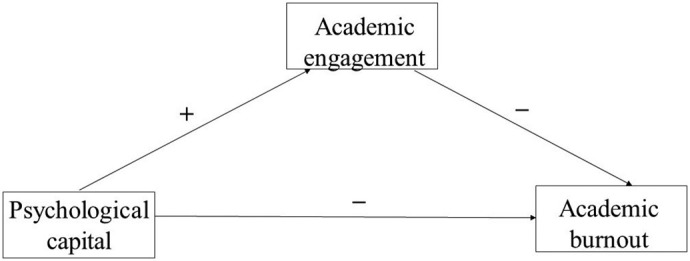
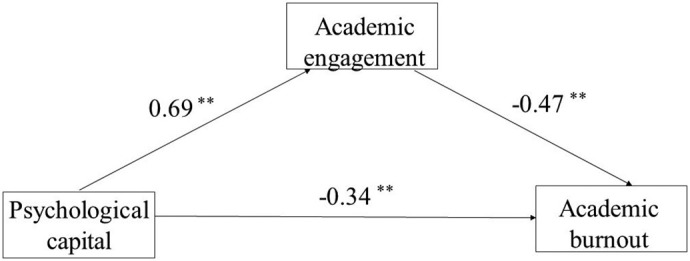
Of all the study participants, 39.29% had a certain degree of academic burnout. Academic engagement and psychological capital were negatively correlated with academic burnout among nursing students in traditional Chinese medicine university. Psychological capital was positively correlated with academic engagement.
Nursing students had a certain degree of academic burnout. Academic engagement played a partial mediated role in the relationship between psychological capital and academic burnout.
在 COVID-19 大流行期间,几乎所有大学都被迫关闭并改为在线教学,这对学生来说是一个巨大的挑战。在这种困难的情况下,很少有关于护理学生学业倦怠的知识,尤其是在中医药大学,也很少有关于倦怠与他们的心理资本和学业投入之间关系的知识。
旨在描述中医药大学护理学生的学业倦怠情况,并阐明学业倦怠、学业投入与心理资本之间的关系。
这是一项横断面、描述性研究。
本研究在山东省济南市的一所四年制本科中医药大学进行。
采用便利抽样法,于 2020 年 4 月至 6 月期间选取 733 名护理专业学生。
使用学业倦怠量表、积极心理资本量表和学业投入量表收集数据,此外还收集了社会人口学数据。采用路径分析厘清学业倦怠、学业投入与心理资本之间的关系。
在所调查的学生中,有 39.29%的学生存在一定程度的学业倦怠。中医药大学护理专业学生的学业投入和心理资本与学业倦怠呈负相关,心理资本与学业投入呈正相关。
护理学生存在一定程度的学业倦怠。学业投入在心理资本与学业倦怠之间起着部分中介作用。