Siengsanan-Lamont Jarunee, Douangngeun Bounlom, Theppangna Watthana, Khounsy Syseng, Phommachanh Phouvong, Kamolsiripichaiporn Somjai, Udon Romphruke, Seeyo Kingkarn Boonsuya, Selleck Paul W, Matsumoto Nina, Gleeson Laurence J, Blacksell Stuart D
Maidol-Oxford Tropical Medicine Research Unit, Faculty of Tropical Medicine, Mahidol University, Bangkok, Thailand.
National Animal Health Laboratory, Department of Livestock and Fisheries, Ministry of Agriculture and Forestry, Vientiane, Lao People's Democratic Republic.
Trop Anim Health Prod. 2021 May 2;53(2):303. doi: 10.1007/s11250-021-02734-y.
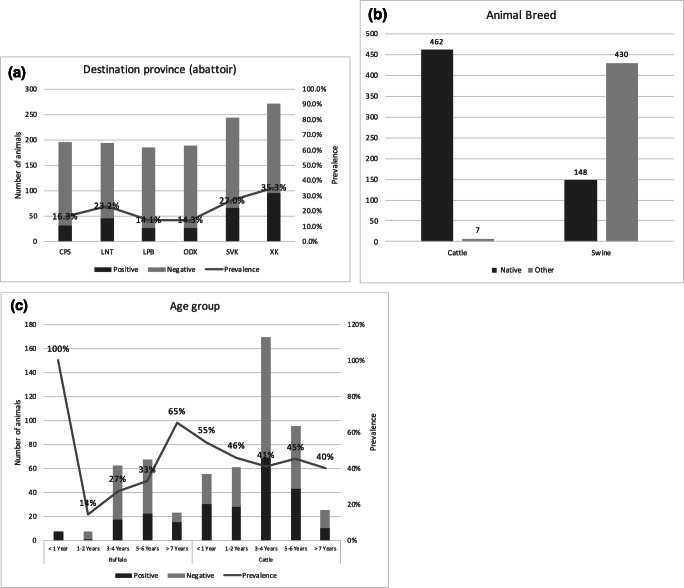
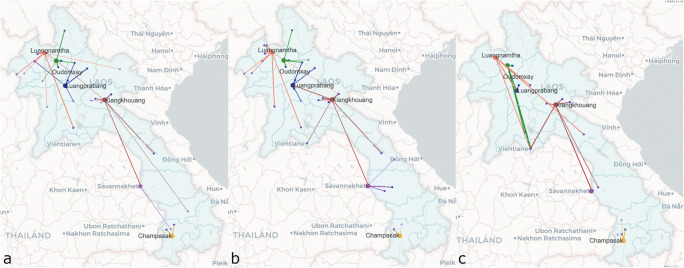
Foot and Mouth Disease (FMD) is a high-impact, contagious transboundary animal disease that is endemic in Southeast Asia. Abattoir samples were routinely collected in six selected provinces between March and December 2019. A total of 1280 samples of abattoir animals were tested for FMD Non-Structural Protein (NSP) antibodies to indicate natural infections. Overall, 22.8% were seropositive for FMD NSP antibodies while seroprevalence of cattle (n = 469), buffalo (n = 214), and pigs (n = 597) were 44.6%, 35.0%, and 1.3%, respectively. The highest seroprevalence destination province was Xiengkhouang (35.3% of 272 samples), followed by Savannakhet (27.0% of 244 samples). Risk factors for evidence of natural infection identified by a multivariate logistic regression model included age groups (p-value = 0.02) and origin provinces (p-value = 2.8 × 10) of the animals. There were significant differences of FMD NSP seroprevalence between age groups and origin provinces of the animals. The odds ratio of a seropositive result in the less than 1 year old group was 2.5 (95% CI; 1.4, 4.4) when compared to the 3-4 years old group, while the odds ratios for animals that originated from Khammouane and Xiengkhouang provinces were 4.5 (95% CI; 1.1, 18.7) and 2.4 (95% CI; 1.4, 4.1), respectively, when compared to Champasak province. Serotype-specific antibody ELISA for 44 NSP antibody-positive samples revealed evidence of FMD serotypes O and A virus circulation in some provinces. Despite the passive abattoir survey providing useful information on FMD virus previous exposure and geographic locations of the animals, timely information on FMD virus circulation and distribution is also crucial to an effective control program. Alternative approaches to increase the cost-effectiveness of the surveillance network are also discussed.
口蹄疫(FMD)是一种具有高影响力的传染性跨界动物疾病,在东南亚地区呈地方性流行。2019年3月至12月期间,在六个选定省份定期采集屠宰场样本。共对1280份屠宰场动物样本进行了口蹄疫非结构蛋白(NSP)抗体检测,以表明自然感染情况。总体而言,22.8%的样本口蹄疫NSP抗体呈血清阳性,而牛(n = 469)、水牛(n = 214)和猪(n = 597)的血清阳性率分别为44.6%、35.0%和1.3%。血清阳性率最高的目标省份是川圹省(272份样本中的35.3%),其次是沙湾拿吉省(244份样本中的27.0%)。通过多变量逻辑回归模型确定的自然感染证据的风险因素包括动物的年龄组(p值 = 0.02)和来源省份(p值 = 2.8 × 10)。动物的年龄组和来源省份之间的口蹄疫NSP血清阳性率存在显著差异。与3 - 4岁组相比,1岁以下组血清阳性结果的优势比为2.5(95%置信区间;1.4,4.4),而与占巴塞省相比,来自甘蒙省和川圹省的动物的优势比分别为4.5(95%置信区间;1.1,18.7)和2.4(95%置信区间;1.4,4.1)。对44份NSP抗体阳性样本进行的血清型特异性抗体ELISA检测显示,在一些省份存在口蹄疫O型和A型病毒传播的证据。尽管屠宰场被动监测提供了有关口蹄疫病毒既往暴露情况和动物地理位置的有用信息,但口蹄疫病毒传播和分布的及时信息对于有效的防控计划也至关重要。还讨论了提高监测网络成本效益的替代方法。