Cantelli Mariateresa, Camela Elisa, Marasca Claudio, Fontanella Giuseppina, Blasio Chiara, Fabbrocini Gabriella
Section of Dermatology, Department of Clinical Medicine and Surgery, University of Naples Federico II, Napoli, Italy.
J Cosmet Dermatol. 2021 Apr;20 Suppl 1(Suppl 1):9-13. doi: 10.1111/jocd.14094.
Stretch marks are linear scars that result from elastic fiber destruction. They usually occur as the consequence of rapid change in the body mass (weight gain and loss, pregnancy, weightlifting), long-term steroid use, or endocrinopathies. Treatment is challenging and mainly based on topical and procedural therapies, although the standard of care is still under debate.
To evaluate the efficacy and tolerance of a topical oil formulation of plant extracts and vitamins on the aesthetic improvement of stretch marks and xerosis.
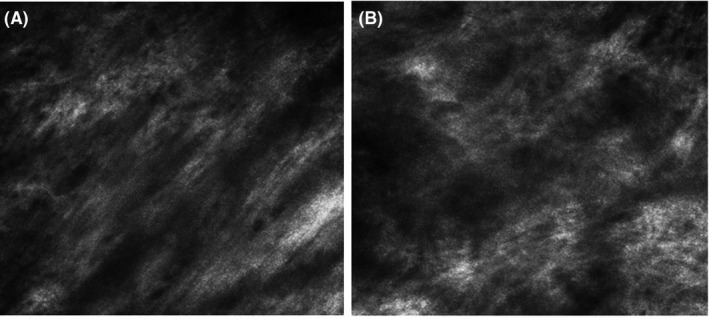
Fifty male and female patients, aged between 14 and 45 years, with stretch marks referring at the University Hospital Federico II, Naples, were enrolled between March and November 2019. Topical application of plant extracts and vitamin-rich oil was performed twice daily on affected skin for 4 months. Patients were monitored at baseline (T0), and at two-month (T1) and 4-month (T2) follow-ups, through clinical and dermoscopic assessment, confocal microscopy, cutaneous ultrasound, MoistureMeterEpiD, and X-Rite spectrocolorimeter. Primary endpoints were as follows: 70% clinical improvement of stretch marks and 3-point decrease in clinical score from baseline to T2. Secondary endpoints were as follows: change in the T0 parallel pattern of collagen fibers at confocal microscopy, cutaneous thickness increase at ultrasounds, cutaneous hydration increase at MoistureMeterEpiD, erythema reduction at X-Rite spectrocolorimeter, and safety and adverse events (AEs).
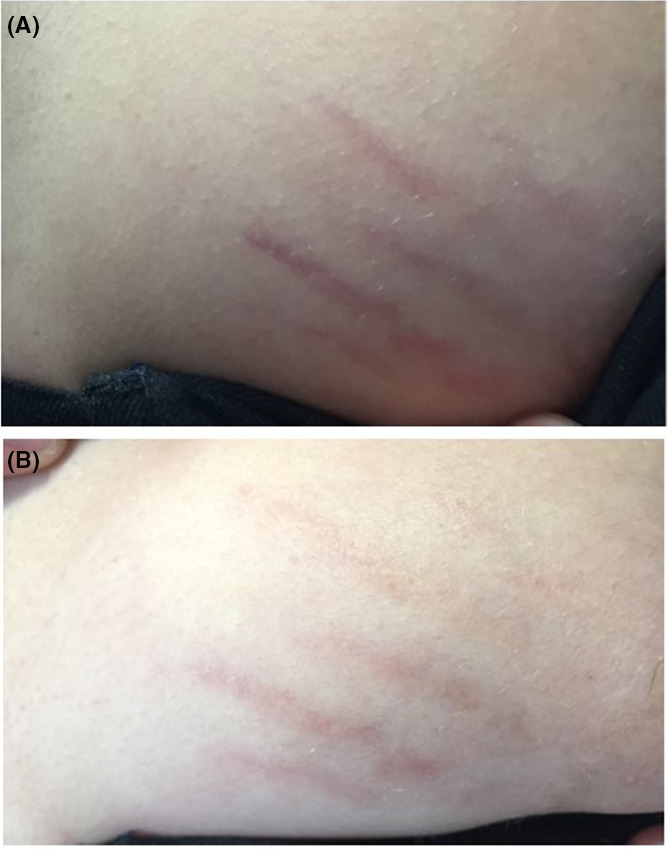
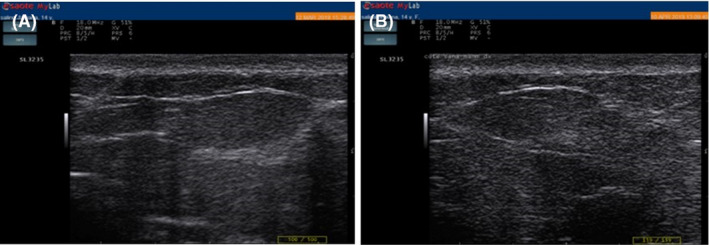
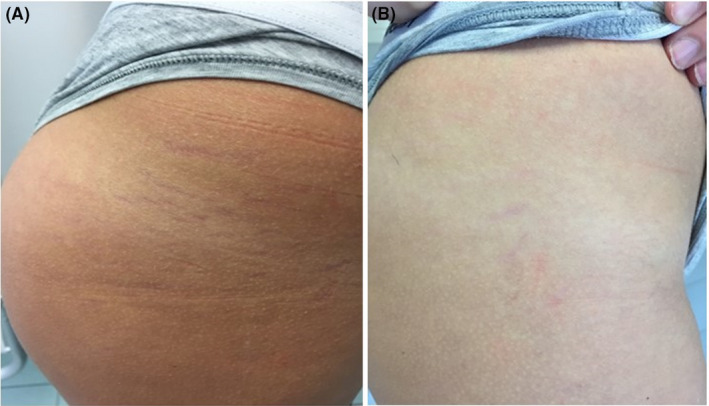
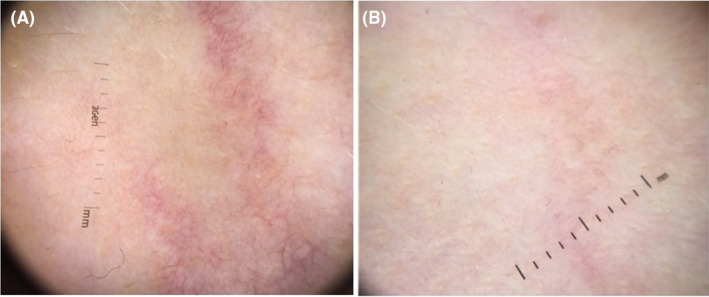
At 4-month follow-up, stretch marks improved objectively and subjectively in all patients (p < 0.001). In detail, there was a 29% and 71% improvement in clinical appearance of stretch marks at T1 and T2, respectively, as documented dermoscopically and by the 3-point reduction in the assessor's mean clinical score at each follow-up visits [from 8.1±0.7 at baseline to 5.7±1.0 at T1 and 2.3 ±0.5 at T2 (p < 0.001)]. Erythema decreased by 15% and 30% and in parallel hydration increased by 25% and 71%, at T1 and T2, respectively (p < 0.001). At T2 confocal microscopy of stretch marks, dermal collagenous fibers assumed casual disposition with reticular pattern and refractivity, as signs of collagen remodeling and neocollagenesis, and also the T2 cutaneous ultrasound revealed increased epidermal thickness and decreased dermal hypoechogenicity as for a higher skin hydration.
Our study showed that a topical oil formulation rich in plant extracts and vitamins appears to be effective and safe in treating stretch marks and xerosis.
膨胀纹是由弹性纤维破坏导致的线性瘢痕。它们通常是体重快速变化(体重增加和减轻、怀孕、举重)、长期使用类固醇或内分泌疾病的结果。治疗具有挑战性,主要基于局部和程序性治疗,尽管护理标准仍存在争议。
评估一种植物提取物和维生素的局部油剂配方对改善膨胀纹和皮肤干燥的美学效果及耐受性。
2019年3月至11月,招募了50名年龄在14至45岁之间、在那不勒斯费德里科二世大学医院就诊的有膨胀纹的男性和女性患者。将富含植物提取物和维生素的油剂每天两次局部涂抹于受影响的皮肤,持续4个月。通过临床和皮肤镜评估、共聚焦显微镜检查、皮肤超声检查、皮肤水分测定仪EpiD和爱色丽分光色度仪,在基线(T0)以及两个月(T1)和4个月(T2)随访时对患者进行监测。主要终点如下:膨胀纹临床改善70%,从基线到T2临床评分降低3分。次要终点如下:共聚焦显微镜下T0时胶原纤维平行模式的变化、超声检查时皮肤厚度增加、皮肤水分测定仪EpiD测量的皮肤水合作用增加爱色丽分光色度仪测量的红斑减轻,以及安全性和不良事件(AE)。
在4个月的随访中,所有患者的膨胀纹在客观和主观上均有改善(p<0.001)。具体而言,T1和T2时膨胀纹的临床表现分别改善了29%和71%,这在皮肤镜检查中有记录,并且每次随访时评估者的平均临床评分降低了3分[从基线时的8.1±0.7降至T1时的5.7±1.0以及T2时的2.3±0.5(p<0.001)]。T1和T2时,红斑分别减少了15%和30%,同时皮肤水合作用分别增加了25%和71%(p<0.001)。在T2时对膨胀纹进行共聚焦显微镜检查,真皮胶原纤维呈现随机排列,具有网状模式和折光性,这是胶原重塑和新胶原形成的迹象,并且T2时的皮肤超声检查也显示表皮厚度增加,真皮低回声减少,表明皮肤水合作用增强。
我们的研究表明,一种富含植物提取物和维生素的局部油剂配方在治疗膨胀纹和皮肤干燥方面似乎是有效且安全的。