Uragami Yuya, Takikawa Kazuhiro, Kareki Hajime, Kimura Koji, Yamamoto Kazuyuki, Iihara Naomi
Star Pharmacy Co., Ltd, 4113-1 Onohara Onohara-cho, Kagawa, 769-1611, Kanonji City, Japan.
Kagawa School of Pharmaceutical Sciences, Tokushima Bunri University, 1314-1 Shido, Sanuki City, Kagawa, 769-2193, Japan.
J Pharm Health Care Sci. 2021 May 3;7(1):15. doi: 10.1186/s40780-021-00195-x.
Frailty is an urgent concern among an aging population worldwide. However, the relationship between frailty and number and types of medications has not been studied in detail among early-stage older patients, and it is unclear what prescriptions may have a role in preventing frailty. This study aimed to clarify the effects of number of medications and use of potentially inappropriate medications (PIMs) on frailty among early-stage older outpatients in Japan.
A cross-sectional study was undertaken. Frailty scores and medications of outpatients aged 65-74 years who regularly visited community pharmacies were investigated. Frailty scores were classified as 0 (non-frailty), 1-2 (pre-frailty), and ≥ 3 (frailty). The association between frailty and number of medications was analyzed by age and compared between PIM use and non-use groups. The proportion of patients who used PIMs was also analyzed by frailty score.
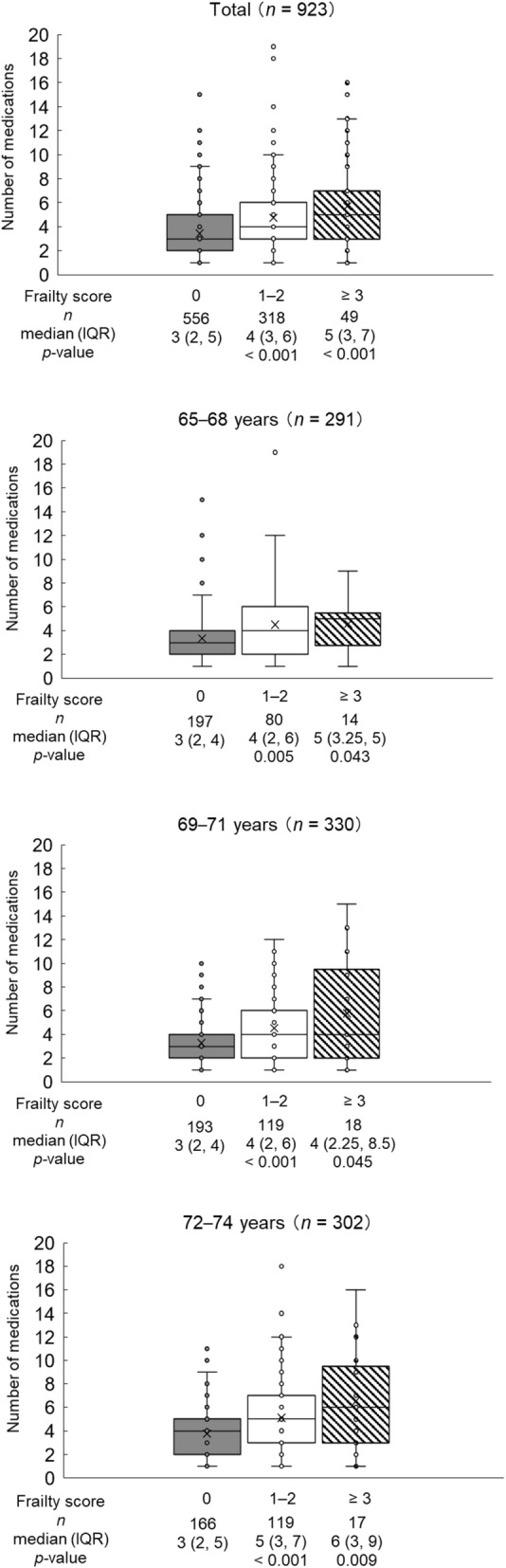
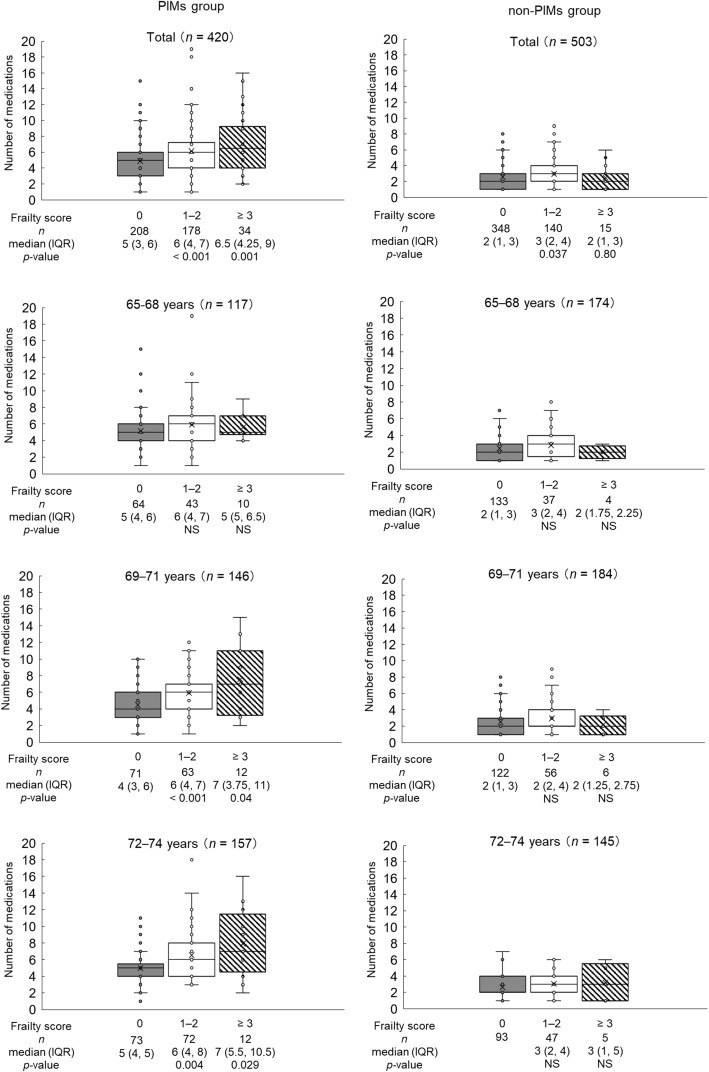
Of 923 older outpatients, 49 (5.3%) and 318 (34.5%) patients had frailty and pre-frailty scores, respectively. The numbers of medications among patients with pre-frailty and frailty were significantly higher than among those with non-frailty (p < 0.001 for both). A similar increase was shown for PIM use groups aged 69-71 and 72-74 years, but not for the PIM use group aged 65-68 years and all groups without PIM use. An increasing linear trend was observed for the relationship between the proportion of patients who used any PIM, as well as some subcategories of PIMs (such as NSAIDs, benzodiazepines, loop diuretics and antithrombotic drugs) and frailty score.
Unnecessary medication use among early-stage older outpatients, especially patients aged ≥69 years who use PIMs and many medications, seems to be associated with frailty, but further research is needed to confirm these findings.
在全球老龄化人口中,衰弱是一个亟待关注的问题。然而,在早期老年患者中,衰弱与药物数量和类型之间的关系尚未得到详细研究,目前尚不清楚哪些处方可能对预防衰弱有作用。本研究旨在阐明药物数量和潜在不适当用药(PIMs)对日本早期老年门诊患者衰弱的影响。
进行了一项横断面研究。对定期前往社区药房的65至74岁门诊患者的衰弱评分和用药情况进行了调查。衰弱评分分为0(非衰弱)、1 - 2(衰弱前期)和≥3(衰弱)。按年龄分析衰弱与药物数量之间的关联,并在使用PIMs组和未使用组之间进行比较。还按衰弱评分分析使用PIMs的患者比例。
在923名老年门诊患者中,分别有49名(5.3%)和318名(34.5%)患者有衰弱和衰弱前期评分。衰弱前期和衰弱患者的用药数量显著高于非衰弱患者(两者p均<0.001)。69至71岁和72至74岁的PIMs使用组呈现出类似的增加趋势,但65至68岁的PIMs使用组和所有未使用PIMs的组没有。在使用任何PIMs的患者比例以及PIMs的一些子类别(如非甾体抗炎药、苯二氮䓬类、袢利尿剂和抗血栓药物)与衰弱评分之间观察到线性增加趋势。
早期老年门诊患者中不必要的药物使用,尤其是使用PIMs且用药较多的≥69岁患者,似乎与衰弱有关,但需要进一步研究来证实这些发现。