Su Huizong, Wang Qian, Li Yue, Jin Jingyi, Tan Bo, Yan Dongming, Zou Bin, Song Guochao, Weng Fengyi, Qiu Furong
Clinical Pharmacokinetic Laboratory, Shuguang Hospital Affiliated to Shanghai University of Traditional Chinese Medicine, Shanghai, China.
Front Pharmacol. 2021 Apr 15;12:611610. doi: 10.3389/fphar.2021.611610. eCollection 2021.
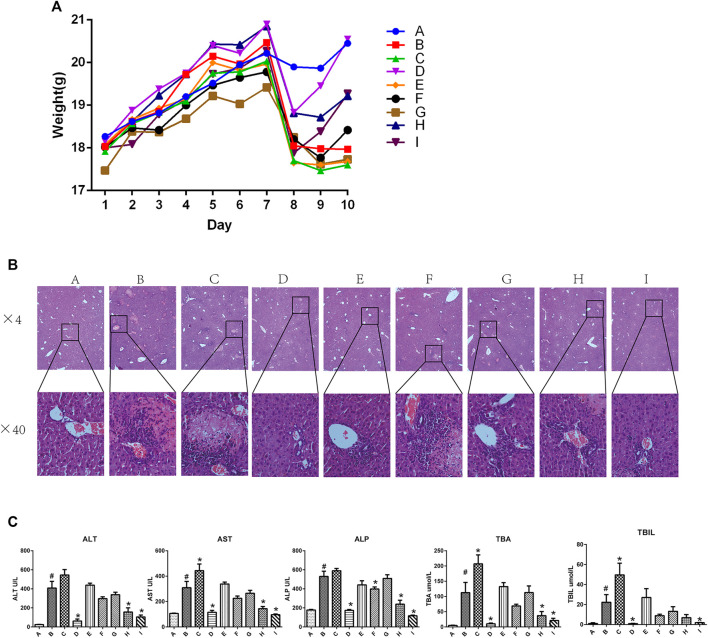
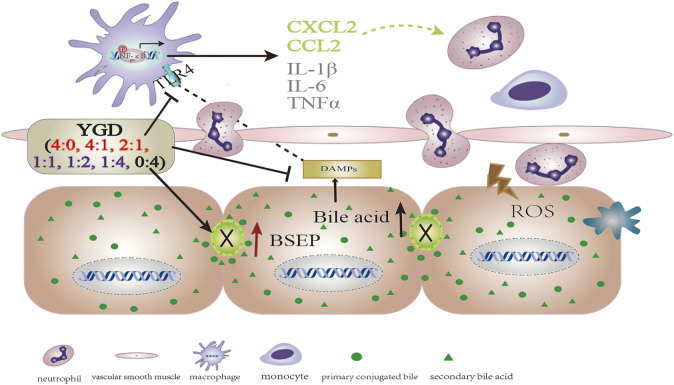
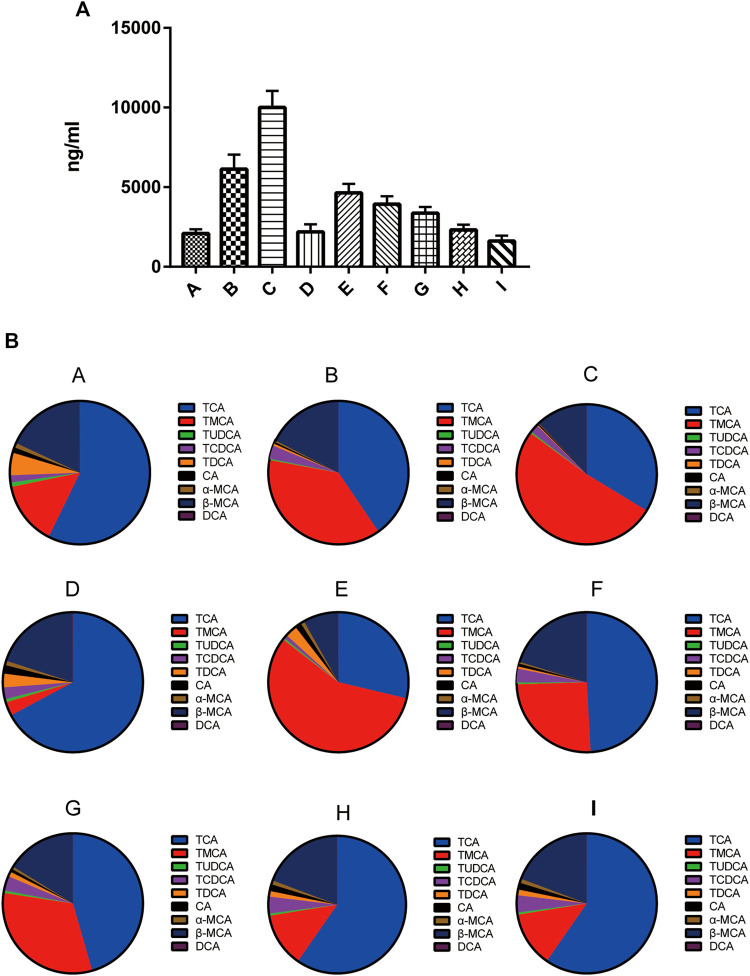
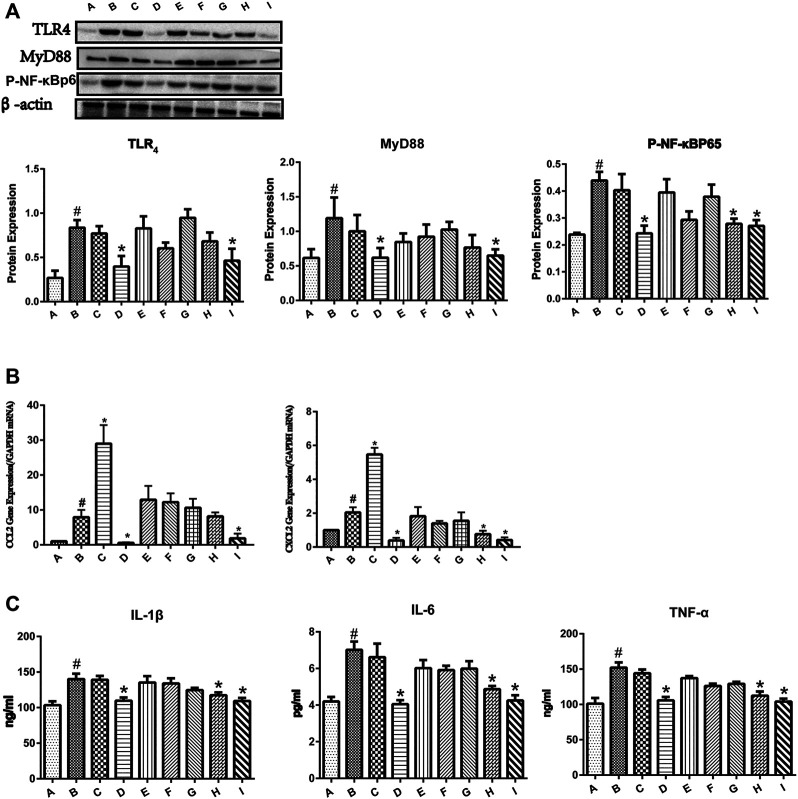
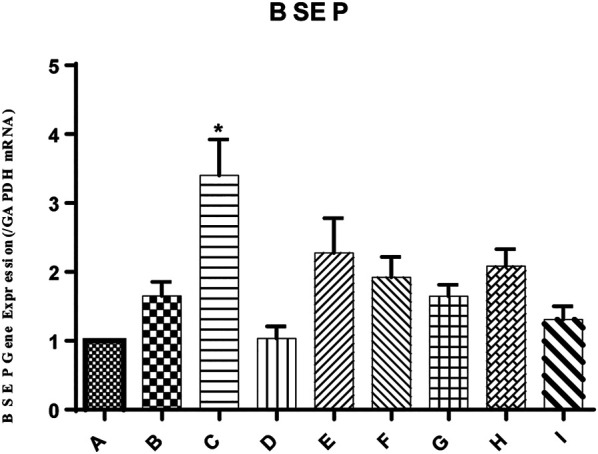
Cholestasis is a pathological state that leads to serious liver disease; however, therapeutic options remain limited. Yinchen and Gancao are often used in combination at different ratios in traditional Chinese formulae for the treatment of jaundice and cholestasis. In the present study, we investigated the effect of decoctions containing different ratios of Yinchen and Gancao (YGD) on alpha-naphthyl isothiocyanate (ANIT)-treated intrahepatic cholestasis (IC) in mice, and further explored the underlying mechanism. Treatment with 0:4 and 1:4 YGD significantly reduced plasma total bile acid (TBA), total bilirubin (TBIL), aspartate aminotransferase (AST), alanine aminotransferase (ALT), and alkaline phosphatase (ALP) activities; decreased unconjugated and conjugated bile acid levels; and improved hepatocyte necrosis and inflammatory cells recruitment to hepatic sinusoids. Moreover, the expression levels of Toll-like receptor 4 (TLR4), interleukin-1β (IL-1β), IL-6, tumor necrosis factor alpha (TNF-α), C-C ligand 2 (CCL2), and C-X-C ligand 2 (CXCL2) in the liver were significantly reduced. However, treatment with 4:1 and 4:0 YGD increased plasma TBA, TBIL, AST, ALT, and ALP activities and aggravated liver cell injury and inflammation. Moreover, the mRNA expression of the bile salt export pump (BSEP) in the liver was significantly increased in mice treated with 4:0 YGD. The present study demonstrates that YGD containing a high proportion of Gancao, which inhibits the TLR4/NF-κB pathway and reduces the inflammatory response, had protective effects against ANIT-treated IC in mice. However, YGD containing a high proportion of Yinchen aggravated the ANIT-treated IC in mice, which may be related to upregulation of BSEP and boosting bile acid regurgitation from damage cholangiocytes to liver in ANIT-treated IC mice.
胆汁淤积是一种可导致严重肝脏疾病的病理状态;然而,治疗选择仍然有限。茵陈和甘草常以不同比例联合用于中药方剂中治疗黄疸和胆汁淤积。在本研究中,我们研究了含不同比例茵陈和甘草的水煎剂(茵陈甘草汤,YGD)对α-萘异硫氰酸酯(ANIT)诱导的小鼠肝内胆汁淤积(IC)的影响,并进一步探讨其潜在机制。0:4和1:4的YGD处理显著降低了血浆总胆汁酸(TBA)、总胆红素(TBIL)、天冬氨酸转氨酶(AST)、丙氨酸转氨酶(ALT)和碱性磷酸酶(ALP)活性;降低了非结合型和结合型胆汁酸水平;改善了肝细胞坏死以及炎性细胞向肝血窦的募集。此外,肝脏中Toll样受体4(TLR4)、白细胞介素-1β(IL-1β)、IL-6、肿瘤坏死因子-α(TNF-α)、C-C配体2(CCL2)和C-X-C配体2(CXCL2)的表达水平显著降低。然而,4:1和4:0的YGD处理增加了血浆TBA、TBIL、AST、ALT和ALP活性,并加重了肝细胞损伤和炎症。此外,4:0的YGD处理的小鼠肝脏中胆盐输出泵(BSEP)的mRNA表达显著增加。本研究表明,高比例甘草的YGD通过抑制TLR4/NF-κB通路并减轻炎症反应,对ANIT诱导的小鼠IC具有保护作用。然而,高比例茵陈的YGD加重了ANIT诱导的小鼠IC,这可能与ANIT处理的IC小鼠中BSEP上调以及受损胆管细胞向肝脏的胆汁酸反流增加有关。