Fukuya Yoshifumi, Fujiwara Takeo, Isumi Aya, Doi Satomi, Ochi Manami
Department of Global Health Promotion, Tokyo Medical and Dental University, Tokyo, Japan.
Department of Health and Welfare Services, National Institute of Public Health, Saitama, Japan.
Front Psychiatry. 2021 Apr 14;12:638088. doi: 10.3389/fpsyt.2021.638088. eCollection 2021.
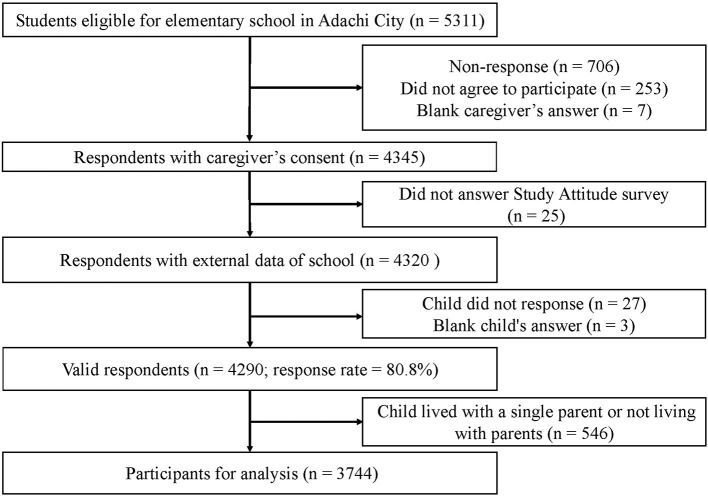
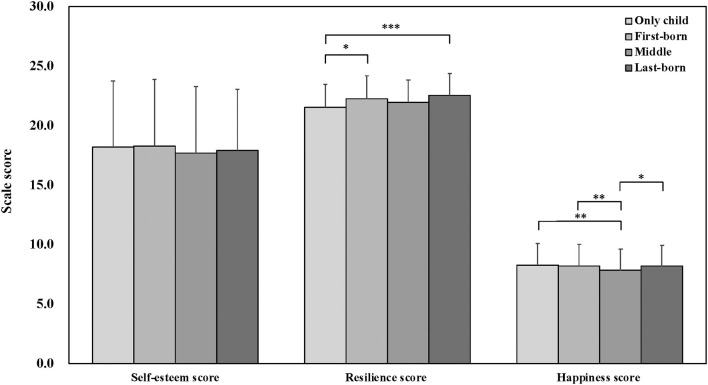
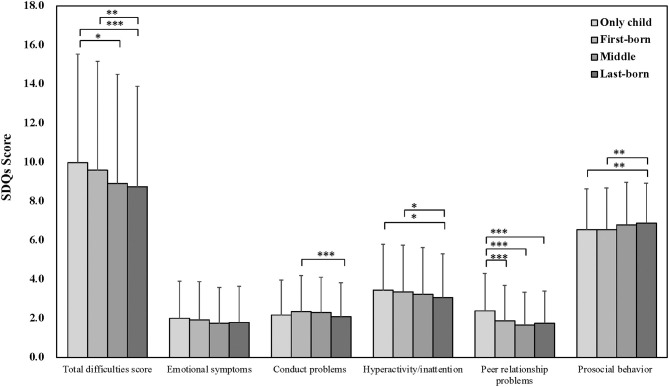
This study aimed to investigate the association of birth order with mental health problems, self-esteem, resilience, and happiness among children aged 9-10 years. This was a cross-sectional study using data from the Adachi Child Health Impact of Living Difficulty (A-CHILD) study, which was a population-based study of children in fourth grade in public schools in Adachi City, Tokyo, Japan in 2018 ( = 3,744). Parent-rated Strengths and Difficulties Questionnaire (SDQ) and self-rated resilience, happiness, and self-esteem score were used to assess child mental health. Multiple regression analysis for continuous outcomes and logistic regression for dichotomous outcomes were used to examine the association of birth order with mental health problems, resilience, happiness, and self-esteem. The analysis was controlled for child sex, mother's age, mother's education, caregiver's depressive symptoms, household income, and living with grandparents. Last-borns showed the lowest total difficulties score in the SDQ, while only children showed the highest ( < 0.001). The highest prosocial behaviors score was found among last-borns ( < 0.001). Resilience score was also highest among last-borns, followed by first-borns, middle-borns, and only children. The lowest happiness score was found among middle-borns. Self-esteem score did not differ by sibling types. These associations were similar in the adjusted model and dichotomized outcomes model. Differential impacts of birth order on child mental health, for both positive and negative sides, were found. Further research is warranted to elucidate the mechanism of the association between birth order and the development of behavior problems and the positive aspects such as resilience, happiness, and self-esteem among children.
本研究旨在调查出生顺序与9至10岁儿童心理健康问题、自尊、心理韧性和幸福感之间的关联。这是一项横断面研究,使用了来自生活困难对足立儿童健康影响(A-CHILD)研究的数据,该研究是2018年对日本东京足立市公立学校四年级儿童进行的一项基于人群的研究(n = 3744)。采用家长评定的长处与困难问卷(SDQ)以及自评的心理韧性、幸福感和自尊得分来评估儿童心理健康。对连续性结果采用多元回归分析,对二分结果采用逻辑回归分析,以检验出生顺序与心理健康问题、心理韧性、幸福感和自尊之间的关联。分析中控制了儿童性别、母亲年龄、母亲教育程度、照料者的抑郁症状、家庭收入以及是否与祖父母同住。末出生的孩子在SDQ中的总困难得分最低,而独生子女得分最高(P < 0.001)。亲社会行为得分最高的是末出生的孩子(P < 0.001)。心理韧性得分也是末出生的孩子最高,其次是头胎出生的孩子、中间出生的孩子和独生子女。中间出生的孩子幸福感得分最低。自尊得分在不同兄弟姐妹类型之间没有差异。在调整模型和二分结果模型中,这些关联是相似的。研究发现出生顺序对儿童心理健康有正负两方面的不同影响。有必要进行进一步研究,以阐明出生顺序与儿童行为问题发展以及心理韧性、幸福感和自尊等积极方面之间关联的机制。