Rollins Elizabeth Mathews, Crandall AliceAnn
Department of Public Health, Brigham Young University, Provo, UT, United States.
Front Psychiatry. 2021 Apr 16;12:649911. doi: 10.3389/fpsyt.2021.649911. eCollection 2021.
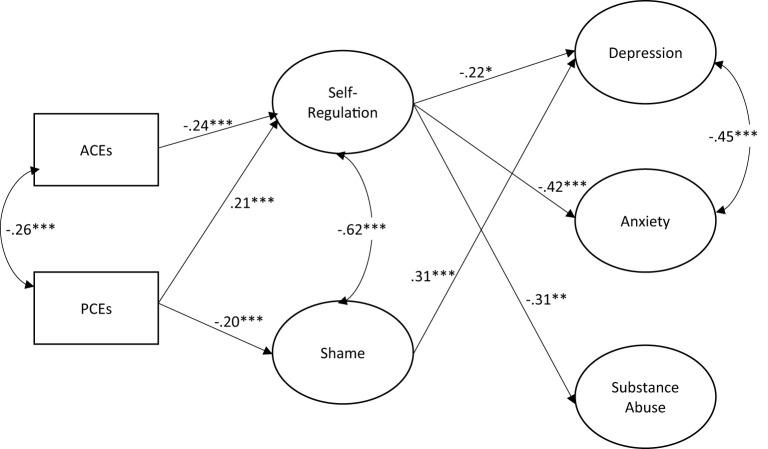
The purpose of this study was to determine whether self-regulation and shame mediated the relationship between adverse and positive childhood experiences (ACEs and PCEs) and young adult health. Data came from the Flourishing Families Project (FFP), a 10-year longitudinal study. Adolescent participants ( = 489; 51% female) completed an annual survey. Data were analyzed using structural equation modeling. Results indicated that PCEs negatively predicted shame and positively predicted self-regulation while ACEs negatively predicted self-regulation. Shame mediated the relationship between PCEs and depression. Self-regulation mediated the relationship between both ACEs and PCEs with anxiety; self-regulation also mediated the relationship between ACEs and substance abuse. Childhood experiences appear to affect the development and maintenance of self-regulation in adolescence. Self-regulation appears to be especially important in protecting against depression, anxiety, and substance abuse in young adulthood.
本研究的目的是确定自我调节和羞耻感是否介导了童年不良经历和积极经历(ACEs和PCEs)与青年健康之间的关系。数据来自蓬勃发展家庭项目(FFP),这是一项为期10年的纵向研究。青少年参与者(n = 489;51%为女性)每年完成一次调查。使用结构方程模型对数据进行分析。结果表明,PCEs对羞耻感有负向预测作用,对自我调节有正向预测作用,而ACEs对自我调节有负向预测作用。羞耻感介导了PCEs与抑郁之间的关系。自我调节介导了ACEs和PCEs与焦虑之间的关系;自我调节还介导了ACEs与药物滥用之间的关系。童年经历似乎会影响青少年自我调节的发展和维持。自我调节在预防青年期的抑郁、焦虑和药物滥用方面似乎尤为重要。