Yang Youcai, Qin Lixia, Ning Ling
Key Laboratory of Adolescent Health Assessment and Exercise Intervention of Ministry of Education, East China Normal University, Shanghai, China.
College of Physical Education and Health, East China Normal University, Shanghai, China.
Front Psychol. 2021 Apr 15;12:628809. doi: 10.3389/fpsyg.2021.628809. eCollection 2021.
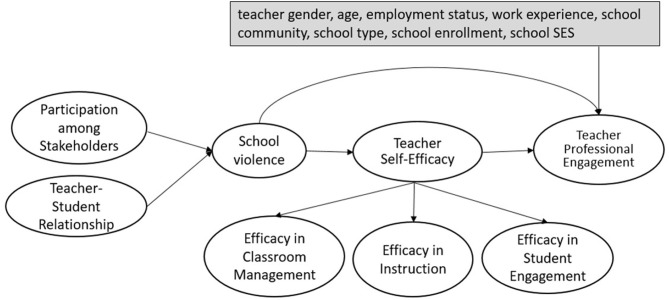
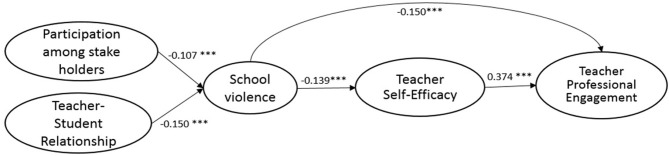
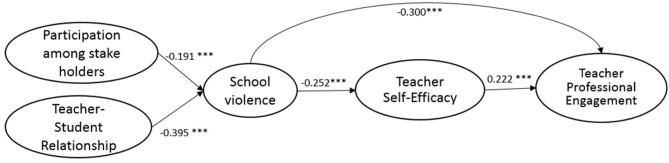
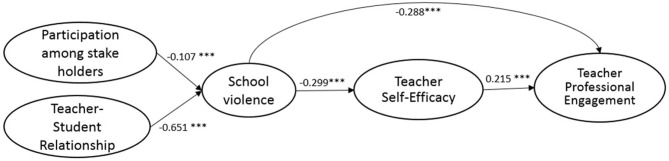
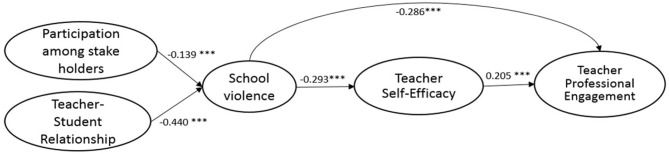
School violence research has mainly focused on the impact on students. Very few studies, even fewer from a cross-cultural perspective, have examined the relationships between school violence and teacher professional engagement, and the role played by teacher self-efficacy and school climate related factors. The present study utilizes a SEM research methodology to analyze the 2013 TALIS data. The purpose is to understand and compare the relationships in four different cultural contexts; the U.S., England, South Korea, and Mexico. Results indicate, on average, that the significant and negative impacts of school violence on teacher professional engagement are partly mediated by teacher self-efficacy. The negativity of school violence is significantly alleviated by enhancing participation among school stakeholders and improving teacher-student relationships. The relationships among the factors apply across all four cultural systems, though, the effects of factors and variables vary to a degree. The paper also discusses other relevant issues and differences as well as their implications.
校园暴力研究主要聚焦于对学生的影响。极少有研究,从跨文化视角进行研究的更是少之又少,探讨过校园暴力与教师职业投入之间的关系,以及教师自我效能感和学校氛围相关因素所起的作用。本研究运用结构方程模型研究方法来分析2013年国际教学与学习调查(TALIS)的数据。目的是了解并比较美国、英国、韩国和墨西哥这四种不同文化背景下的关系。结果表明,平均而言,校园暴力对教师职业投入的显著负面影响部分是由教师自我效能感介导的。通过加强学校利益相关者的参与和改善师生关系,校园暴力的负面影响得到显著缓解。尽管这些因素和变量的影响在一定程度上有所不同,但这些因素之间的关系在所有四种文化体系中都适用。本文还讨论了其他相关问题和差异及其影响。