Nass Robert Daniel, Akgün Katja, Dague Karmele Olaciregui, Elger Christian Erich, Reichmann Heinz, Ziemssen Tjalf, Surges Rainer
Department of Epileptology, University Hospital Bonn, Bonn, Germany.
Department of Neurology, Dresden University Hospital, Dresden, Germany.
Front Neurol. 2021 Apr 16;12:647428. doi: 10.3389/fneur.2021.647428. eCollection 2021.
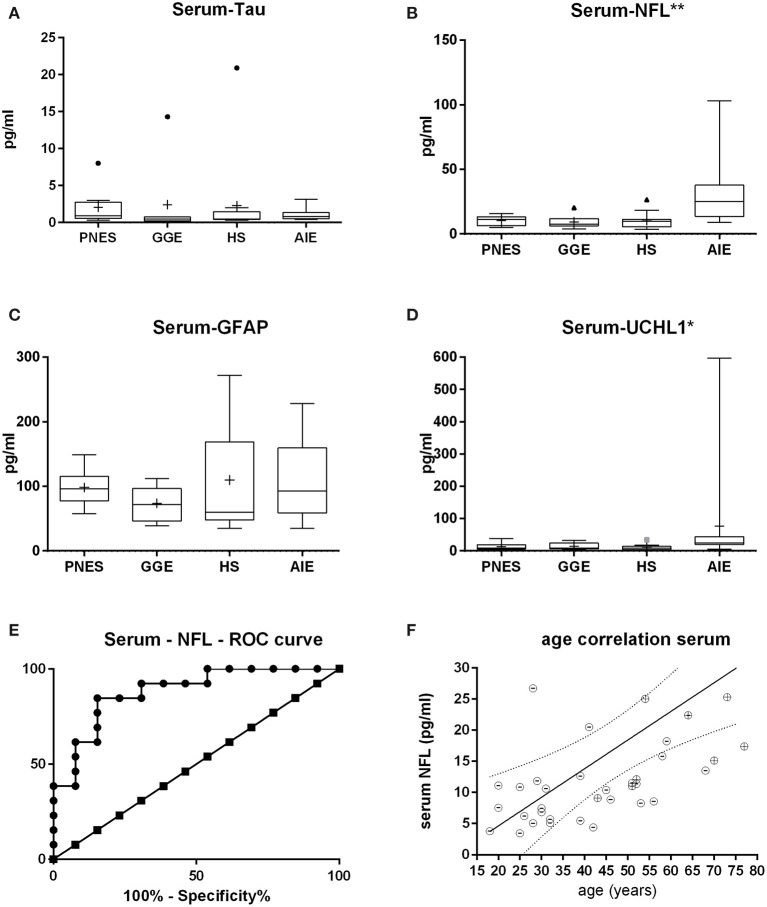
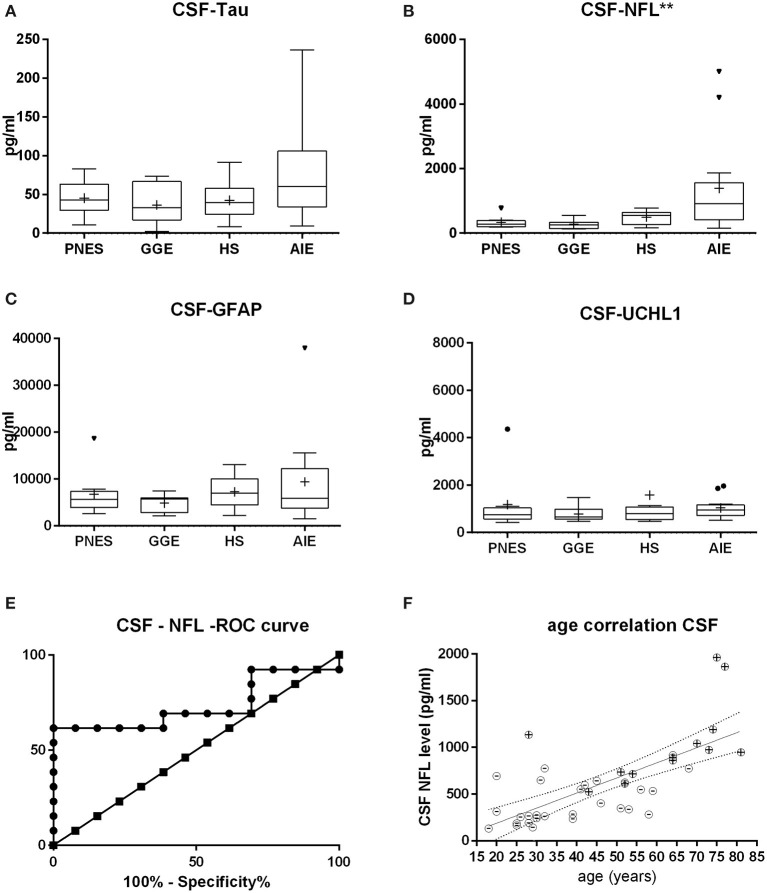
Our goal was to investigate whether biomarkers of cerebral damage are found in autoimmune-mediated epilepsy (AIE) and whether these can differentiate AIE from other seizure disorders. We retrospectively searched our cerebrospinal fluid (CSF) database for patients with definite AIE, hippocampal sclerosis due to other causes (HS), genetic generalized epilepsy (GGE), and psychogenic, non-epileptic seizures (PNES). We measured serum and CSF tau, neurofilament 1 (NFL), glial fibrillary acid protein (GFAP), and ubiquitin-carboxy-terminal hydrolase L1 with a single-molecule array. We identified suitable samples from patients with AIE ( = 13) with different antibodies and compared them to HS ( = 13), GGE ( = 7), and PNES ( = 8). The NFL levels were significantly elevated in the serum ( = 0.0009) and CSF ( < 0.0019) of AIE patients. The AIE group was significantly older, while the disease duration was significantly shorter than in the control groups. NFL correlated significantly with age in all groups, and the NFL levels of AIE patients were hardly higher than those of healthy elderly people published elsewhere. Our data indicate that the elevated NFL levels in AIE patients are most likely due to the higher age in this group and not due to the underlying inflammation. Unless larger prospective studies with intra-individual, longitudinal analyses and treatment responses would contradict our findings, NFL in serum might yet become a biomarker for disease activity and differential diagnosis.
我们的目标是研究在自身免疫介导的癫痫(AIE)中是否能发现脑损伤生物标志物,以及这些生物标志物能否将AIE与其他癫痫疾病区分开来。我们回顾性地在脑脊液(CSF)数据库中搜索确诊为AIE、其他原因导致的海马硬化(HS)、遗传性全身性癫痫(GGE)以及心因性非癫痫发作(PNES)的患者。我们使用单分子阵列测量血清和脑脊液中的tau蛋白、神经丝轻链(NFL)、胶质纤维酸性蛋白(GFAP)和泛素羧基末端水解酶L1。我们从13例AIE患者中用不同抗体鉴定出合适的样本,并将其与13例HS患者、7例GGE患者和8例PNES患者的样本进行比较。AIE患者血清(P = 0.0009)和脑脊液(P < 0.0019)中的NFL水平显著升高。AIE组患者年龄显著更大,而病程显著短于对照组。在所有组中,NFL与年龄显著相关,且AIE患者的NFL水平几乎不高于其他地方报道的健康老年人。我们的数据表明,AIE患者NFL水平升高很可能是由于该组患者年龄较大,而非潜在炎症所致。除非有更大规模的前瞻性研究,进行个体内纵向分析和治疗反应分析与我们的发现相矛盾,否则血清中的NFL仍可能成为疾病活动和鉴别诊断的生物标志物。