Department of Molecular Neuropathology, Beijing Neurosurgical Institute, Capital Medical University, Beijing, China.
Department of Neurosurgery, Beijing Tiantan Hospital, Capital Medical University, Beijing, China.
Front Immunol. 2021 Apr 16;12:659659. doi: 10.3389/fimmu.2021.659659. eCollection 2021.
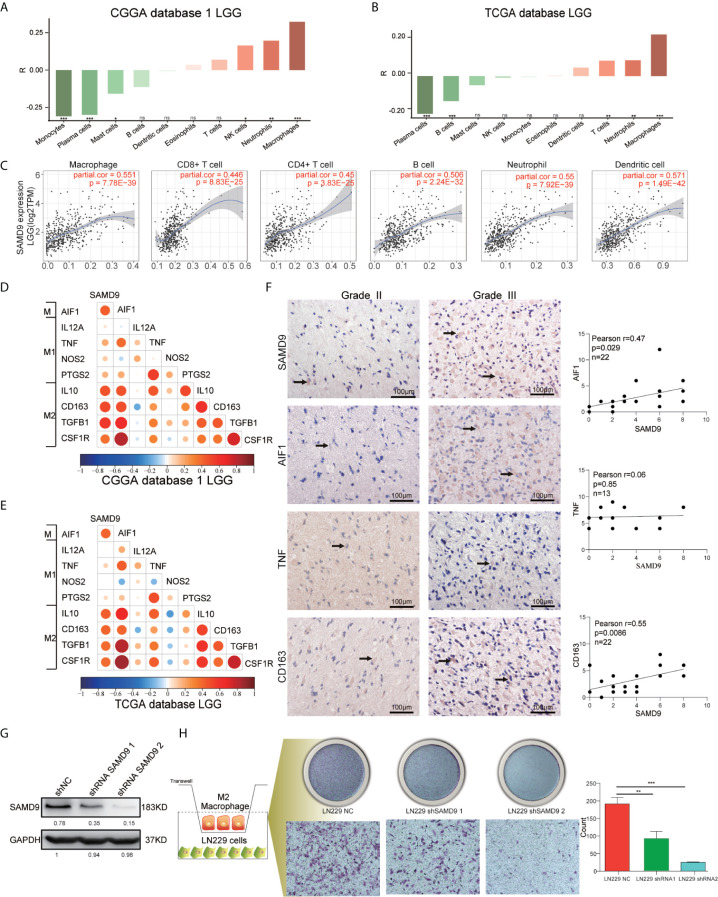
Immunoreactions regulated by TAMs (Tumor-associated macrophages) play a pivotal role in tumorigenesis and metastasis. In recent decades, treatments based on immune regulation have achieved revolutionary breakthroughs in cancer targeted therapies. The phenotypes of TAMs in gliomas are more heterogeneous and inherently complex than can be simply defined by classification into the M1 and M2 polarized states. The detailed mechanisms surrounding infiltrating macrophage phenotype and glioma characteristics remain undefined. SAMD9 (Sterile Alpha Motif Domain-Containing Protein 9) was found to be highly expressed in glioma and closely related to histological and genetic features in CGGA and TCGA databases. Simultaneously, we present evidence to show that there was a positive association between SAMD9 and malignancy characters in LGG. Univariable and Multivariate proportional hazard Cox analysis showed that SAMD9 was an independent prognostic factor for LGG. Surprisingly, Gene Ontology (GO) analysis showed SAMD9 expression level was remarkably well correlated with immunological responses and the Kyoto Encyclopedia of Genes and Genomes (KEGG) analysis supported the connection with immune responses and tumorigenesis. Immune infiltration analysis demonstrated that high SAMD9 expression resulted in an accumulation of macrophages by CIBERSORT and TIMER databases, especially positively related to macrophage total marker gene AIF1 and Macrophage M2 marker gene CD163. IHC staining further indicated a high correlation of SAMD9 with those specific macrophage markers in the immune response. Human THP-1 cells were induced into M2 macrophages, which were then co-cultured with LN229 cells. Silencing of SAMD9 by shRNA in LN229 cells attenuated the infiltration abilities of M2 macrophage. SAMD9 explored immune response via relating of M2 macrophage . Our results revealed SAMD9 acted as the malignancy characters in LGG, enrichment with M2 macrophage.
肿瘤相关巨噬细胞(TAMs)调节的免疫反应在肿瘤发生和转移中起着关键作用。近几十年来,基于免疫调节的治疗在癌症靶向治疗中取得了革命性突破。与简单地分为 M1 和 M2 极化状态相比,胶质瘤中 TAMs 的表型更为异质和复杂。浸润巨噬细胞表型和神经胶质瘤特征的详细机制仍未确定。SAMD9(Sterile Alpha Motif Domain-Containing Protein 9)在神经胶质瘤中表达水平较高,与 CGGA 和 TCGA 数据库中的组织学和遗传特征密切相关。同时,我们提供证据表明,SAMD9 与 LGG 中的恶性特征之间存在正相关。单变量和多变量比例风险 Cox 分析显示,SAMD9 是 LGG 的独立预后因素。令人惊讶的是,基因本体论(GO)分析显示 SAMD9 的表达水平与免疫反应显著相关,京都基因与基因组百科全书(KEGG)分析支持与免疫反应和肿瘤发生的联系。免疫浸润分析表明,SAMD9 高表达通过 CIBERSORT 和 TIMER 数据库导致巨噬细胞的积累,特别是与巨噬细胞总标志物基因 AIF1 和巨噬细胞 M2 标志物基因 CD163 呈正相关。免疫组化染色进一步表明,SAMD9 与免疫反应中这些特定巨噬细胞标志物高度相关。人 THP-1 细胞被诱导为 M2 巨噬细胞,然后与 LN229 细胞共培养。LN229 细胞中 SAMD9 的 shRNA 沉默减弱了 M2 巨噬细胞的浸润能力。SAMD9 通过与 M2 巨噬细胞相关来探索免疫反应。我们的研究结果表明,SAMD9 作为 LGG 中的恶性特征,富含 M2 巨噬细胞。