Freitas Cláudia, Sousa Catarina, Machado Francisco, Serino Mariana, Santos Vanessa, Cruz-Martins Natália, Teixeira Armando, Cunha António, Pereira Tania, Oliveira Hélder P, Costa José Luís, Hespanhol Venceslau
Department of Pulmonology, Centro Hospitalar e Universitário São João, Porto, Portugal.
Faculty of Medicine, University of Porto, Porto, Portugal.
Front Oncol. 2021 Apr 16;11:634316. doi: 10.3389/fonc.2021.634316. eCollection 2021.
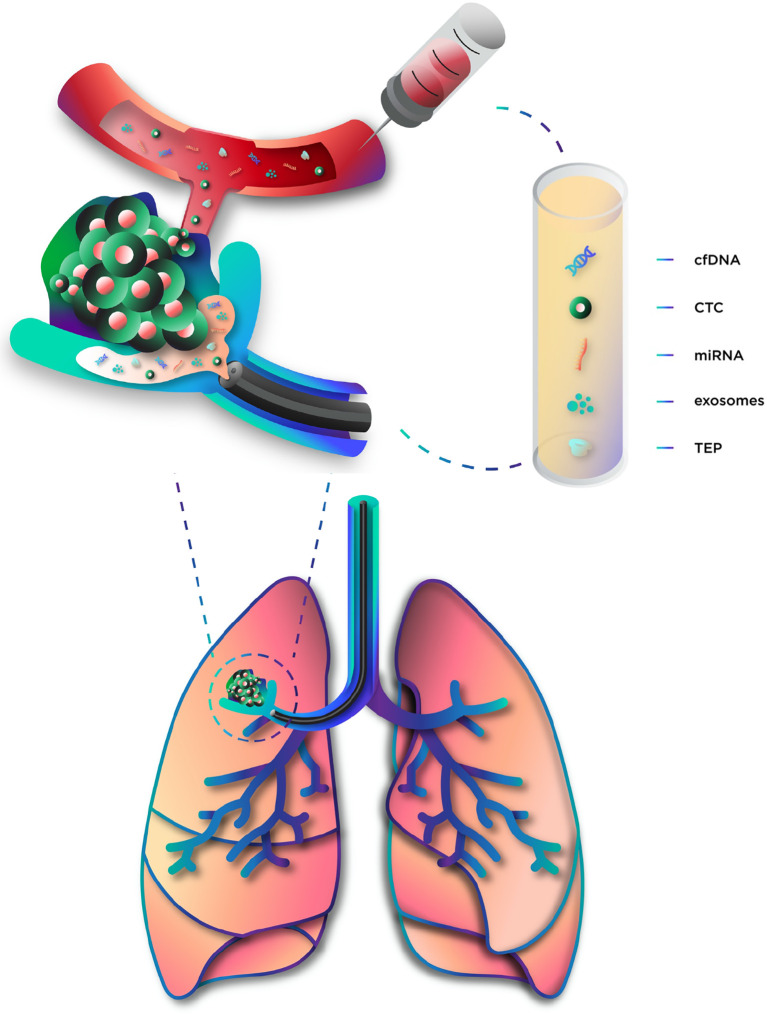
Liquid biopsy is an emerging technology with a potential role in the screening and early detection of lung cancer. Several liquid biopsy-derived biomarkers have been identified and are currently under ongoing investigation. In this article, we review the available data on the use of circulating biomarkers for the early detection of lung cancer, focusing on the circulating tumor cells, circulating cell-free DNA, circulating micro-RNAs, tumor-derived exosomes, and tumor-educated platelets, providing an overview of future potential applicability in the clinical practice. While several biomarkers have shown exciting results, diagnostic performance and clinical applicability is still limited. The combination of different biomarkers, as well as their combination with other diagnostic tools show great promise, although further research is still required to define and validate the role of liquid biopsies in clinical practice.
液体活检是一项新兴技术,在肺癌筛查和早期检测中具有潜在作用。几种源自液体活检的生物标志物已被识别,目前正在进行研究。在本文中,我们回顾了关于使用循环生物标志物进行肺癌早期检测的现有数据,重点关注循环肿瘤细胞、循环游离DNA、循环微小RNA、肿瘤来源的外泌体和肿瘤诱导血小板,概述其在临床实践中的未来潜在适用性。虽然几种生物标志物已显示出令人兴奋的结果,但其诊断性能和临床适用性仍然有限。不同生物标志物的组合,以及它们与其他诊断工具的组合显示出巨大潜力,尽管仍需要进一步研究来确定和验证液体活检在临床实践中的作用。