Duan Guo-Chen, Zhang Xiao-Peng, Wang Hui-En, Wang Zhi-Kang, Zhang Hua, Yu Lei, Xue Wen-Fei, Xin Zhi-Fei, Hu Zhong-Hui, Zhao Qing-Tao
Department of Thoracic Surgery, Hebei General Hospital, Shijiazhuang, Hebei, People's Republic of China.
Onco Targets Ther. 2020 Mar 4;13:1931-1939. doi: 10.2147/OTT.S241956. eCollection 2020.
Circulating tumor cells (CTCs) have become potential diagnostic biomarker for several types of cancer, including lung cancer. In this study, we aim to determine whether CTCs detected by CellCollector can be used for early-stage diagnosis of lung cancer.
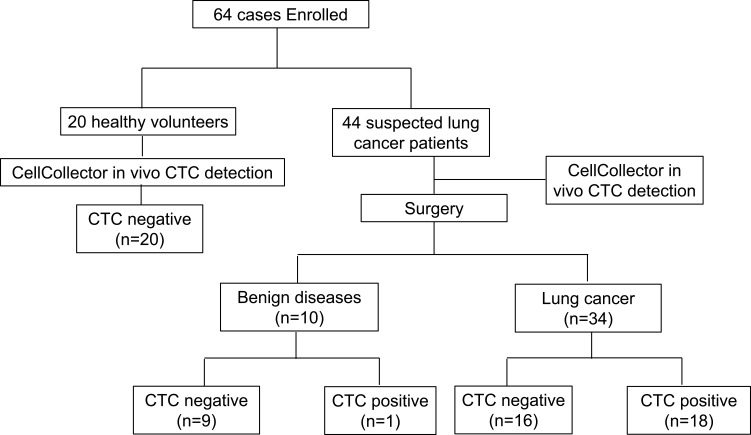
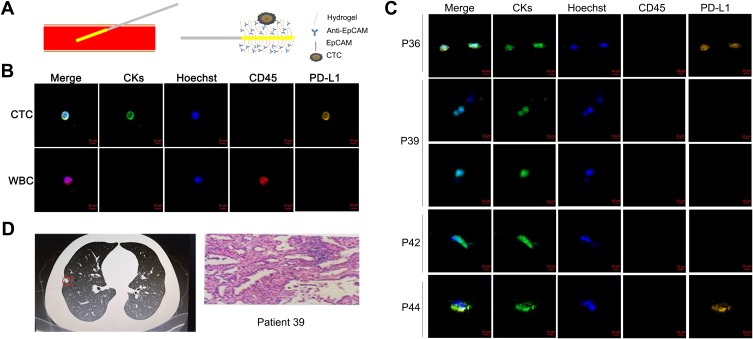
In this study, we recruited 64 volunteers, among whom 44 were suspected lung cancer patients requiring surgical treatment and 20 were healthy volunteers. We simultaneously analyzed PD-L1 expression in CTCs isolated using the GILUPI CellCollector and copy number variation by next-generation sequencing (NGS).
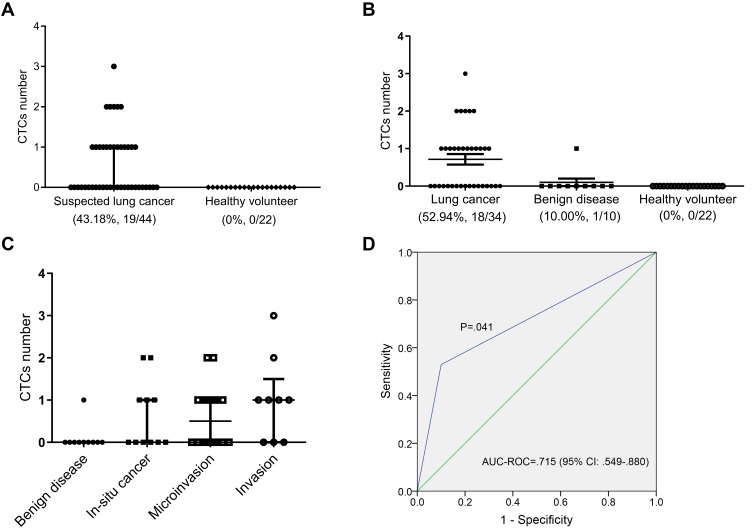
We enrolled a total of 44 patients with suspected lung cancer who required surgery and 20 healthy volunteers. The patients were classified into 4 groups based on their pathological results: benign disease, in situ cancer, microinvasive, and invasive. The CTCs detection rate for each group was 10.00% (1/10), 45% (5/11), 50% (7/14), and 67% (6/9), respectively. Among the patients with lung cancer, the CTCs detection rate increased with disease progression. The rate of CTCs positivity was 52.94% (18/34) in patients who were diagnosed with lung cancer by pathology and 10% (1/10) in patients with benign disease. CTCs were not detected in the control group. The area under the receiver operating characteristic (ROC) curve, a measure for distinguishing patients with primary lung cancer, was 0.715 (95% CI 0.549-0.880, P=0.041). The sensitivity and specificity of the in vivo CTCs detection strategy for the diagnosis of early-stage lung cancer were 52.94% and 90%, respectively. CTCs were associated with clinical pathology but not with the size and location of the nodules.
CTCs isolation using the CellCollector in vivo detection method might be effective for distinguishing between benign and malignant nodules and may be used for early-stage diagnosis of lung cancer.
循环肿瘤细胞(CTCs)已成为包括肺癌在内的多种癌症的潜在诊断生物标志物。在本研究中,我们旨在确定通过细胞采集器检测到的CTCs是否可用于肺癌的早期诊断。
在本研究中,我们招募了64名志愿者,其中44名是需要手术治疗的疑似肺癌患者,20名是健康志愿者。我们同时分析了使用GILUPI细胞采集器分离的CTCs中PD-L1的表达以及通过下一代测序(NGS)检测的拷贝数变异。
我们共招募了44名需要手术的疑似肺癌患者和20名健康志愿者。根据病理结果,患者被分为4组:良性疾病、原位癌、微浸润癌和浸润癌。每组的CTCs检测率分别为10.00%(1/10)、45%(5/11)、50%(7/14)和67%(6/9)。在肺癌患者中,CTCs检测率随疾病进展而增加。经病理诊断为肺癌的患者中CTCs阳性率为52.94%(18/34),良性疾病患者中为10%(1/10)。对照组未检测到CTCs。用于区分原发性肺癌患者的受试者操作特征(ROC)曲线下面积为0.715(95%CI 0.549 - 0.880,P = 0.041)。体内CTCs检测策略诊断早期肺癌的敏感性和特异性分别为52.94%和90%。CTCs与临床病理相关,但与结节的大小和位置无关。
使用细胞采集器的体内CTCs检测方法可能有助于区分良性和恶性结节,并可用于肺癌的早期诊断。