Düll Miriam M, Wolf Katharina, Vetter Marcel, Dietrich Peter, Neurath Markus F, Kremer Andreas E
Department of Medicine 1, University Hospital Erlangen and Translational Research Center, Friedrich-Alexander-University Erlangen-Nürnberg, Erlangen, Germany.
Emil-Fischer-Zentrum, Institute of Biochemistry, Friedrich-Alexander-University Erlangen-Nürnberg, Erlangen, Germany.
Front Med (Lausanne). 2021 Apr 14;8:641163. doi: 10.3389/fmed.2021.641163. eCollection 2021.
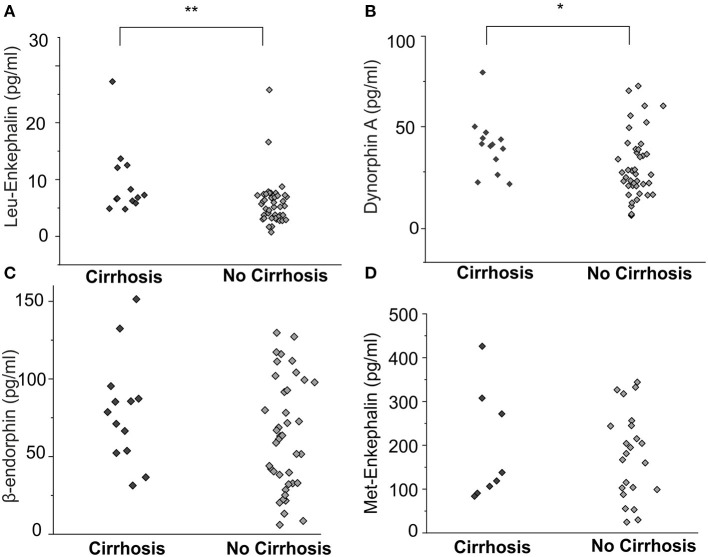
Chronic pruritus affects up to 70% of patients with immune-mediated hepatobiliary disorders. Antagonists of the μ-opioid receptor (MOR) and agonists of the κ-opioid receptor (KOR) are used to treat hepatic itch, albeit with limited success. An imbalance between ligands of MOR and KOR receptors has recently been suggested as a potential mechanism of hepatic pruritus. In this study, we therefore investigated systemic levels of important endogenous opioids such as β-endorphin, dynorphin A, Leu- and Met-enkephalin in plasma of a large cohort of well-characterized patients with immune-mediated cholestatic disorders, including patients with liver cirrhosis, and during effective anti-pruritic therapy. Plasma samples and clinical data were prospectively collected from well-characterized patients with primary/secondary sclerosing cholangitis (PSC/SSC), primary biliary cholangitis (PBC) and overlap syndromes suffering from pruritus ( = 29) and age-, gender- and disease-matched controls without pruritus ( = 27) as well as healthy controls ( = 20). General laboratory testing for hepatobiliary and renal function was performed. Levels of β-endorphin, dynorphin A, Leu- and Met-enkephalin were quantified in plasma by ELISA. Intensity of pruritus over the last week was evaluated using a visual analog scale (VAS, 0-10). PBC and PSC patients with or without pruritus did neither differ in disease entity, disease stage, nor in the presence of cirrhosis. While both dynorphin A and β-endorphin concentrations were lower in pruritic patients compared to those without pruritus and healthy controls, the MOR/KOR ligand ratio was unaltered. No significant differences were observed for Leu- and Met-enkephalin concentrations. Opioid levels correlated with neither itch intensity nor stage of disease. Cirrhotic patients displayed higher concentrations of MOR agonist Leu-enkephalin and KOR agonist dynorphin A. Endogenous opioid levels remained largely unchanged after successful treatment with the potent anti-pruritic drugs rifampicin and bezafibrate. Endogenous opioid levels and the MOR/KOR ligand ratio neither correlate with itch intensity nor differentiate pruritic from non-pruritic patients with immune-mediated liver diseases. Thus, endogenous opioids may modulate signaling pathways involved in hepatic pruritus, but are unlikely to represent the major pruritogens in liver disease.
慢性瘙痒影响多达70%的免疫介导性肝胆疾病患者。μ-阿片受体(MOR)拮抗剂和κ-阿片受体(KOR)激动剂被用于治疗肝性瘙痒,尽管效果有限。最近有人提出,MOR和KOR受体配体之间的失衡是肝性瘙痒的潜在机制。因此,在本研究中,我们调查了一大群特征明确的免疫介导性胆汁淤积性疾病患者(包括肝硬化患者)以及有效抗瘙痒治疗期间血浆中重要内源性阿片类物质如β-内啡肽、强啡肽A、亮氨酸脑啡肽和甲硫氨酸脑啡肽的全身水平。前瞻性地收集了特征明确的原发性/继发性硬化性胆管炎(PSC/SSC)、原发性胆汁性胆管炎(PBC)和重叠综合征且伴有瘙痒的患者(n = 29)、年龄、性别和疾病匹配的无瘙痒对照者(n = 27)以及健康对照者(n = 20)的血浆样本和临床数据。进行了肝胆和肾功能的常规实验室检测。通过酶联免疫吸附测定法(ELISA)对血浆中β-内啡肽、强啡肽A、亮氨酸脑啡肽和甲硫氨酸脑啡肽的水平进行定量。使用视觉模拟量表(VAS,0 - 10)评估过去一周的瘙痒强度。有或无瘙痒的PBC和PSC患者在疾病类型、疾病阶段以及是否存在肝硬化方面均无差异。与无瘙痒患者和健康对照者相比,瘙痒患者的强啡肽A和β-内啡肽浓度均较低,但MOR/KOR配体比值未改变。亮氨酸脑啡肽和甲硫氨酸脑啡肽浓度未观察到显著差异。阿片类物质水平与瘙痒强度和疾病阶段均无相关性。肝硬化患者显示出较高浓度的MOR激动剂亮氨酸脑啡肽和KOR激动剂强啡肽A。在用强效抗瘙痒药物利福平和苯扎贝特成功治疗后,内源性阿片类物质水平基本保持不变。内源性阿片类物质水平和MOR/KOR配体比值既不与瘙痒强度相关,也不能区分免疫介导性肝病的瘙痒患者和非瘙痒患者。因此,内源性阿片类物质可能调节参与肝性瘙痒的信号通路,但不太可能是肝病中的主要致痒原。