
鸟类内源性阿片肽研究综述
Perspectives on Endogenous Opioids in Birds.
作者信息
Scanes Colin G, Pierzchala-Koziec Krystyna
机构信息
Center of Excellence in Poultry Science, University of Arkansas, Fayetteville, AR, United States.
Department of Animal Physiology and Endocrinology, University of Agriculture in Krakow, Kraków, Poland.
出版信息
Front Physiol. 2018 Dec 21;9:1842. doi: 10.3389/fphys.2018.01842. eCollection 2018.
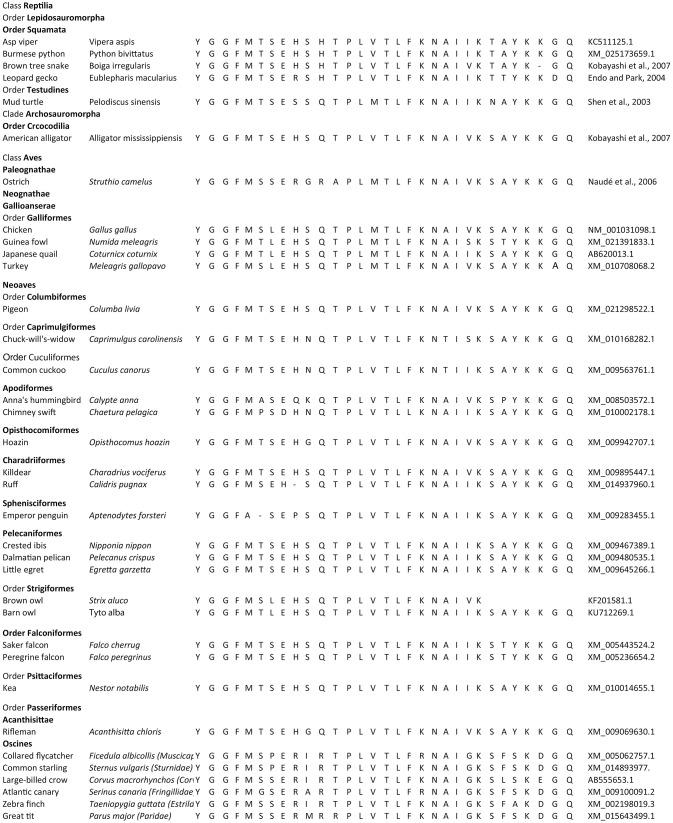
The present review summarizes the state of knowledge of endogenous opioids in birds. Endogenous opioid peptides acts in a neuromodulatory, hormonal and paracrine manner to mediate analgesic and other physiological functions. These peptides act through specific G-protein coupled receptors. Opioid receptors consist of a family of four closely-related proteins. The three types of opioid receptors are the mu (MOR or μ), delta (DOR or δ), and kappa (KOR or κ) opioid receptor proteins. The role of the fourth member of the opioid receptor family, the nociceptin or orphanin FQ receptor (ORL), is not clear. The ligands for opioid receptors are: β -endorphin (MOR), Met- enkephalin, Leu-enkephalin (DOR) and dynorphin (KOR), together with probably endomorphins 1 and 2. In spite of long history of research on endogenous opioid peptides, there are no studies of endogenous opioids in wild birds and few in poultry species. β-endorphin is present in all birds investigated and there is close agreement between the structures of β-endorphin in different birds. Plasma concentrations of β-endorphin are increased by ether stress in geese. There is evidence that β-endorphin plays a role in the control of luteinizing hormone release in chickens. Met-enkephalin is present in tissues such as the retina, hypothalamus, pituitary gland, and adrenals together with circulation of birds. Stresses such as crowding and withholding water increase circulating concentrations of Met-enkephalin in chickens. The structures of chicken dynorphin A and B have been deduced from cDNA. What is missing are comprehensive studies of plasma concentrations and expression of the full array of endogenous opioids in multiple avian species under different situations. Also, what is not known is the extent to which circulating or locally released or intra-cellular Met-enkephalin influence physiological process in birds. Thus, there is considerable scope for investigation of the physiology of endogenous opioids in birds.
本综述总结了鸟类体内内源性阿片类物质的知识现状。内源性阿片肽以神经调节、激素和旁分泌的方式发挥作用,介导镇痛和其他生理功能。这些肽通过特定的G蛋白偶联受体发挥作用。阿片受体由四种密切相关的蛋白质组成的家族。三种类型的阿片受体是μ(MOR或μ)、δ(DOR或δ)和κ(KOR或κ)阿片受体蛋白。阿片受体家族的第四个成员,即孤啡肽或孤啡肽FQ受体(ORL)的作用尚不清楚。阿片受体的配体有:β-内啡肽(MOR)、甲硫氨酸脑啡肽、亮氨酸脑啡肽(DOR)和强啡肽(KOR),可能还有内吗啡肽1和2。尽管对内源性阿片肽的研究历史悠久,但在野生鸟类中尚未有关于内源性阿片类物质的研究,在家禽物种中的研究也很少。β-内啡肽存在于所有被研究的鸟类中,不同鸟类的β-内啡肽结构之间有密切的一致性。鹅受到乙醚应激时,血浆β-内啡肽浓度会升高。有证据表明,β-内啡肽在鸡促黄体生成素释放的控制中起作用。甲硫氨酸脑啡肽存在于视网膜、下丘脑、垂体和肾上腺等组织以及鸟类的循环系统中。拥挤和禁水等应激会增加鸡血浆中甲硫氨酸脑啡肽的浓度。鸡强啡肽A和B的结构已从cDNA中推导出来。缺少的是对多种鸟类在不同情况下内源性阿片类物质的血浆浓度和完整表达阵列的综合研究。此外,尚不清楚循环、局部释放或细胞内的甲硫氨酸脑啡肽在多大程度上影响鸟类的生理过程。因此,鸟类内源性阿片类物质的生理学研究有很大的空间。


 Zotero 插件