Mitsuzawa Sadaki, Takeuchi Hisataka, Ando Maki, Sakazaki Taiki, Ikeguchi Ryosuke, Matsuda Shuichi
Department of Orthopaedic Surgery, Kyoto University Graduate School of Medicine, Kyoto, Japan.
OTA Int. 2020 Aug 12;3(3):e085. doi: 10.1097/OI9.0000000000000085. eCollection 2020 Sep.
The purpose of this study is to provide a detailed comparison of 4 posterior approaches of the ankle: the posteromedial, modified posteromedial (mPM), Achilles tendon-splitting (TS), and posterolateral approaches.
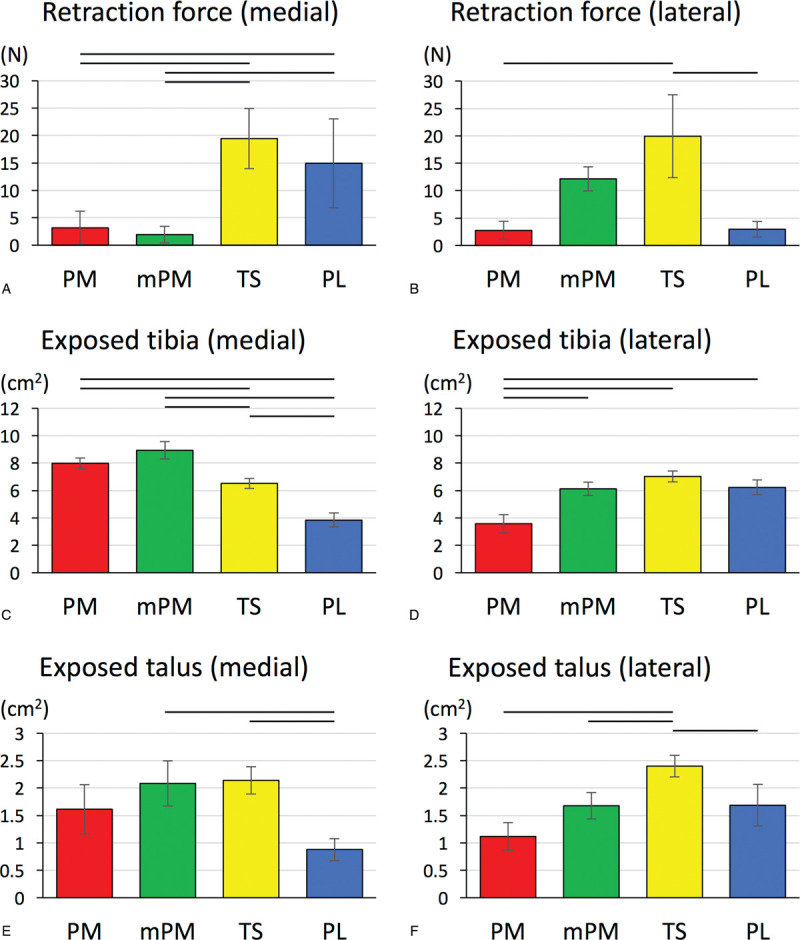
Cadaveric dissections were performed to assess the influence of the medial and lateral retraction forces on the neuro-vascular bundle with suspension scales and to measure the medial and lateral exposed areas of the posterior tibia and talus. Data was acquired with the ankle in neutral position and in plantar flexion.
Both the mPM and TS approaches provided excellent visualization of the posterior tibia with the ankle in plantar flexion (16.6 cm and 16.2 cm, respectively). The medial aspect of the posterior tibia, however, was significantly better exposed in the mPM approach than in the TS approach with the ankle in neutral position (8.9 cm vs 6.5 cm). The lower value for medial retraction force in the mPM approach (1.9 N in neutral position and 0.9 N in plantar flexion) indicated a lower risk of injury to the neuro-vascular bundle (the tibial nerve and the posterior tibial artery). The posterior talus, however, is best visualized through the TS approach with the ankle in neutral position (4.5 cm).
The current study demonstrated the usefulness of the mPM approach. When internal fixation of the fibula is unnecessary, the mPM approach is preferable, considering the potential damage to the Achilles tendon associated with the TS approach.
本研究旨在对踝关节的4种后入路进行详细比较:后内侧入路、改良后内侧入路(mPM)、跟腱劈开入路(TS)和后外侧入路。
进行尸体解剖,用悬挂秤评估内侧和外侧牵拉力对神经血管束的影响,并测量胫骨和距骨后侧的内侧和外侧暴露面积。在踝关节处于中立位和跖屈位时采集数据。
在踝关节跖屈时,mPM和TS入路均能很好地显露胫骨后侧(分别为16.6 cm和16.2 cm)。然而,在踝关节中立位时,mPM入路对胫骨后侧内侧的显露明显优于TS入路(8.9 cm对6.5 cm)。mPM入路较低的内侧牵拉力值(中立位时为1.9 N,跖屈位时为0.9 N)表明神经血管束(胫神经和胫后动脉)损伤风险较低。然而,在踝关节中立位时,通过TS入路能最好地显露距骨后侧(4.5 cm)。
本研究证明了mPM入路的实用性。当不需要对腓骨进行内固定时,考虑到TS入路可能对跟腱造成损伤,mPM入路更可取。