Coma Science Group, GIGA-Consciousness, University of Liège, Liège, Belgium.
Centre du Cerveau2, University Hospital of Liège, Liège, Belgium.
Ann Neurol. 2021 Jul;90(1):89-100. doi: 10.1002/ana.26095. Epub 2021 Jun 1.
Brain-injured patients who are unresponsive at the bedside (ie, vegetative state/unresponsive wakefulness syndrome - VS/UWS) may present brain activity similar to patients in minimally conscious state (MCS). This peculiar condition has been termed "non-behavioural MCS" or "MCS*". In the present study we aimed to investigate the proportion and underlying brain characteristics of patients in MCS*.
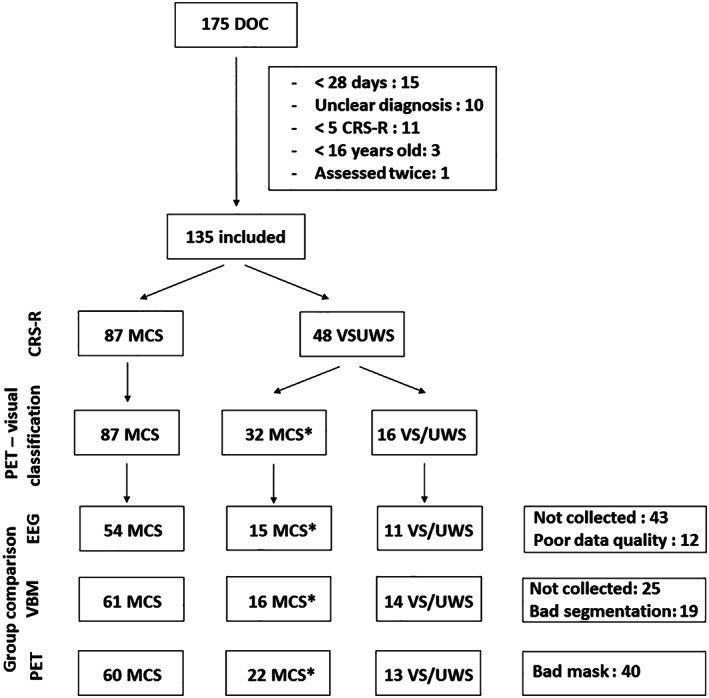
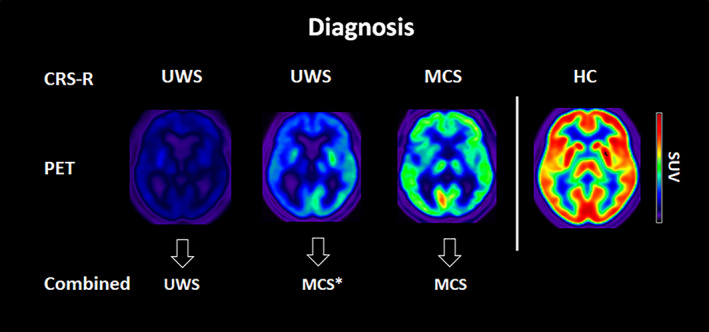
Brain F-fluorodeoxyglucose Positron Emission Tomography (FDG-PET) was acquired on 135 brain-injured patients diagnosed in prolonged VS/UWS (n = 48) or MCS (n = 87). From an existing database, relative metabolic preservation in the fronto-parietal network (measured with standardized uptake value) was visually inspected by three experts. Patients with hypometabolism of the fronto-parietal network were labelled "VS/UWS", while its (partial) preservation either confirmed the behavioural diagnosis of "MCS" or, in absence of behavioural signs of consciousness, suggested a diagnosis of "MCS*". Clinical outcome at 1-year follow-up, functional connectivity, grey matter atrophy, and regional brain metabolic patterns were investigated in the three groups (VS/UWS, MCS* and MCS).
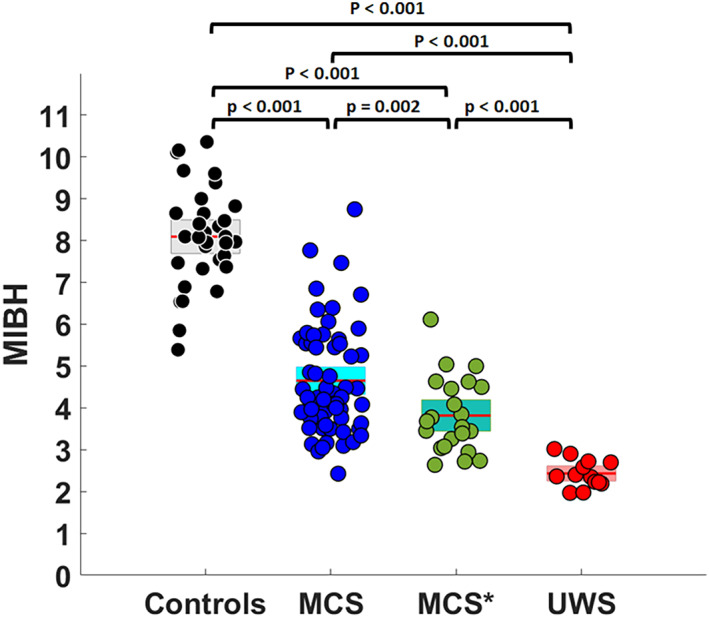
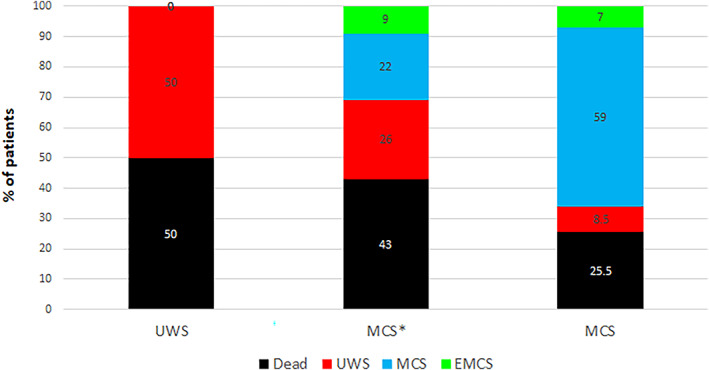
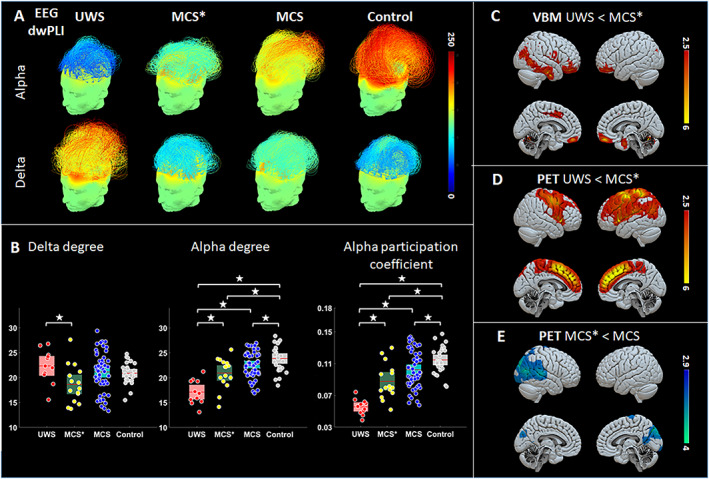
67% of behavioural VS/UWS presented a partial preservation of brain metabolism (ie, MCS*). Compared to VS/UWS patients, MCS* patients demonstrated a better outcome, global functional connectivity and grey matter preservation more compatible with the diagnosis of MCS. MCS* patients presented lower brain metabolism mostly in the posterior brain regions compared to MCS patients.
MCS* is a frequent phenomenon that is associated with better outcome and better brain preservation than the diagnosis of VS/UWS. Complementary exams should be provided to all unresponsive patients before taking medical decisions. ANN NEUROL 2021;90:89-100.
bedside 无反应的脑损伤患者(即植物状态/无反应性觉醒综合征-VS/UWS)可能表现出与最小意识状态(MCS)患者相似的脑活动。这种特殊情况被称为“非行为性 MCS”或“MCS*”。在本研究中,我们旨在调查 MCS*患者的比例和潜在的大脑特征。
对 135 名被诊断为长期 VS/UWS(n=48)或 MCS(n=87)的脑损伤患者进行脑 F-氟脱氧葡萄糖正电子发射断层扫描(FDG-PET)。从现有的数据库中,三位专家通过视觉检查额顶网络的相对代谢保留情况(用标准摄取值测量)。额顶网络代谢降低的患者被标记为“VS/UWS”,而其(部分)保留则证实了“MCS”的行为诊断,或者在没有意识行为迹象的情况下,提示了“MCS*”的诊断。在三组(VS/UWS、MCS*和 MCS)中,研究了 1 年随访时的临床结局、功能连接、灰质萎缩和区域脑代谢模式。
67%的行为性 VS/UWS 患者存在部分脑代谢保留(即 MCS*)。与 VS/UWS 患者相比,MCS患者的预后更好,整体功能连接和灰质保存更符合 MCS 的诊断。与 MCS 患者相比,MCS患者的大脑代谢水平较低,主要位于大脑后部区域。
MCS*是一种常见现象,与 VS/UWS 诊断相比,它与更好的预后和更好的大脑保存有关。在做出医疗决策之前,应向所有无反应的患者提供补充检查。