Leukaemia Research Cytogenetics Group, Translational and Clinical Research Institute, Newcastle University, Newcastle upon Tyne, UK.
Department of Clinical Genetics, Children's Cancer Research Institute, Vienna, Austria.
Genes Chromosomes Cancer. 2021 Sep;60(9):604-615. doi: 10.1002/gcc.22956. Epub 2021 May 17.
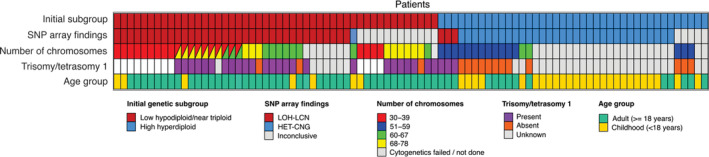
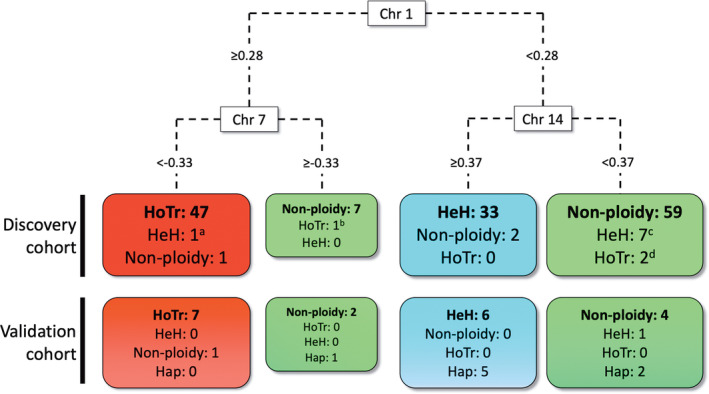
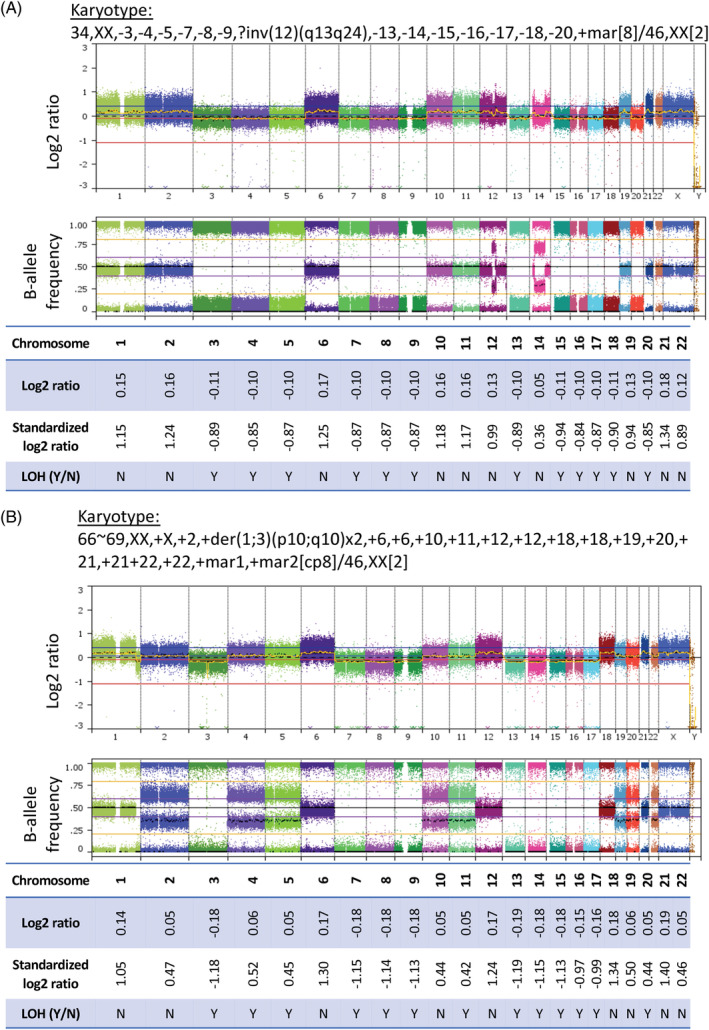
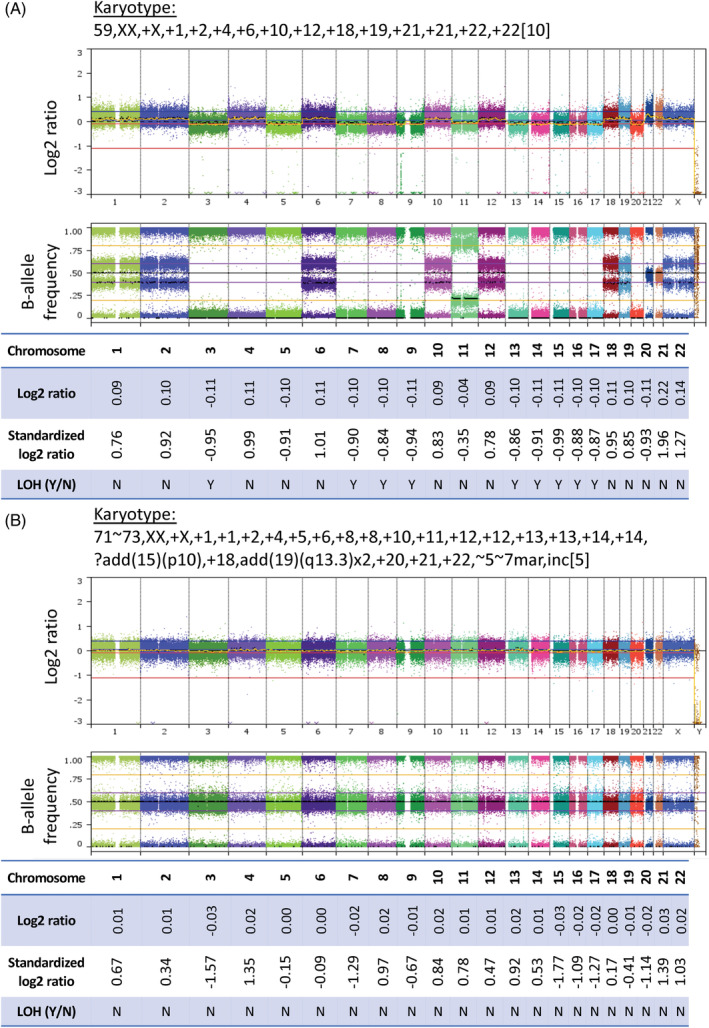
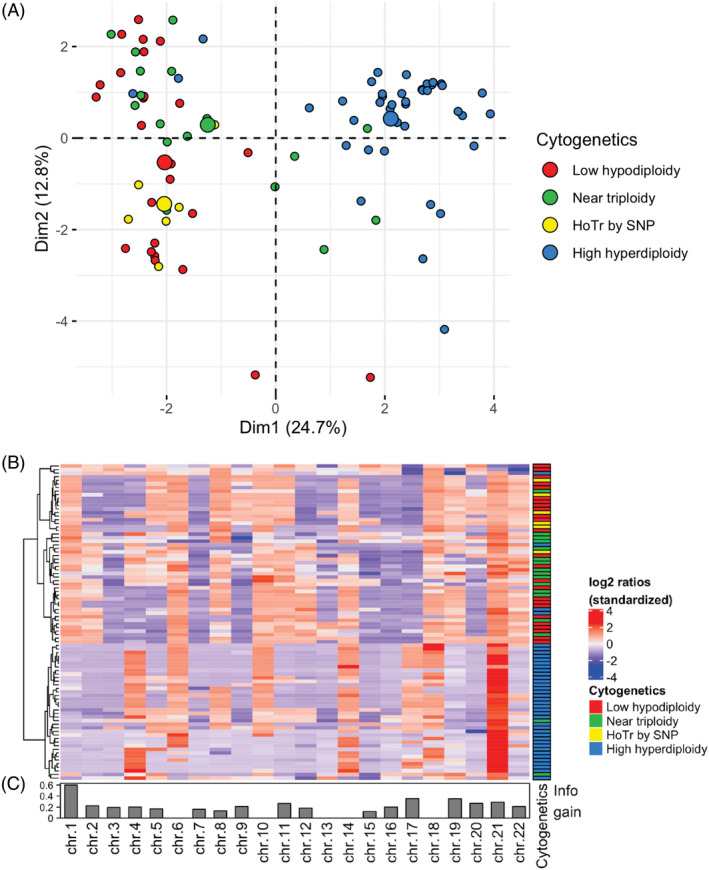
Low hypodiploidy (30-39 chromosomes) is one of the most prevalent genetic subtypes among adults with ALL and is associated with a very poor outcome. Low hypodiploid clones can often undergo a chromosomal doubling generating a near-triploid clone (60-78 chromosomes). When cytogenetic techniques detect a near triploid clone, a diagnostic challenge may ensue in differentiating presumed duplicated low hypodiploidy from good risk high hyperdiploid ALL (51-67 chromosomes). We used single-nucleotide polymorphism (SNP) arrays to analyze low hypodiploid/near triploid (HoTr) (n = 48) and high hyperdiploid (HeH) (n = 40) cases. In addition to standard analysis, we derived log2 ratios for entire chromosomes enabling us to analyze the cohort using machine-learning techniques. Low hypodiploid and near triploid cases clustered together and separately from high hyperdiploid samples. Using these approaches, we also identified three cases with 50-60 chromosomes, originally called as HeH, which were, in fact, HoTr and two cases incorrectly called as HoTr. TP53 mutation analysis supported the new classification of all cases tested. Next, we constructed a classification and regression tree model for predicting ploidy status with chromosomes 1, 7, and 14 being the key discriminators. The classifier correctly identified 47/50 (94%) HoTr cases. We validated the classifier using an independent cohort of 44 cases where it correctly called 7/7 (100%) low hypodiploid cases. The results of this study suggest that HoTr is more frequent among older adults with ALL than previously estimated and that SNP array analysis should accompany cytogenetics where possible. The classifier can assist where SNP array patterns are challenging to interpret.
低倍体性(30-39 条染色体)是成人 ALL 中最常见的遗传亚型之一,与非常差的预后相关。低倍体克隆通常可以经历染色体加倍,产生近三倍体克隆(60-78 条染色体)。当细胞遗传学技术检测到近三倍体克隆时,可能会出现诊断上的挑战,需要区分假定的复制性低倍体性与风险低的高倍体性 ALL(51-67 条染色体)。我们使用单核苷酸多态性(SNP)阵列分析低倍体性/近三倍体(HoTr)(n=48)和高倍体性(HeH)(n=40)病例。除了标准分析外,我们还推导了整个染色体的对数比,使我们能够使用机器学习技术分析队列。低倍体性和近三倍体性病例聚集在一起,与高倍体性样本分开。使用这些方法,我们还确定了三个具有 50-60 条染色体的病例,最初被称为 HeH,但实际上是 HoTr,并且有两个病例被错误地称为 HoTr。TP53 突变分析支持对所有测试病例的新分类。接下来,我们构建了一个分类和回归树模型,用于预测倍性状态,其中染色体 1、7 和 14 是关键的判别器。分类器正确识别了 47/50(94%)HoTr 病例。我们使用 44 例独立队列验证了分类器,其中正确地对 7/7(100%)低倍体性病例进行了分类。本研究的结果表明,HoTr 在老年 ALL 患者中比以前估计的更为常见,并且在可能的情况下,SNP 阵列分析应伴随细胞遗传学分析。分类器可以帮助解释 SNP 阵列模式具有挑战性的情况。